
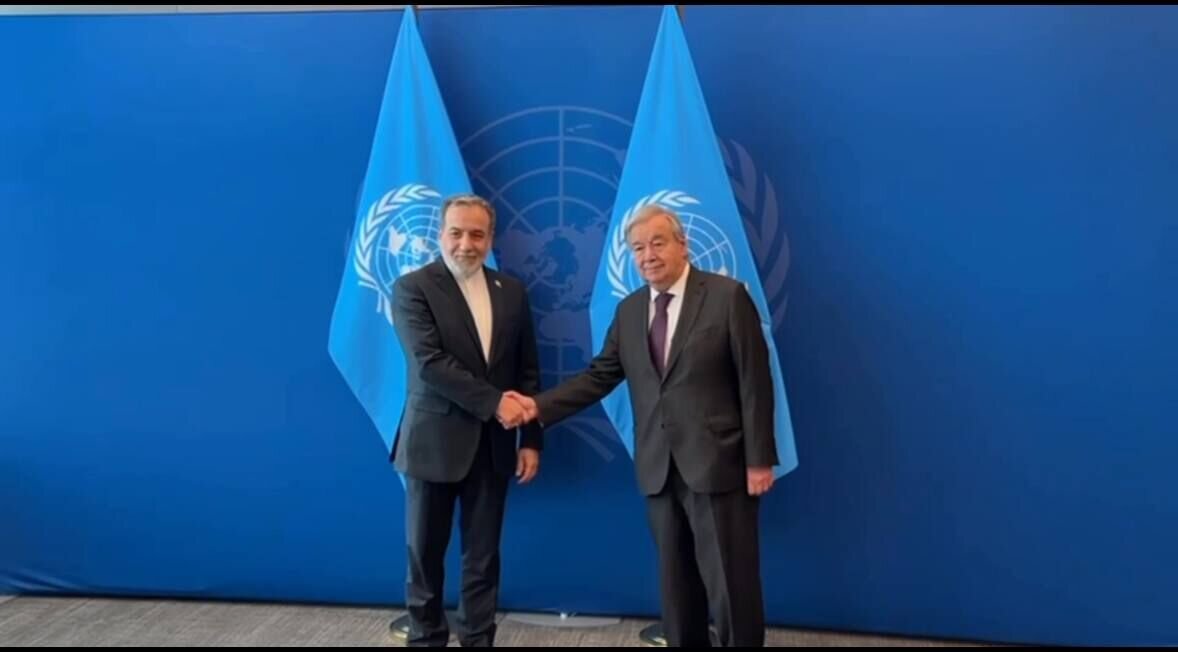
TEHRAN – Iranian Foreign Minister Abbas Araguchi has condemned efforts by the US and three European countries to reactivate expired UN sanctions on Tehran, describing the move as “unfair and illegal” and warned it “will deal an unprecedented blow to diplomacy.”
Araguchi spoke at a meeting in New York on Monday with UN Secretary-General Antonio Guterres. There, he strongly criticised Washington and its European allies for calling a snapback mechanism based on the 2015 nuclear deal. The mechanism was designed to reimpose sanctions in cases of non-compliance, but according to Tehran, it no longer remains effective after the US withdrew from the agreement in 2018.
Speaking to a New York reporter before his meeting with Guterres, Araguchi said he had held more than 31 bilateral meetings, during which he had reached an agreement on expanding economic cooperation. He described the Global Development Initiative Summit held at the Chinese Initiative as a “very important conference” and pointed to Iran’s role in promoting the 1,500th anniversary of the birth of the Prophet within an organization of Islamic cooperation.
He explained that his meeting with Guterres will focus on Iran’s “final position on the issue of snapback,” and emphasized that negotiations over the past week have been intense. “We have faced an attempt to draw concessions from the Islamic Republic of Iran. It is a completely unreasonable request,” he said. “In contrast, we offered our own suggestions, which were completely reasonable and even accepted as such by Europeans.”
Araghchi noted that numerous meetings were held with three European powers, the UN Secretary-General and the Director-General of the International Atomic Energy Agency to reach a compromise. However, he said these efforts failed because of “overrelationships from the US and collaboration between European countries with Washington.”
Later during a meeting with Guterres, Iran’s foreign minister emphasized that all restrictions imposed on Iran’s peaceful nuclear activities under UN Security Council resolution 2231 would expire on October 18th.
The conflict escalated on September 19, when the 15-member Security Council failed to adopt a resolution aimed at preventing automatic reassessment of sanctions. E3 accused Iran of not supporting the JCPOA commitment, sparking a snapback mechanism. A follow-up resolution that attempted to extend both the JCPOA framework and resolution 2231 by six months was also not approved on Friday.
Sanctions were resurrected at midnight GMT on Sunday as both measures were denied. The restored ban freezes Iran’s assets overseas, bans the sale of weapons between and among them, and places updated restrictions on the country’s defense missile programme.
Tehran repeatedly dismissed the move as illegal, claiming that Washington had confiscated its legal authority to invoke the JCPOA mechanism after leaving the agreement. Araguchi said the decision to side with Washington not only undermine nuclear deals, but also erodes trust in the diplomatic process.
Araguchi also highlighted recent military action against Iran, accusing both the US and Israel of targeting Iran’s territorial integrity and nuclear facilities in June, even if diplomatic negotiations were underway. “The illegal attacks on our peaceful nuclear facilities are a serious violation of international norms and demand the accountability of invaders,” he said, describing the attack as a violation of international law and the UN Charter.
Additionally, the Foreign Minister condemned Washington’s repeated violations of the UN Headquarters Agreement, saying he has restricted the movement and activity of Iranian delegations in New York. He urged Guterres to deal with the violation and to ensure that Iranian diplomats could perform their duties without obstructing them.
Secretary-General Guterres repeatedly reiterated the importance of diplomacy, calling on all parties to resolve the conflict through political and legal channels. He said the UN Secretariat is ready to support these efforts, highlighting the need for the United States as a host country to support its obligations under the headquarters treaty.