
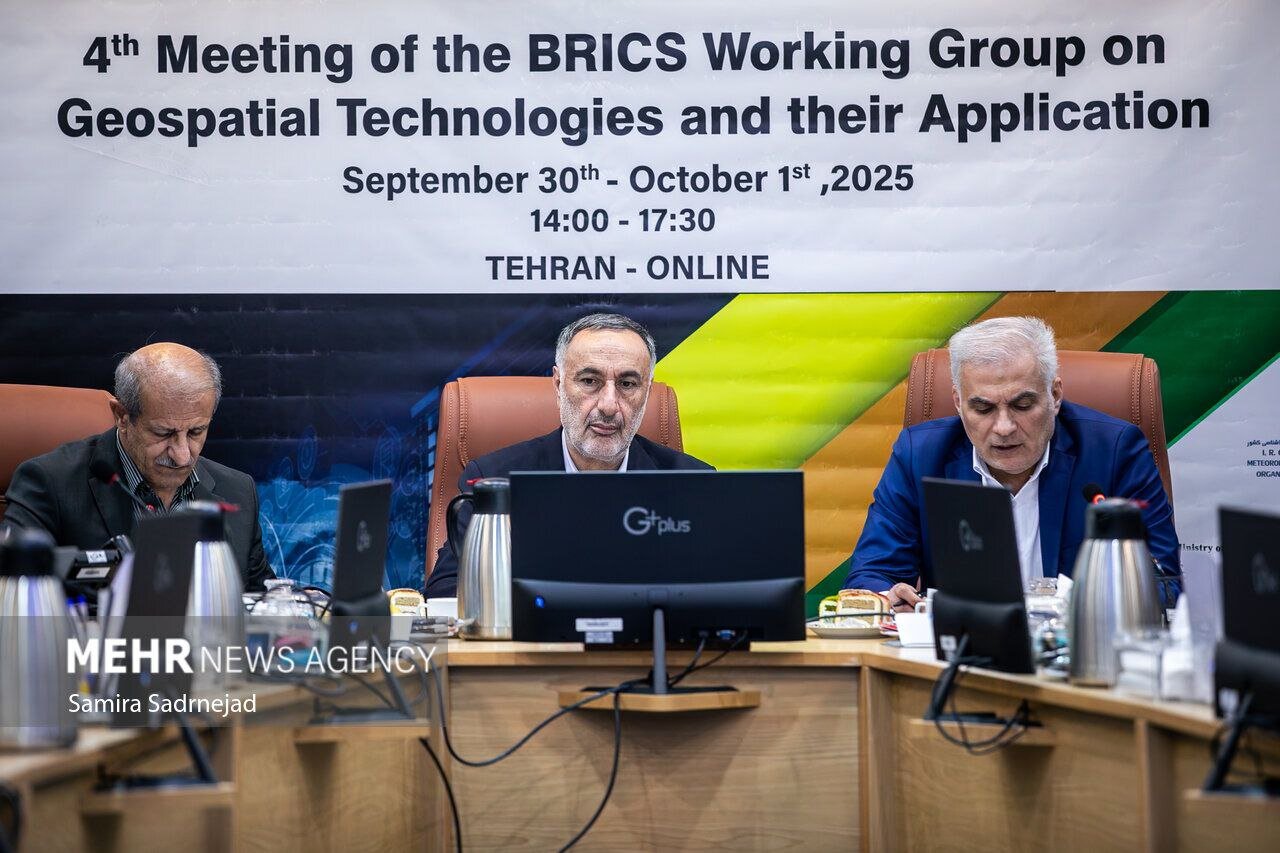
Tehran – Iran hosted the fourth conference of the BRICS Working Group on Geospatial Technologies and its applications.
The meeting was held online from September 30th to October 1st, bringing together BRICS members, including Brazil, China, Russia, India, Indonesia, Ethiopia, South Africa and the United Arab Emirates, Mehr’s news agency reported.
The two-day event was organized in collaboration with scientific institutions such as the Mapping Organization, Metrology Organization, Space Organization, Space Research Institute, Geology and Mineral Exploration Agency, Tehran University and Kagenasir-Torsi University of Technology.
The event served as a great opportunity to showcase Iran’s capabilities in modern technology, develop scientific and technical cooperation, and share expertise with BRICS member states.
The first day focused on showing the capabilities, capabilities and opportunities to promote cooperation between member states.
On the second day of the meeting, participants discussed and investigated the expansion of collaboration in geospatial data and its applications.
The issues raised at the conference will be summarised and approved in the form of multilateral cooperation documents. This document lays the foundation for state joint practices in spatial data for next year. Reports on actions taken based on the document will be presented at the next meeting.
Moscow held its third meeting of the BRICS Working Group on Geospatial Technologies and its applications from September 16th and 17th, 2024.
The meeting welcomed the proposal presented by the former Director of the Iranian National Mapping Centre (NCC) to establish the BRICS Spatial Data Infrastructure (SDI).
Addressing the opening ceremony of the conference, Ali Javidaneh said that maps and spatial data are key tools in the sustainable development of communities and provide information necessary for informed decision-making, effective planning and economic growth.
Officials also presented several proposals. Among them, BRICS SDI attracted the attention of participants.
Geospatial technology is a term used to describe the scope of modern tools that contribute to geographical mapping and analysis of Earth and human society.
They play an important role in today’s interconnected world, providing valuable support to individuals, governments, and various sectors of the economy.
The combination of spatial technology with artificial intelligence, deep learning, and big data analytics has positive outcomes for communication, navigation, transportation, cadus, cartography, and other applications.
Examples of geospatial technologies include remote sensing, geographical information systems (GIS), and geographical positioning systems (GPS). Geospatial technology can be used for all types of activities, including military use, environmental use, and everyday use.
mt/mg