
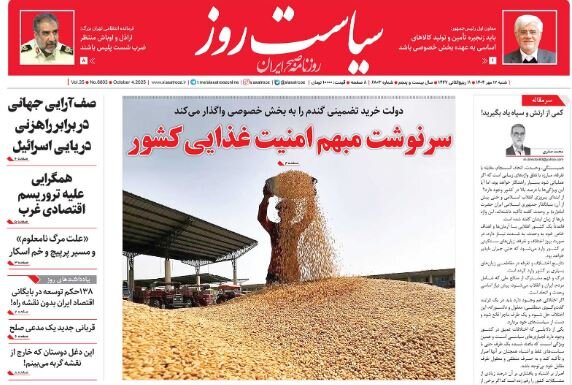
Tehran – In the analysis, Siasat-e-Rooz dealt with the IRGC statement on the anniversary of Operation’s True Promise II, and the True Promise II is not only a harsh punishment for enemy attacks and crime in the silence of the world’s indifferent assembly, but also a clear message that the world and evil Geonists will end.
The operation, which aimed to attack the enemy’s strategic centers deep within the occupied territory, showed that Iranian missiles and drones, the source of national security and dignity, penetrate all defensive shields, including the multi-layered defense of the Zionist regime, surprising targets with remarkable accuracy. On the anniversary of this operation, the IRGC warned that new errors and attacks from enemy camps would lead to a more accurate and fatal response than a true promise. A response that can bring the fake Zionist regime closer to the promised hell.
Shargh: Eastern consensus for the West
In the commentary, Sharg addressed Moscow’s harsh response to the actions of three European countries in restoring the sanctions resolution adopted by the UN Security Council prior to the 2015 nuclear deal. The paper said that Maria Zakhalova, a spokesman for the Russian Ministry of Foreign Affairs, had no “legal validity.” From Moscow’s perspective, this European action not only exacerbated the security council’s legitimacy crisis, but also showed that the West was willing to ignore even agreed legal rules when it contradicts political interests. Abbas Aragchi’s explicit letter to the Secretary-General of UN, Mohammad Bagh Gallibach’s solid position in Parliament, and a harsh statement from a spokesman for the Russian Foreign Ministry, show an Eastern consensus on the West, highlighting the recent Security Council decision not only lacks international legitimacy, but also faces basic procedural flaws. What we are witnessing today is not merely a revival of sanctions, but the emergence of a deep gap in the legal reading of international duties and liability. The gap that lays pressure and sanctions rhetoric in the West, but Iran and its partners emphasize the principles of national sovereignty and the ineffectiveness of unilateral decisions.
Arman-e-Emrooz: Neighborhood policies, opportunities or restrictions?
In the memo, Arman-E-Emrooz addressed Iran’s position in the region and its neighbourhood policies. It writes as follows: Neighborhood policies could be both opportunities and limitations due to specific geopolitical and geological strategic locations in Iran. From an opportunity perspective, Iran can use its neighbourhood strategy to expand regional trade and partially compensate for issues arising from international sanctions. From a political perspective, constructive interaction with neighbors can enhance Iran’s negotiation power in the international system. Meanwhile, sanctions and foreign pressures on neighboring countries have prevented them from entering into easy broader cooperation with Iran. Neighborhood policies have always been challenging for Iran. It could serve as a springboard for Iran in an era of sanctions and pressure when it involves aggressive diplomacy, tension management, trust building and targeted economic cooperation. But if it only pays attention to competition and conflict, it becomes a limitation rather than an opportunity. Regional cooperation is certainly under the greatest pressure when some neighbours distance themselves from Tehran or show commitment to a great power.
Hamshali: Iran and Russia’s strategic partnership
In his article, Hamshahri considered the strategic partnership between Iran and Russia, saying: With the Iranian-Russia treaty on comprehensive strategic partnerships coming into effect on October 2, 2025, a new chapter on Tehran and Moscow relations has begun. Both sides emphasize that partnerships pave the way for closer interactions on the international stage, especially in the context of the emergence of the multipolar world, and are defined under two basic policy priorities: “oppose Western sanctions” and “shaping a new global order.” Strategic partnerships articulate the willingness to cooperate, security agreements, binding security commitments, and the development of multifaceted relationships. Given the imposition of Western sanctions on Iran and Russia, the two countries have a common goal of neutralizing sanctions pursued within the framework of economic, financial and banking cooperation development. Iran and Russia face common regional and international threats and challenges, and the “strategic treaties” are seen in this respect as an appropriate framework for cooperation.