
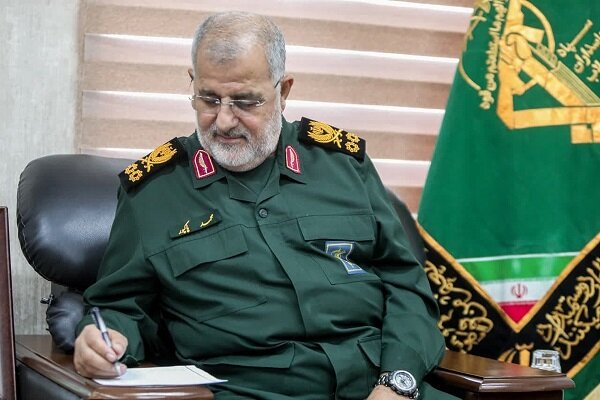
TEHRAN – The commander of Iran’s Islamic Revolutionary Guards Corps (IRGC) has warned that any hostile moves against the country will be met with a strong response.
“Any miscalculation of the enemy in the Persian Gulf, the Strait of Hormuz or the Iranian Islands will invite a decisive, immediate and overwhelming response that will make us regret the day,” Rear Admiral Mohammad Pakpour said in a message marking the Revolutionary Guard’s Naval Day on Wednesday.
“Without a doubt, the Revolutionary Guards Navy today not only ensures the security of the Islamic Iranian state and region, but also serves as the founder of a new maritime order based on justice, strength and national independence that counters the tyrannical attitude of world hegemony,” General Top added.
Earlier this week, Maj. Gen. Pakpour also issued another stern warning to the enemy. He said the Revolutionary Guard’s naval forces would respond with full force to any enemy movements in the Persian Gulf.
Maj. Gen. Mohammad Pakpour made the comments while inspecting an operational unit of the Revolutionary Guards in the Persian Gulf waters.
“With the (Iranian) military bringing the Israeli regime and the United States to their knees in a 12-day forced war, the Revolutionary Guards Navy will respond with full readiness to any enemy movements at sea or in the (Persian Gulf) islands,” General Top said.
General Pakpour’s naval inspection of the Revolutionary Guards preceded a possible second war between Israel and the United States.
In the event of another war, Iran could close off the strategic Strait of Hormuz, through which more than 20% of the world’s oil and natural gas passes, and begin mining operations.
The closure of the Strait of Hormuz could have a serious impact on the economies of countries around the world, including Western countries and the United States.
On June 13, Israel launched a blatant and unprovoked invasion of Iran, sparking a 12-day war that left at least 1,064 people dead in the country, including military commanders, nuclear scientists, and civilians.
The United States also entered the war by bombing three Iranian nuclear facilities in flagrant violation of international law.
In response, Iranian forces targeted strategic locations throughout the occupied territories, as well as Qatar’s Al Udeid Air Base, the largest US military base in West Asia.
Iran’s three highest-ranking military commanders reaffirmed the country’s full readiness to resist any aggression and emphasized that inter-military unity is the basis for safeguarding national security, independence and the ideals of the Islamic revolution.
In late September, Iranian Armed Forces Chief of Staff Maj. Gen. Abdulrahim Mousavi said in a meeting with Maj. Gen. Pakpour that the military is “fully prepared to resolutely confront any threat or possible invasion.”
“The great victories and impressive achievements of the Armed Forces, especially the Revolutionary Guards and the Basij Armed Forces, prove the effectiveness of the strategy of active deterrence and strong, courageous and overwhelming response to threats,” he said.
General Mousavi said that the unity of the Army and the Revolutionary Guard remains “a factor in the defeat of the enemy and a guarantee of Iran’s independence, national security, territorial integrity and protection of the ideals of the Islamic revolution.”
General Pakpour stressed that the Revolutionary Guards are at the forefront of implementing the Islamic Republic’s defense principles.
He pointed to the June invasion of Iran, in which “the Zionist enemy and the United States suffered a defeat,” and stressed that his forces were ready to respond “quickly, decisively and profitably” to any adventurism by the enemy.