
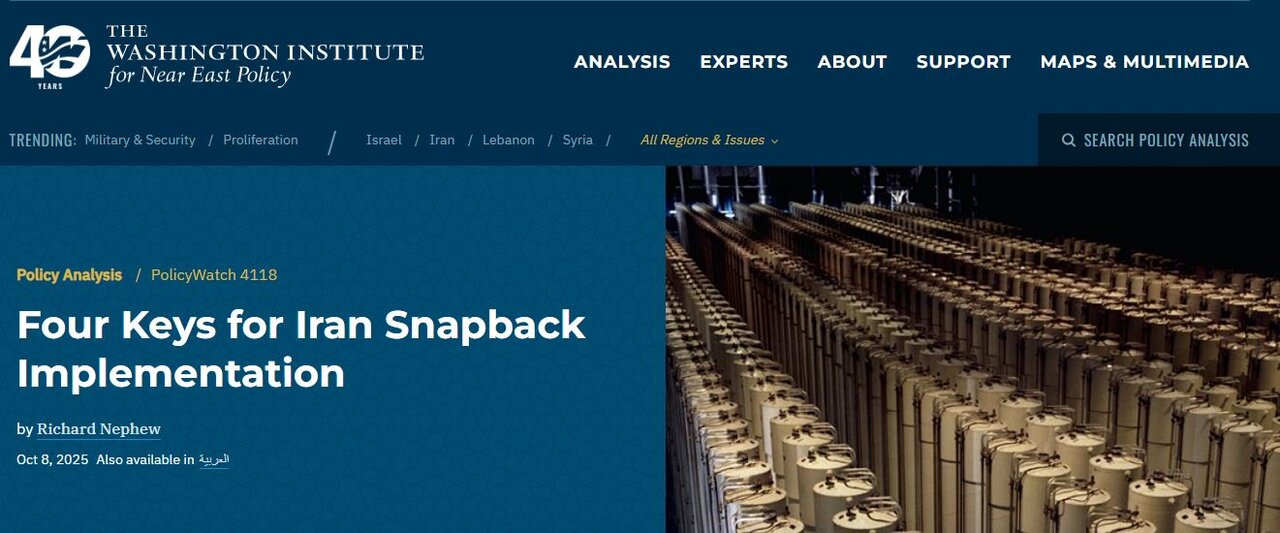
In a recent article titled “Four Keys to Implementing an Iran Snapback,” the Washington Institute re-establishes an outdated formula for putting pressure on Iran: reimposing sanctions, increasing intelligence links against Iran, and restricting access to Iranian advanced technology.
It is the same well-worn script that has been on the table in Washington for more than 40 years and has produced nothing but increased Iranian independence and diminished American credibility on the world stage. The author presents “snapback” as a means of deterrence, ignoring decades of historical experience, but forgets that Iran is no longer a country that can be restrained through economic threats or diplomatic isolation.
For more than 40 years, U.S. policy toward Iran has never deviated from a pattern of pressure, sanctions, and threats. From the 1953 coup to Trump’s withdrawal from the JCPOA, from the oil embargo of the 1990s to today’s Second Bank sanctions, the objective has always been the same: to halt the rise of Iran. However, today’s reality shows that all these policies are producing the opposite effect. Iran has transformed itself into a state that relies less on Western powers and more on its own domestic strength and indigenous capabilities. Every time Washington tightened its grip, Tehran found a new path forward.
Countries under sanctions but moving towards progress
Since the victory of the Islamic Revolution, sanctions have been the backbone of US policy toward Iran. Every U.S. president, from Carter to Biden, Obama to Trump, has appeared with a different face but with the same outdated idea of curbing Iran’s independence and preventing it from becoming a regional power. However, the result of this policy is nothing short of a remarkable growth in Iran’s domestic capabilities.
Iran has achieved medical self-sufficiency during years when even imports of medicines for critically ill patients were blocked by Washington. At a time when even airplane parts were banned, Iranian scientists developed advanced drones that are now central to regional security. From missile technology to nanoscience, nuclear engineering to medical innovation, all of this was achieved through adversity and pressure, not with comfort or cooperation with the West.
The sanctions were aimed at isolating Iran, but the opposite happened. As Washington seeks to cut Tehran off from the rest of the world, the very same pressures have prompted Iran to forge new avenues of cooperation with the East, its neighbors, and the Global South. Currently, Iran is not only the center of the Middle East’s energy network, but also plays a vital role in the political dynamics of Asia, the Caucasus, and the Persian Gulf.
Western countries still refuse to acknowledge that once sanctions become chronic, they cease to be a means of coercion and evolve into a mechanism of adaptation and resilience. Over the years, Iran has learned how to adapt its economic structure to the realities of sanctions: creating non-Western financial channels, expanding regional trade using local currencies, developing a “resistance economy,” and launching indigenous industries. Tehran today is no longer an isolated capital. It is a dynamic economy that helps reshape patterns of global trade.
Israel’s recent 12-day war against Iran marked a turning point in the regional balance. With the green light from some Western powers, Tel Aviv tried to strike a military blow, but Iran’s precise response with missiles and drones not only neutralized the attack, but also made it clear that military options against Iran no longer exist. Iran’s defense and deterrence capabilities, the product of years of sanctions and intimidation, ensure that its security can never be outsourced and must be built from within.
Once its adversaries realized they could not defeat Iran militarily, they quickly reverted to their old strategy of economic warfare. But once again they miscalculated. Iranian society has learned to innovate under pressure. The experience of past sanctions has created a culture of collective patience, a national habit that turns any economic shock into an opportunity for renewal.
Why “snapback” stopped working
The “snapback” mechanism of UN Security Council Resolution 2231 was designed for a situation in which all JCPOA parties remain engaged. With the US’ withdrawal from the agreement in 2018, the US government was automatically stripped of its legal right to trigger that mechanism. In 2020, the Security Council formally rejected America’s reinvigoration efforts. Therefore, there remains no legal or political basis for its implementation.
Now, in 2025, the US government is trying to do so again, but in reality it has exerted little economic pressure on Iran beyond a symbolic political posturing. When the Washington Institute calls for “further sanctions” against Tehran, it is effectively admitting that the snapback is nothing more than a political farce.
Moreover, years of experience have proven that sanctions cannot curb Iran’s economic growth. By deepening its economic ties with the East, joining the Shanghai Cooperation Organization, joining the BRICS bloc, and increasing trade with neighboring countries, Tehran has discovered new routes for commerce and investment. Ironically, the very sanctions aimed at isolating Iran have taken the Iranian economy out of the Western orbit and aligned it more closely with the East.
If, as the Washington Institute suggests, the West once again wages a full-scale economic war against Iran, the Iranian government’s response will not come from the financial sphere, but from the geography of power: the Strait of Hormuz.
About a third of the world’s oil and more than a quarter of its liquefied natural gas pass through this narrow chokepoint, a key artery for global energy trade. If Iran were to restrict the navigation of Western ships or impose stricter security checks, the effects would be immediate and ripple around the world.
In the first few days of such a move, oil prices could soar above $150 per barrel. The world economy will face an energy shock. Fuel prices in Europe and America will rise, supply chains will come to a halt, and global inflation will spiral. National budgets in Western capitals will be shaken and governments will face a wave of social unrest.
Under these circumstances, international insurance companies in London and New York would declare the Strait of Hormuz a “war danger zone.” The cost of insuring a single oil tanker is many times higher. Many shipping companies will be forced to reroute ships along longer and more costly routes or abandon Persian Gulf ports altogether, dramatically increasing shipping costs around the world and placing new burdens on Western economies.
Shutting down or even restricting Hormuz would not only attack the United States and Europe, but would disrupt the entire global economic order. China, India, Japan, and South Korea all rely heavily on Gulf energy and will face their own crises. But these countries will also understand the root of the turmoil: the West’s stubbornness in perpetuating sanctions rather than Iran’s unilateral invasion. In that context, a wave of global criticism will target Washington’s failed policies, and Iran will emerge not as the culprit, but as a sovereign entity challenging unjust orders.
Public dissatisfaction is likely to increase as fuel prices soar in the United States and inflation worsens in Europe. No politician in Washington or Brussels would be willing to foot the bill for an anti-Iran campaign paid for out of voters’ pockets. The same sanctions aimed at putting pressure on Tehran will therefore become a political liability for Western leaders themselves.
Iran as a decisive role
Western countries prefer to portray Iran as just a regional player, but in reality it occupies a position that could change the balance of the global economy. In today’s multipolar world, power no longer resides only in armories and banks, but in controlling energy routes and trade corridors. From the Persian Gulf to the Mediterranean, from the Caucasus to the Sea of Oman, Iran is a central link in the chain of regional stability. Every decision by Iran, whether diplomatic or military, reverberates far beyond its borders.
Iran today wields not only hard power but also soft power through active diplomacy to promote balance between East and West. While Western countries remain embroiled in internal crises and proxy wars, the Iranian government has pursued dialogue and cooperation with emerging powers. This is the reality that Washington strategists fail to understand. The unipolar world has ended, and the era of sovereign and diverse nations has begun.
The Washington Institute paper is an attempt to revive a dead policy that not only failed to deter Iran, but also made Iran stronger, more independent, and more experienced. After Israel and its supporters failed to break Iran’s resolve in the 12-day war, returning to the sanctions option would be an admission of military and diplomatic defeat.
If the West still believes that “reimposing sanctions” can thwart Iran, they need to understand that Iran can just as easily thwart them along maritime, trade, and energy routes. And when the Strait of Hormuz is no longer calm, no market on earth can remain stable.
Sanctions are no longer the language of power. They are the language of failure. Iran has emerged from decades of war, pressure and isolation and now stands as the true architect of a new world order, a world beyond American control. Those who cannot recognize this reality do not understand Iran or the post-American era.