
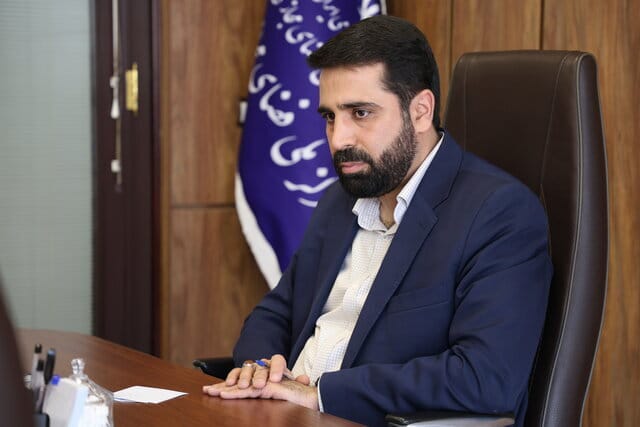
TEHRAN – Iran’s National Cyberspace Center revealed that three major cyberattacks targeting the country’s critical infrastructure were successfully contained and repelled in recent weeks thanks to the rapid response and coordination of national cybersecurity agencies.
The announcement was made by Mohammad Amin Aghamili, Secretary of the Supreme Council for Cyberspace and Director of the National Cyberspace Center, during the First National Conference on Cybersecurity Oversight held in Tehran on Tuesday with the participation of key government and security institutions.
Agamiri said the public’s increasing reliance on digital services has made cybersecurity a national priority, and warned that any disruption could cause widespread discontent.
“Cyberspace has become the fifth domain of conflict, alongside land, sea, air and space,” he said, outlining four major categories of cyber threats: destructive attacks on infrastructure, psychological operations targeting public opinion, the use of online data for military or intelligence purposes, and cyber weapons used for extortion and sabotage.
He emphasized the need for greater collaboration between state institutions, similar to the unity shown during the recent 12-day war with the Israeli regime, and said this meeting was the beginning of a new phase of cooperation to protect the country’s digital realm.
Agamiri noted that in 2023, the National Cyberspace Center issued a comprehensive directive to prevent vulnerabilities, calling it “an important step toward strengthening national cybersecurity.” He said one of its main goals is to eliminate the culture of excessive data collection by both the public and private sectors, require data to be collected only with user consent, and allow citizens to delete their data at any time.
He stressed that proper implementation of this directive will protect user privacy, adding that sensitive and identity-related data should be encrypted to limit access in case of a cyber-attack.
Mr. Agamiri also announced new initiatives such as cyber insurance developed in collaboration with the Central Insurance Organization, which recently issued Iran’s first cyber insurance license. He said this measure will help protect organizations from potential digital losses and promote resilience in the face of attacks.
The official further noted that under recent directives from the Supreme Council for Cyberspace, the private sector is playing an increasing role in national cybersecurity. This includes collaboration with FATA Police, which runs a program that allows cybersecurity experts to identify vulnerabilities before attacks occur.
“Cyberwarfare may be silent, but Iran has turned it into an area of strength thanks to its skilled human capital,” Agamiri said, calling on all cybersecurity professionals to “protect public trust, protect privacy, and ensure the nation’s digital stability.”
The conference also featured remarks from Mohammad Hossein Sheikh, Director of the ICT Institute, and Brigadier Vahid Majid, Director of FATA Police, who emphasized the evolving nature of cyber threats and the need for increased cooperation between government, academia, and the private sector to counter increasingly sophisticated attacks.
Majid warned that modern cyberattacks are moving from data theft and denial-of-service attacks to data destruction and public announcements of attacks, while Sheikh stressed the need for urgent investment in cybersecurity education and talent development.
Officials concluded that Iran’s cybersecurity outlook remains positive due to increased preparedness, interagency coordination, and the establishment of a new strategic framework aimed at building a secure and resilient national cyberspace.