
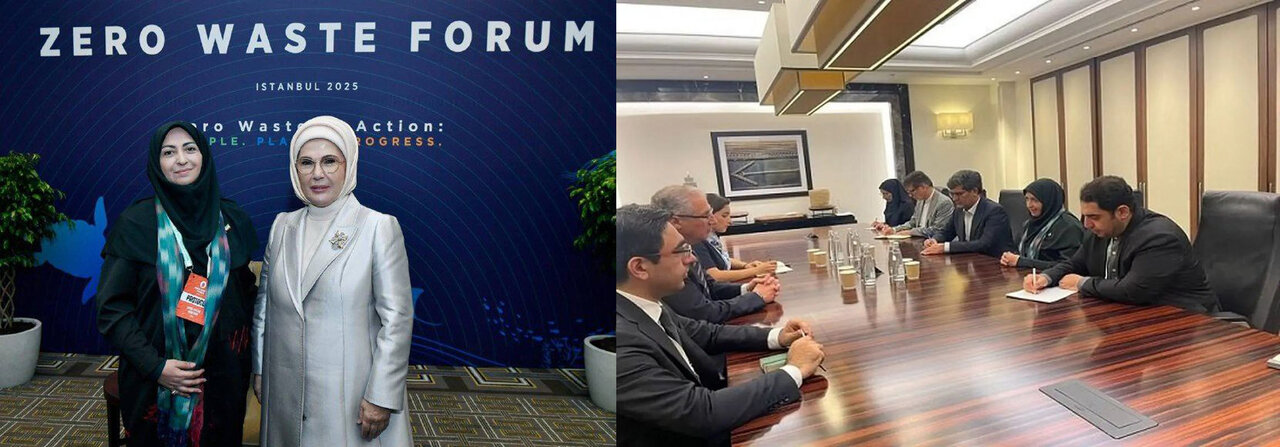
TEHRAN – Secretary of the Ministry of Environment Shina Ansari met separately with Turkish First Lady Emine Erdoğan and Azerbaijani Minister of Ecology and Natural Resources Mukhtar Babaev to explore ways to increase cooperation in the environmental field.
On the sidelines of the Global Zero Waste Forum to be held in Istanbul, Turkey from October 17 to 19, President Ansari and President Erdoğan emphasized promoting environmental cooperation and sharing experiences.
doe.ir quoted President Erdoğan as saying, “Promoting cooperation with neighboring countries, especially in the environmental field, will lay the foundations for regional and international peace.”
The official stressed the importance of common environmental challenges, saying the environment connects countries, from land to air to sea. President Erdoğan praised Iran’s valuable experience in the environmental field and expressed Turkey’s readiness to cooperate with Iran in all fields.
Ansari said waste management is one of the Department of Energy’s top priorities. Iran is keen to benefit from international expertise, including Türkiye’s successful experience. She proposed developing relationships in the conservation of biodiversity and protected areas.
Azerbaijani officials also emphasized the expansion of bilateral and regional relations in the environmental field. Mr. Babayev referred to his previous meeting with the Secretary of the Ministry of Energy and stressed the importance of sustained dialogue and implementation of previous agreements. Officials also agreed to develop collective action to protect the Hyrcanian Forest from climate change.
The World Zero Waste Forum is organized by the Zero Waste Foundation and Turkish ministries and is themed “People, Place, Progress”.
The three-day event will focus on a variety of themes including translating policy into concrete action, scaling up effective solutions, mobilizing financial resources and building strong international coalitions to tackle the global waste problem.
This forum will provide a great opportunity to strengthen environmental exchanges between Iran and other countries.
environmental diplomacy
Because they are transnational, many complex environmental issues can be addressed through environmental diplomacy, or negotiations between two or more countries.
IRNA reports that environmental diplomacy is used globally to resolve issues such as conflicts over energy sources, water, and climate change.
The fact that all countries share the same environment makes it necessary to promote environmental diplomacy to resolve conflicts over water resources, environmental pollution, and the effects of climate change.
Environmental diplomacy is an effective tool needed to reduce and eliminate serious impacts by allocating responsibility fairly among the countries involved as they present their national interests and solutions.
Dust storms (DSDs) are a typical example of a meteorological disaster in West Asia, involving many countries, with some countries originating and others affected.
SDS has attacked countries such as Saudi Arabia, Iraq, Syria, Turkey, and Iran, and at times affected parts of Azerbaijan, Turkmenistan, and even Afghanistan and Pakistan.
These dust particles have a devastating impact on respiratory health and ecosystems. As a result, airports, schools, and offices are closed, power transmission infrastructure is affected, and economic losses result.
Removing pollution from the Aras River and securing water rights and some wetlands in the Hilmand River are also examples of how environmental policy has been used to resolve conflicts.
The Treaty of Tehran is a major achievement for the Caspian Sea coastal states to protect the Caspian Sea environment from all sources of pollution, but it also covers the conservation, restoration and protection of Caspian Sea species and habitats.
Therefore, to mitigate the effects of climate change and achieve the Sustainable Development Goals, we need to strengthen our environmental policies so that Iran and its neighbors can benefit from available resources and secure our rights at the international level.
The Ministry of Foreign Affairs, in cooperation with other executive agencies such as the Ministry of Energy, the Ministry of Industry, the Ministry of Agriculture, and the Ministry of Environment, could establish a center to focus on specific missions, follow up on discussions and goals in line with national interests, and improve the living conditions of citizens through environmental diplomacy.
MT/MG