
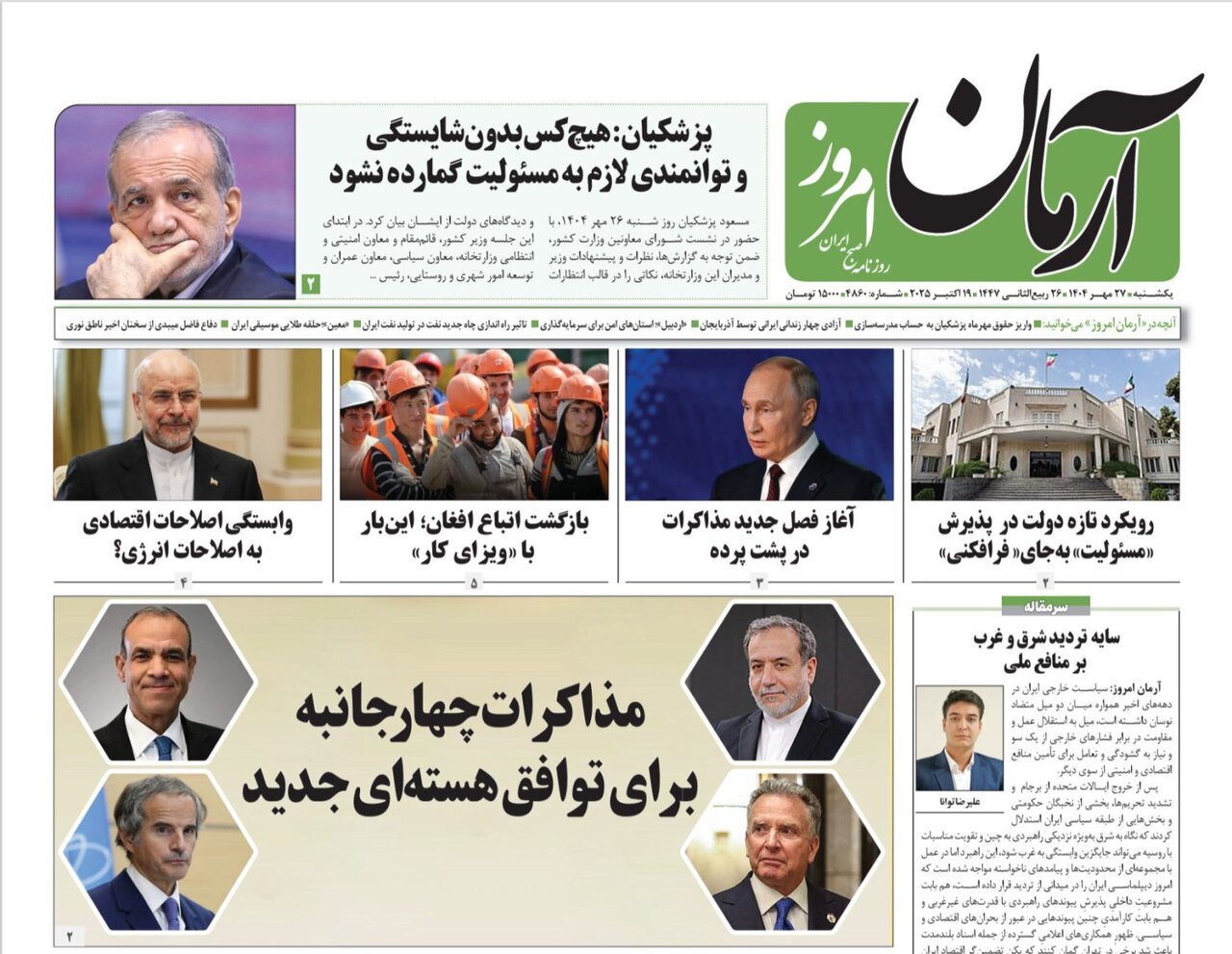
TEHRAN – Foreign Minister Arman Emrouz analyzed the meeting between Ali Larijani and Russian President Vladimir Putin in Moscow, calling it a very important diplomatic engagement.
“This meeting, which was widely reported in the international media, not only conveyed a direct message from the Iranian leadership to Moscow, but also marked the beginning of a new phase of strategic cooperation between the two countries,” the newspaper said. The main purpose of Larijani’s visit was to strengthen and deepen military cooperation between Iran and Russia. In a region where external threats loom large, both countries are bound by common interests and aim to strengthen their defense relationship. The second purpose of the visit was to leverage Russia’s role as an intermediary to foster dialogue between Iran and the West toward the broader goal of restoring lasting security to the Middle East. Amid rising nuclear tensions and crippling sanctions that destabilize the region, Russia has been positioned as a potential bridge between Tehran and Washington. More than just a diplomatic meeting, the visit symbolizes Iran and Russia’s shared ambition to form a multipolar world order. The two countries aim to form an unyielding alliance through enhanced military cooperation, and hope that Russia’s mediation will usher in a new era of regional stability.
Jam-e-Jam: Benefits of Russia’s announcement of abolition of JCPOA
Jam Jam praised the Russian government’s announcement officially announcing the abolition of the JCPOA, the official name of the 2015 nuclear deal, and the expiration of UN Security Council Resolution 2231, which approved it. The newspaper wrote: Russia’s official declaration marking the expiration of the JCPOA and the expiration of UN Security Council Resolution 2231 provides Iran with several strategic advantages. The announcement by Russia, a major signatory to the JCPOA and the current head of the Security Council, demonstrated its commitment to international law and its rejection of unilateral pressure from the West. This would not only ease Iran’s path out of long-term restrictions, but also boost Russia’s standing in the world’s diplomatic circles. Moreover, Russia’s resolute opposition to European and American attempts to trigger the snapback mechanism strengthens Iran’s image as a responsible and constructive player on the world stage. This development is expected to strengthen cooperation between Tehran and Moscow within the framework of the Comprehensive Strategic Partnership. Russia’s moves highlight the depth of its strategic partnership with Iran, as Western countries face increasing isolation due to their own policy flaws. It could also serve as a springboard for expanding influence across Eurasia and the Middle East.
Iran: Tehran and Ankara deepen cultural diplomacy
In a recent article, Iranian newspapers highlighted the three-day visit of Iran’s Minister of Culture and Islamic Guidance to Turkey, calling it one of the most important cultural missions in recent years. “The visit, which took place at the official invitation of the Turkish Minister of Culture and Tourism, was not only part of the 2025 Iran-Turkish Year of Culture initiative, but was also notable for the depth of discussions and the number of cultural agreements concluded,” the newspaper said. This was one of the most unprecedented cultural exchanges between the two countries in more than a decade. In a world full of tensions, cultural diplomacy offers a quieter, deeper and more effective path to promoting mutual understanding. If Iran and Turkey continue on this trajectory with care and consistency, they could present a convincing model of cultural coexistence to the broader Muslim world. At a time when media coverage often distorts the image of Islam, collaborations between arts and culture can help reveal the true human face of Islamic societies. Initiatives such as Islamic arts festivals, cultural weeks, film and documentary co-productions, and youth artist exchanges have the potential to become lasting assets for both countries.
Jawan: “New sanctions are doomed to failure”
Jawan mentioned the declining influence of Western countries, particularly efforts to reimpose sanctions on Iran. “The United States and European countries are attempting to re-create the pre-JCPOA global agreement with the aim of justifying a new wave of widespread sanctions (against Iran),” the report said. This time, however, their efforts appear to be facing significant resistance, with many countries becoming reluctant to go along with Washington’s unilateral policies. Efforts to revive international pressure on Iran are facing a political impasse, largely due to growing global opposition to Western unilateralism. Without broad international support, any attempt to reimpose sanctions is likely to fail and have limited impact. Over the past three years, Russia and China have actively sought to work with developing countries through blocs such as BRICS to challenge Western-led institutions and promote a new economic order. As new coalitions form within the UN Security Council, the effectiveness of traditional Western pressure mechanisms is severely undermined.