
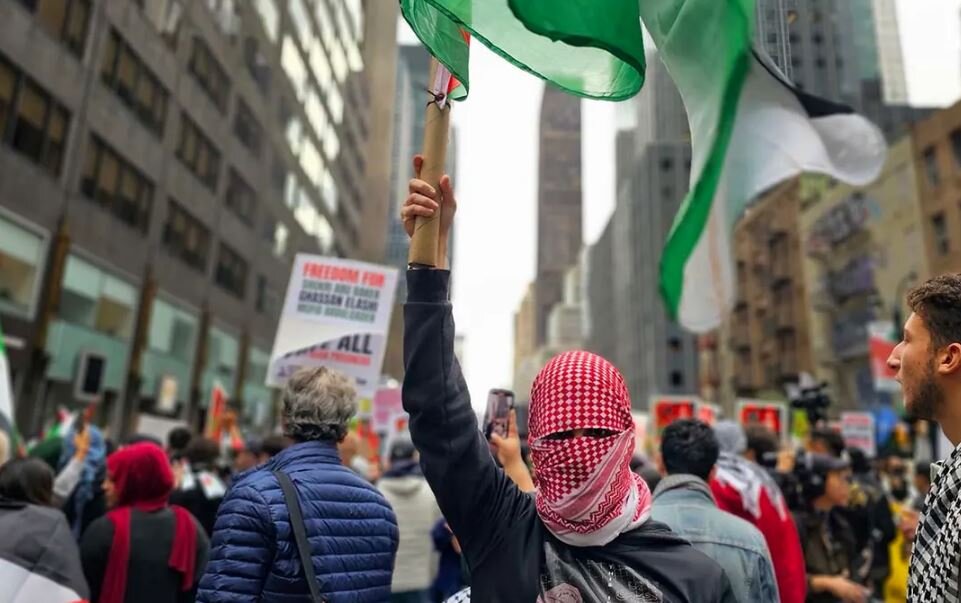
In the world after October 7, 2023, everything has changed, not only within the borders of occupied Palestine, but also within the global conscience of humanity. The shelling of Gaza, the silence of Western institutions, and the apparent contradiction between human rights rhetoric and reality on the ground have undermined the West’s moral legitimacy.
The media, which had long reproduced the Zionist narrative with impunity, suddenly found itself facing a storm of public questioning. Universities, streets and digital platforms from London and New York to Johannesburg and Jakarta became the setting for a new awakening. Amid this change, Iran’s name has become more prominent than ever, emerging at the center of a global debate now called “civilized resistance.”
For years, Western countries have portrayed Iran as an “isolated” nation. But today it stands as the conceptual center of a movement that began in Palestine and transcends geography. In a world shaken by Gaza, Iran’s philosophy of resistance has transformed from a regional stance to a universal moral call to redefine the meaning of justice across borders.
The philosophy of independence and resistance and its growth
In Iranian thought, resistance is not just a military or political response. It is rooted in a civilizational tradition that links freedom with human dignity. From the wisdom of Mullah Sadra to the poetry of Hafez and Ferdowsi, from the constitutional revolution to the Islamic revolution, Iran’s intellectual tradition has always been sensitive to humiliation and domination. It is this sensibility that is now re-emerging as the philosophical basis of civilized resistance.
For Iran, resistance is not simply a response to an enemy, but a moral choice to confront injustice as an ethical obligation. This worldview stands in sharp contrast to the Western logic of power, which perceives resistance as a threat. Iran understands resistance as part of its collective identity, a living expression of a civilization that sees humans not as instruments of power but as bearers of sacred values.
After October 7, this philosophy went beyond Iran’s borders and became a common discourse in the Global South. In Cairo, students spoke about “resistance as dignity.” In Johannesburg, civil society activists evoked memories of apartheid to make sense of the Palestinian struggle. In Caracas, the media described Iran as “a country that did not surrender.” These considerations show that resistance is no longer the response of a single nation, but a shared language among peoples who have endured centuries of domination and humiliation.
Over the past two decades, Iran has redefined the very meaning of power. While Western countries measure security by arms stockpiles and military alliances, Iran defines it in two words: “defense” and “dignity.” This is the essence of the concept of “defense as dignity” that distinguishes the Islamic Republic’s security philosophy from Western pursuits of hegemony.
Iran’s role in forming a regional “axis of resistance” from Lebanon to Yemen must be understood in this light. Iran’s objective was never to dominate other countries, but to maintain a balance against external coercion. After October 7, this deterrent force acquired new importance. Israel’s attack on Gaza not only provoked an armed response from resistance movements, but also exposed the reality that the region’s security architecture is no longer unipolarity. Through its strategic presence, Iran has emerged as the moral and logistical backbone of the anti-Zionist front. Not out of a desire for confrontation, but out of a determination to protect the dignity and self-determination of oppressed peoples.
The difference between Iran and Western countries lies in the source of legitimacy. Tehran derives its legitimacy not from military superiority but from moral authority. NATO equates security with control, while Iran equates security with justice. This is why Iranian power is perceived in the region’s collective consciousness as protection rather than threat. This is a double deterrence, combining military capability and moral legitimacy.
Beyond political and security transformation, deeper economic transformation is also underway. The world is moving away from the unipolar financial order of the Western world and toward a multipolar system. Iran has emerged as a key player in this transition period. Officially joining the Shanghai Cooperation Organization and joining BRICS marks Iran’s return to the world economic map through its own path based on South-South cooperation, de-dollarization, and financial sovereignty.
Discourses of resistance that were once confined to the battlefield have now extended to the realm of economics. The concept of “economic resistance” in Iran has evolved into a paradigm that aligns with the aspirations of many developing countries. Countries such as India, Brazil, South Africa and even Saudi Arabia are trying to reduce their dependence on Western-led financial institutions. Having endured decades of sanctions, Iran is now a working model of economic independence under pressure, a model that resonates across the Global South.
Within this framework, Iran is positioned not only as a political actor but also as a symbol of economic confidence. From trade with China and Russia to developing the North-South Corridor and partnerships with neighboring countries, Iran is charting a new path for growth. That path is built on fair cooperation and economic justice, not domination and conditional financing from Western institutions.
Battle of Stories and Iranian Cultural Power
Perhaps the most profound changes after October 7th occurred not on the battlefield, but in the setting of the story. In today’s media-driven world, real war loses its meaning. The Zionist narrative of “self-defense” and “terrorism” faced a wave of global skepticism for the first time in decades. Millions of people around the world challenged Western media’s monopoly on storytelling by amplifying Palestinian voices and images.
In this context, Iran played a central role in shaping the moral narrative of resistance. From official statements to short films, regional media networks to cultural expressions, Iran has introduced a new moral language to audiences around the world. Rather than glorifying or denying violence, it places violence within the framework of human dignity and the right to self-defense.
Today, Iran’s cultural influence is visible from Tehran to Beirut, from Cairo to Caracas. In American universities, students inspired by this discourse see colonialism not as a relic of the past, but as a living wound to modern humanity. On the streets of London and Paris, you can hear chants that reflect the vocabulary of resistance rather than Western propaganda. Some might say, “Iran’s influence cannot be measured in weapons. It can be measured in terms of a global moral awakening.”
This soft side of Iran’s power complements its hard side and economic power. Unlike Western cultural projection models built on the entertainment industry, Iranian influence operates through national meanings, ethics, and historical memory. And it is precisely this intellectual and moral force that is reshaping the world order from within.
By combining three dimensions of power: philosophical, military, and cultural, Iran participates in building a new world order based on independence, economic justice, and human dignity.
Today’s resistance is no longer essentially Palestinian or Arab. It’s universal. From Latin America to Africa and across Asia, a new understanding of ‘responsible freedom’ is emerging to counter the logic of domination. In this transformation, Iran is not just a nation, but represents ideas born of history, faith and culture, now translated into the global language of justice.
In a world where old powers have lost their moral legitimacy, Iran’s synthesis of ethics and politics, its fusion of reason and faith, and its inspiration for the countries of the Global South are shaping the future. A future in which the silenced voices of history once again speak clearly and confidently.
From Tehran to Tunis, from Caracas to Cape Town, the philosophy of resistance has found its voice. And the voice speaks Persian.