
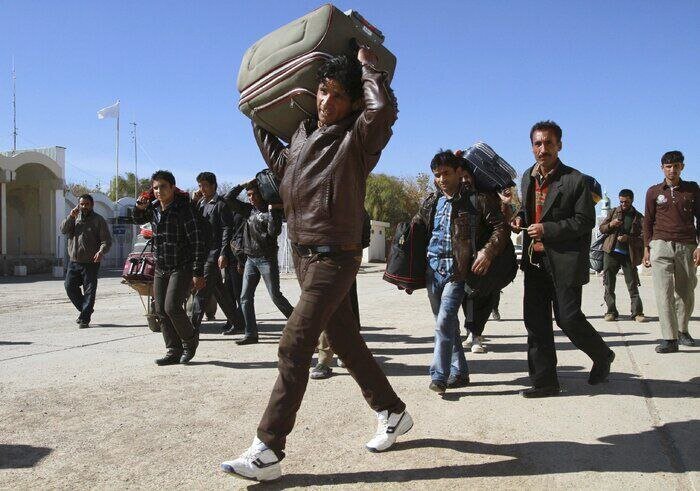
TEHRAN – Voluntary returns of Afghan refugees illegally staying in their homeland via the Dogalon border terminal in Taybad city, northeastern Khorasan Razavi province, have increased by 30 percent since the beginning of autumn compared to the summer.
Since the start of the current Iranian year (March 21), more than 1.2 million illegal Afghans have returned to their home country through this border, YJC.IR quoted Taybad Governor Hossein Jamshidi as saying.
Additionally, the number of illegal Afghans identified and deported nationwide increased by 10 percent during the same period, officials noted.
The official went on to say that the Dogalon border terminal will soon be equipped with a biometric identification system, the first of its kind at an Iranian border crossing.
This system will be used to detect and prevent illegal immigration.
IOM praises Iran’s services to Afghan refugees
Kim Erin, Senior Advisor to the Director-General of the International Organization for Migration (IOM), praised the country’s efforts in hosting and providing services to Afghan refugees.
IOM officials met with Iranian Deputy Interior Minister Mohammad Batai on Monday on the sidelines of the 76th Annual Meeting of the Executive Committee of the Office of the United Nations High Commissioner for Refugees, held from October 6 to 10 in Geneva, Switzerland.
Mr. Elling praised the country’s efforts in hosting the Afghan nationals and said reduced aid from donor countries was the main challenge for the United Nations in moving the project forward.
Iranian officials stressed that “despite unilateral mandatory sanctions, Iran has been providing important services to foreign nationals.”
Iran wants donor countries to take on some of the responsibility by allocating appropriate aid to projects being implemented in the country, the official added.
Iranian officials’ plans include speaking and meeting with Filippo Grandi, the High Commissioner for Refugees, and Kamal Kishore, the UN Secretary-General’s Special Representative for Disaster Risk Reduction.
The Executive Committee of the High Commission Program (ExCom) meets annually in Geneva to review and approve the High Commission’s programs and budget, advise on international protection, and discuss a variety of other issues with UNHCR and intergovernmental and non-governmental partners.
In August, Interior Minister Eskandar Momeni announced that more than 1.2 million Afghans, most of them illegal immigrants, had left Iran in the past year, with the highest number of departures recorded at the eastern border in Khorasan Razavi province.
Momeni said the country has no plans to deport documented and recognized refugees.
“We are only deporting the two million Afghans who are in Iran illegally,” he said.
“Iran hosts 6 million foreigners and is not an anti-immigration country. Since the beginning of this Iranian year (March 21), around 800,000 of the 2 million illegal refugees have left the country,” ISNA quoted Momeni as saying on July 18.
“They are honorable people who have contributed to the country’s production. Based on regulations, unauthorized refugees have to leave the country. If they want to live here, they have to follow legal procedures,” the official further said.
MT/MG