
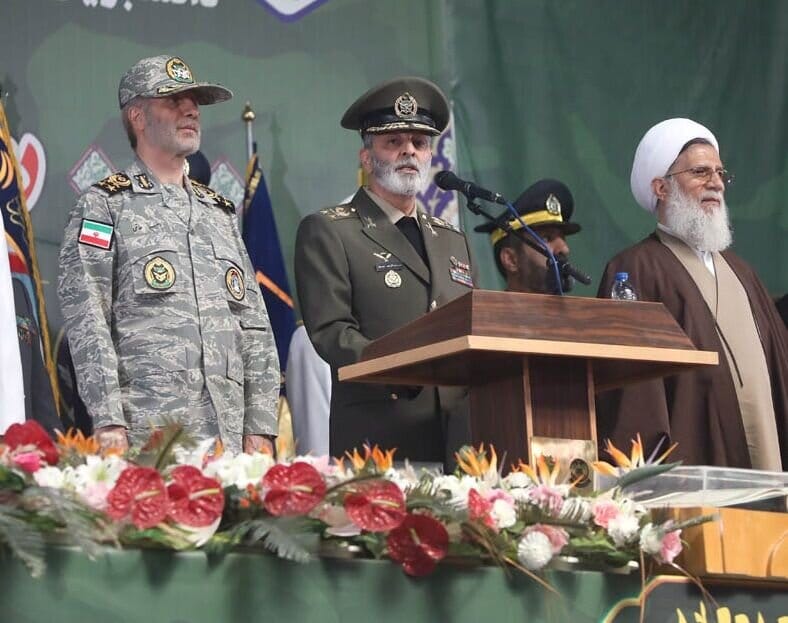
TEHRAN – A senior Iranian military commander has warned that the country’s response to any mistake made by the enemy will be very different this time from previous responses, calling on the military to maintain the highest level of preparedness and strengthen it every day.
Major General Abdulrahim Mousavi, Iran’s military chief of staff, said: “The Israeli regime, with US support, wanted to escape from the humiliation, public hatred, and domestic turmoil by attacking Iran, but it suffered a crushing defeat and desperately called for a ceasefire.”
On June 13, Israel launched a blatant and unprovoked act of aggression against Iran, sparking a 12-day war that left at least 1,064 people dead in the country, including military commanders, nuclear scientists, and civilians. The United States also entered the war by bombing three Iranian nuclear facilities in a serious violation of international law.
In response, Iranian forces targeted strategic locations throughout the occupied territories, as well as Qatar’s Al Udeid Air Base, the largest US military base in West Asia.
In separate remarks on the war, a senior general in Iran’s Islamic Revolutionary Guards Corps (IRGC) reiterated that Iran’s missile capabilities are completely intact. Brigadier General Mohammadreza Naqdi said, “Our missiles have not suffered a single scratch.”
The commander’s remarks came as the Tel Aviv administration claims that some of Iran’s missile capabilities were destroyed during the Israeli invasion. Naqdi added that Iran responded in response to Israel’s military attack.
Another Iranian commander also said his country was preparing for a two-month war following an Israeli military invasion. “Our war strategy was to inflict more effective and more devastating blows in stages through proper management,” said Maj. Gen. Mohsen Rezaei.
During Israel’s 12-day war with Iran in June, the United States destroyed about a quarter of its supply of advanced THAAD anti-missile missiles, according to two sources familiar with the operation.
The U.S. military responded to Tehran’s barrage of ballistic missiles by firing more than 100 and possibly more than 150 THAAD (Terminal High Altitude Area Defense) missiles, a significant portion of America’s stockpile of advanced air defense systems. The United States has seven THAAD systems, two of which were used in the Israeli conflict.
The use of so many THAAD interceptors in such a short period of time, at a time when U.S. public support for the defense of Israel is at historic lows, has exposed flaws in the U.S. missile defense network and depleted valuable assets.
Meanwhile, in response to the Zionist regime’s unprovoked aggression and U.S.-backed attacks on Iranian diplomatic and scientific institutions, the Islamic Revolutionary Guards Corps (IRGC) launched a series of carefully calculated missile and drone strikes over 12 days.
These targeted attacks are now known to have amounted to 22 different operational waves, dismantling Israel’s major military, intelligence and technological infrastructure and leading to a cessation of hostilities.
In the face of unprecedented destruction, Israel has imposed strict censorship. Foreign journalists are banned, satellite imagery is restricted, and social media platforms are under pressure to suppress content showing Israel’s losses.
The Iranian attack hit several key targets in the occupied territories, including Kirya, often referred to as Israel’s “Department of Defense,” Camp Moshe Dayan, a training and operations center for military intelligence officers, Ternov, one of the most fortified air bases in the occupied territories, Nevatim, Israel’s main base for operating U.S.-made F-35 stealth fighter jets, and Hatzerim, another equally important air base. Ovda Air Base is an important Israeli military facility said to house command and control systems and electronic warfare capabilities.
Iran has repeatedly stated that it will respond firmly to any military invasion or any move that threatens national security.