
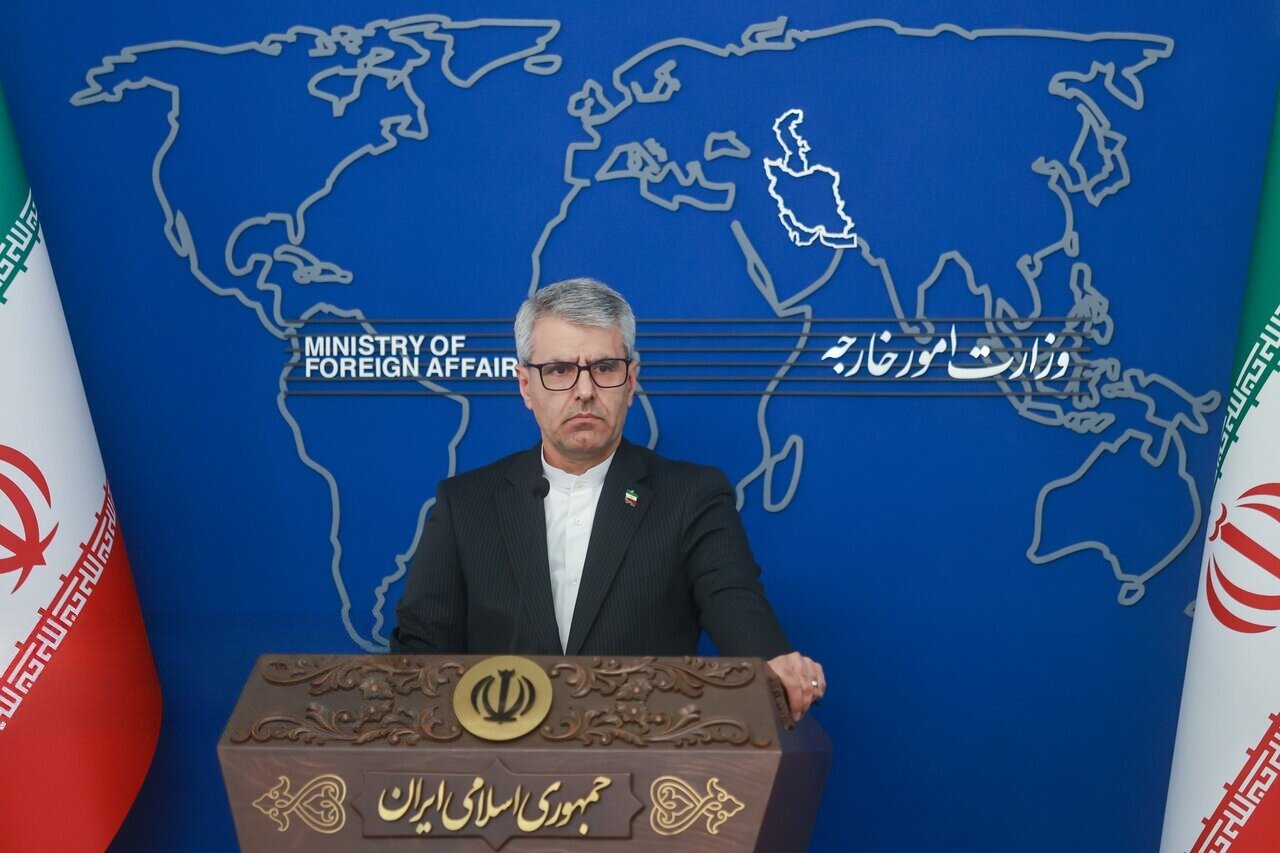
TEHRAN – Iranian Foreign Ministry Spokesperson Esmail Bakaei addressed a wide range of domestic and international issues during his weekly press conference on Monday.
His remarks covered topics such as Iran’s diplomatic activities, regional developments, ongoing negotiations, and Iran’s position on major world affairs. Throughout the session, he reaffirmed Iran’s principled position on dialogue, resistance to external pressure, regional stability and cooperation.
“Negotiations with the US are not progressing”
Baquay said that while indirect contacts between Iran and other parties continue, there is currently no sign of a new negotiation process with the United States or the three European countries.
“Indirect communication still exists as before,” he told reporters. “However, it would be inaccurate to claim that we are on the brink of a negotiation process. Negotiations can only begin if all parties recognize each other’s rights, but we are not at that stage.”
“Palestine remains the central issue in the region.”
Mr. Baquay began his remarks by reiterating that Palestine remains a central issue in the region. He condemned Israel’s ongoing attack on Gaza as a “continuing genocide” and criticized the international community for not keeping its promises.
“Nearly 100 people have lost their lives in Gaza in the last few days,” he said. “The Rafah crossing remains closed and despite promises that at least 600 aid trucks would enter Gaza every day, this has not materialized. As expected, the Zionist regime has once again failed to fulfill its promises. Meanwhile, the guarantors of the ceasefire, especially the United States, have stood by and allowed these crimes to continue.”
He said Iran’s stance since the beginning of the conflict has been “consistent and based on experience,” adding: “The regime has never complied with its obligations and is not serious about its claims.”
According to the Gaza government media office, the occupation forces have violated the ceasefire agreement at least 47 times since it entered into force on October 11.
“The world rejects Western unilateralism”
Baquai referred to the recently held Non-Aligned Movement (NAM) Ministerial Conference in Uganda, underscoring the strong support for Iran’s position against Western unilateralism.
“The summit adopted an important resolution supporting Iran’s view that the actions of the three European countries and the United States to reinstate the revoked UN Security Council resolution are illegal,” he said. “This was not just a written statement, but a reflection of the international community’s deep concerns about the way certain great powers use international institutions to advance their own political objectives.”
He added that this support from NAM and other member states “demonstrates growing global resistance to the abuse of the Security Council by a small number of states.”
Araghchi arrived in Kampala early Wednesday morning to attend the 19th Interim Ministerial Conference of the Non-Aligned Movement, which was held under the theme of “Deepening Cooperation for Greater Global Prosperity.”
“Resolution 2231 has officially ended.”
Regarding the status of UN Security Council Resolution 2231, Mr. Bakuayi declared that it must be considered to have expired on October 17th.
“Iran, Russia and China reaffirmed in a joint letter that resolution 2231 has been terminated,” he said. “The UN Secretariat should act accordingly. China and Russia’s opposition shows that the Security Council has not reached a decision to reimpose the revoked sanctions. The Non-Aligned Movement also expressed firm support for Iran’s position.”
He said the actions of the three European countries had “caused a legal and political rift in the international community,” and stressed that “the responsibility for this lies directly with these countries.”
Baquay further emphasized that the termination of Resolution 2231 does not change Iran’s fundamental rights, including the right to enrich uranium.
“Fifteen IAEA reports confirm Iran’s full compliance with its commitments,” he said. “However, since 2018, both the United States and three European countries have violated the JCPOA. The expiration of the resolution does not change anything about Iran’s essential obligations or rights.”
Britain, France and Germany activated a mechanism known as “snapback” on August 28, starting a 30-day process to reinstate all UN sanctions against Iran. The snapback mechanism was part of the 2015 Iran nuclear deal (officially known as the Joint Comprehensive Plan of Action or JCPOA), which allowed signatories other than Iran to reinstate UN sanctions if they deemed Iran not in compliance with its commitments.
“Iran’s nuclear program is not an international issue”
Bakkai dismissed Western claims that Iran’s nuclear program is causing international problems, saying: “We do not believe that the nuclear issue is a matter of global concern. It is the Zionist regime and some Western countries that have pushed the nuclear issue onto the international agenda.”
He said that Iran’s nuclear activities “must be viewed within the framework of the Non-Proliferation Treaty,” and stressed that “the right to enrichment is inherent, not something given to us by others, and is a right established under safeguards agreements.”
“Our message to Europe is simple: do no evil.”
In response to the European trio’s call for renegotiation, Bakuayi replied: “Our short answer is to do no evil.”
He said the three European countries first needed to prove they could act as “reliable partners”, adding that officials acknowledged that even within Europe they lacked influence in West Asia.
“The German Chancellor’s recent statements show that Europe lacks both the means and the political will to play an effective role,” he said.
Baquay also condemned Europe’s move to bring some non-EU countries into line with sanctions against Iran, calling it a “violation of international law” and stressing that “many countries have already indicated that they will not comply.”
“There are no restrictions on cooperation with Russia.”
Responding to Russian Foreign Minister Sergei Lavrov’s statement that there are no limits to defense cooperation with Iran, Bakkai said bilateral relations between Iran and Moscow continue to expand in all areas.
“We have several important basic agreements, including a comprehensive partnership that covers a wide range of areas of cooperation, including defence,” he said. “With the expiry of Resolution 2231, cooperation with Russia will continue seriously and without restriction.”
He explained Ali Larijani’s recent visit to Moscow and his continued talks with the Russian envoy as part of regular regional consultations, stressing that “these contacts are within the framework of natural and continuous coordination between the two countries.”
“Local solutions must come from within the community.”
Regarding Pakistan and Afghanistan, the spokesperson said Iran urged restraint on both sides and welcomed the recent ceasefire agreement between the two neighboring countries. “We hope this will lead to broader dialogue aimed at resolving conflicts and reducing tensions,” he said.
Baquai also warned against a new US military presence in Afghanistan, pointing to Washington’s track record, saying: “The US presence has brought nothing but security, instability and drug trafficking. All participants at the recent Moscow conference reaffirmed Afghanistan’s territorial integrity and warned that foreign presence will only create further instability.”
Once strategic partners, relations between Pakistan and the Taliban government have deteriorated in recent years, with Islamabad accusing Kabul of harboring TTP militants responsible for cross-border attacks. In the first three quarters of this year alone, at least 2,414 people lost their lives to violent incidents in Pakistan, according to the Islamabad-based Center for Research and Security Studies.
According to reports, Pakistan has accused Afghanistan of allowing insurgents to attack from its territory, while the Taliban has accused Pakistan of carrying out airstrikes inside Afghanistan. Taliban sources claim they have captured two Pakistani border posts in Helmand province, and Pakistani officials report “heavy gun battles” at multiple points along the border.
The two countries share a rugged 2,600-kilometre (1,600-mile) border known as the Durand Line, established in 1893 under British rule. Pakistan recognizes the border, but Afghanistan disputes it and insists that operations along this line require mutual consent. The Durand line cuts through historic tribal areas that divide Pashtun communities and has long been a source of political tension.
Iran has repeatedly expressed its intention to help the two neighbors resolve the conflict peacefully.