
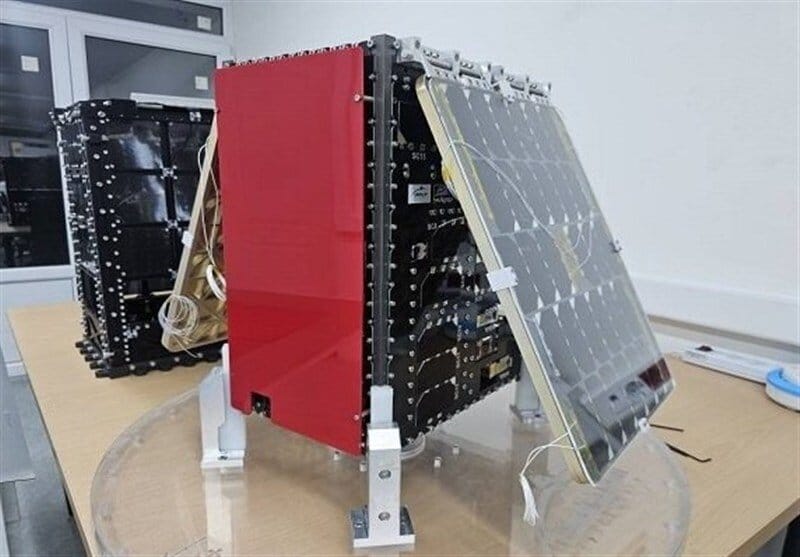
TEHRAN – Iran plans to launch Kowsar 1.5, an upgraded version of the Kowsar 1 satellite, integrating Earth imaging and Internet of Things (IoT) communication capabilities into a single platform, according to the developer.
The launch is part of the national dual mission plan and is scheduled by the end of the Persian calendar.
Kowsar 1.5 builds on lessons learned from previous satellites Kowsar and Hohod while addressing technical limitations experienced by its predecessors, such as limited ground communications and limited observation windows. These previous missions helped establish Iran’s private sector capabilities in satellite design and launch, paving the way for a new generation of multipurpose space assets.
“The new satellite operates through two different optical perspectives: one for Earth imaging and one for IoT communications,” said Dr. Hossein Shalebi, CEO of Omid Faza, the satellite’s designer. “This approach allows us to maximize operational efficiency while leveraging lessons learned from previous missions.”
Kowsar 1.5 is classified as an In-Orbit Demonstration (IOD) mission. An IOD is designed to demonstrate the technical capabilities of a satellite in orbit, similar to a minimum viable product (MVP) in the terrestrial industry. Shalebi emphasized that early missions are expected to uncover technical challenges that will be used to improve subsequent designs.
The project also introduces a new economic model to support Iran’s civil space sector. Omid Faza is working with the Iranian Space Agency and the Vice President for Science and Technology to participate in the Advance Purchase Guarantee Program, with the agency committing to obtain satellite data in advance. The arrangement provides financial stability for private companies and encourages investment in risky space technology.
“This initiative creates a viable market for knowledge-based companies,” Shalebi said. “Without government support, private investment in space would not be economically possible. At the same time, the mission involves high technical risks due to the innovative nature of the technologies involved.”
Kawsar 1.5 represents a significant step in Iran’s evolving space program, demonstrating both technological advances and deeper private sector involvement in satellite development. It is expected to serve as a bridge between early experimental satellites and the next generation of operational spacecraft, advancing Iran’s goal of an independent multipurpose space capability.