
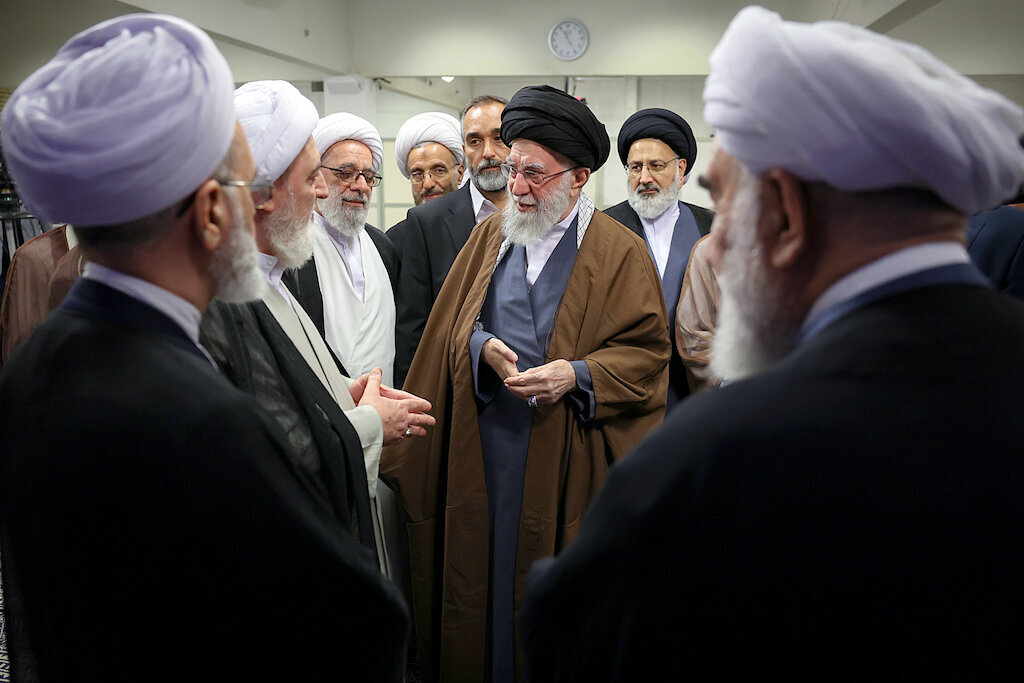
TEHRAN – Remarks made during a meeting with the organizers of the international memorial service for Islamic revolutionary leader Ayatollah Saeed Ali Khamenei, Allah Mirza Muhammad Hussein Naini (RA), were announced Thursday morning at the event venue in Qom.
During a conference held on Wednesday, October 22, the leaders of the Islamic Revolution praised Alameh Naini as one of the most prominent academic and spiritual pillars of Najaf’s ancient hawza (seminary). He further pointed out that from a professional point of view, the most notable feature of Alameh Naini was the way it structured its lessons in the science of Islamic jurisprudential principles (Usul al-Fiqh). The framework is firmly “based on an intellectual and scientific order” and is characterized by his “numerous solid innovations,” the leaders said.
Khamenei went on to highlight another outstanding quality that sets Allame Naini apart among great religious authorities: his political ideology. This vision, he noted, is reflected in Alameh Naini’s “invaluable but little-known book, Tambi al-Ummah.”
The leader claimed that Alame Naini’s political ideology was rooted in the principle of establishing an Islamic government based on divine guardianship (wilaya) against tyranny. He stressed that according to Alameh Naini’s political ideology, the government and all its officials must be subject to national supervision and responsibility. He added that this would require the establishment of a “representative parliament” through elections for oversight and legislation, and that the validity of the law would be subject to approval by eminent jurists and scholars.
The Islamic revolutionary leader described the framework of the Islamic People’s Government envisioned by Allameh Naini as what is understood today as an “Islamic Republic.” Explaining why he personally collected Allameh Naini’s book Tambi al-Ummah, Imam Khamenei explained that the constitutional movement supported by Allameh Naini and Najaf scholars essentially supports “the establishment of a just government and the end of tyranny.” He stressed that this is different from the constitutionalism that the British had created in Iran, which had tragic consequences such as the conflict and the execution of Sheikh Fazlollah Nouri.
During the meeting, Ayatollah Alireza Alafi, Director of the Seminary, reported on the programs and activities of the Allameh Naini International Commemoration.