
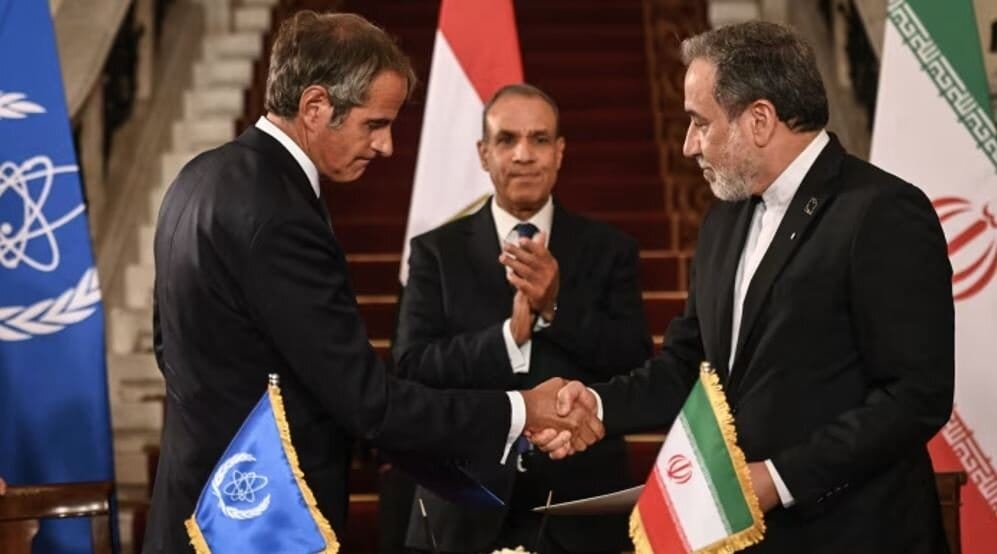
TEHRAN – Iran’s foreign minister warned the head of the U.N. nuclear watchdog against divisive language in remarks Thursday, saying such an approach would lead to “nothing but further defeat.”
Foreign Minister Abbas Araghchi’s comments targeted International Atomic Energy Agency (IAEA) Director-General Rafael Grossi.
The informal diplomatic exchanges began after Grossi’s comments in an interview with the Swiss daily Le Temps assessing the impact of illegal attacks by the United States and Israel on Iran’s nuclear facilities in June. Grossi acknowledged that the attacks caused “significant damage” to sites in Isfahan, Natanz and Fordow, but noted that Iran’s basic technological expertise and enrichment capabilities remained intact.
In response to this assessment, Mr. Araguchi expressed skepticism about the IAEA Director’s intentions. “I don’t know whether he made that statement out of concern or as a threat,” Araghchi was quoted as saying in Iranian media. “But those who make such threats need to realize that repeating their failed experiences will only lead to new defeats.”
This reaction coincided with significant procedural changes. Iran’s Ministry of Foreign Affairs has officially announced the expiration of UN Security Council Resolution 2231, which approved the 2015 nuclear deal, originally known as the JCPOA. The Iranian government claims that with the resolution’s expiration, the restrictions it imposed no longer apply.
In the interview, Grossi offered a detailed technical perspective that seemed to refute previous justifications for military action. He confirmed that Iran’s stockpile of enriched uranium (approximately 400 kilograms at 60% enrichment) remains below the 90% level considered conventional weapons grade. “Even so, there is no evidence that Iran has any intention of producing nuclear weapons,” Grossi said, adding that most of the material remains securely stored in facilities under IAEA oversight.
The director-general also pushed back against rhetoric that preceded the June airstrike, which was the first major joint attack by the United States and Israel on Iranian nuclear and military facilities. US President Donald Trump has justified the move by claiming that Iran is close to building a nuclear weapon, although no public evidence has been presented.
“Countries that independently follow Iran’s plans have come to the same conclusion as us,” Grossi said, adding that “Iran’s activities remain stable, traceable and not geared toward weaponization.”
Grossi praised Iran’s diplomatic stance following 12 days of intense conflict following the attack, which has involved Iranian retaliatory attacks on Israeli-occupied territory and US military bases. He suggested that Iran’s current restrictions on access to inspectors are the product of legitimate security concerns.
“After 12 days of war, Iran could have chosen to isolate itself by cutting off dialogue, withdrawing from the Non-Proliferation Treaty, and pursuing a more confrontational path. But it did not do that,” Grossi said. “Instead, Iran has chosen to remain engaged, demonstrating a willingness to maintain diplomacy even under intense pressure. Its wariness is understandable given recent attacks on sovereign facilities.”
The IAEA Director-General highlighted the way forward and emphasized continued communication. “I remain in regular contact with Foreign Minister Abbas Araghchi and we are focused on maintaining diplomatic momentum,” Grossi concluded. “If diplomacy continues, there is no reason for the use of force to occur again.”