
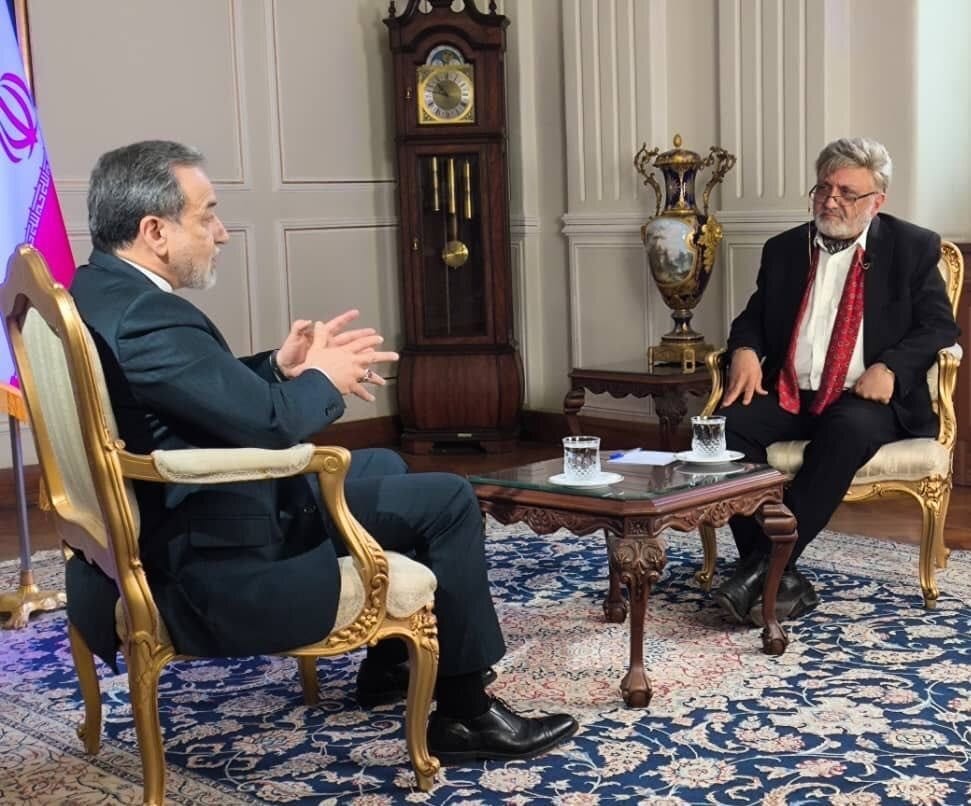
TEHRAN – Iran’s foreign minister said that Iran always supports diplomacy and is ready to come to the negotiating table with the United States if it acts in good faith.
“We have not had a positive experience with the United States, even though we came forward honestly every time and paved the way. But it is possible to engage cautiously even without trust,” Abbas Araqchi said in an interview with an online network.
“We have never given up on diplomacy if the United States is willing to engage in serious talks on an equal footing with an honest approach to secure mutually beneficial rather than unilateral agreements based on mutual respect in order to arrive at a solution that satisfies both sides,” the top diplomat said.
“There is no reason for either side to pay unnecessary costs…There are deep differences with the United States, most of which stem from Washington’s pursuit of primacy.”
Araghchi stressed that Iran will not bow to pressure or coercion and is open to respectful dialogue.
He added: “The Iranian people will not respond to force, pressure or sanctions.” “But if you speak with dignity and behave with respect to the Iranian people, you will receive the same.”
A few days ago, the Secretary of Iran’s Supreme Council of National Security rejected the outright demands that the US made behind closed doors in a message to Iran to reduce the range of its missiles against Iran.
Ali Larijani said that “demanding that the range of missiles be reduced is tantamount to demanding obedience and stripping away national security.” “Reducing the range of missiles is tantamount to undermining this country’s most important means of defense.”
Iran’s nuclear issue has been a point of contention with Western countries since 2003. Several rounds of talks were held with Western countries to resolve the issue until the Iran nuclear deal, known as the Joint Comprehensive Plan of Action (JCPOA), was signed in 2015.
Under the JCPOA, Iran accepted confidence-building restrictions on its nuclear program in exchange for the lifting of UN, US, and EU sanctions. The agreement was approved by UN Security Council Resolution 2231, which also set a permanent expiration date for nuclear-related restrictions in October 2025.
But Iran has repeatedly complained that the United States, even under former President Barack Obama, has been reluctant to allow Iran to benefit economically from the deal. In 2018, the United States unilaterally withdrew from the JCPOA and reimposed comprehensive sanctions against Iran.
In response, after waiting more than a year for European countries to compensate it for the US withdrawal, the Iranian government began to gradually reduce its compliance with nuclear restrictions pursuant to the JCPOA, but maintained that it remained open to negotiations once sanctions were lifted.
The Iranians have participated in several rounds of talks to revive the nuclear deal in 2022. Mikhail Ulyanov, Russia’s permanent representative to international organizations in Vienna, said the remaining signatories to the 2015 Iran nuclear deal – Iran, Russia, China, France, Germany and the UK – had been trying to reach an agreement on reinstating the deal in September 2022, the same year Iran signed the deal, in coordination with the US, before Europe pulled out of the negotiations. It was hit by deadly violence.
He said European countries were not major players here and that keeping the nuclear deal depended on US actions.
Iran’s next major attempt to find a diplomatic solution to its nuclear conflict came this year, when it agreed to engage in indirect negotiations with the United States. These talks proved fruitless and were abruptly interrupted by attacks on Iranian nuclear facilities by the United States and Israel.
Last week, Ayatollah Seyyed Ali Hammanei, leader of the Iranian Islamic Revolution, warned that the United States is in no position to dictate anything to Iran.