
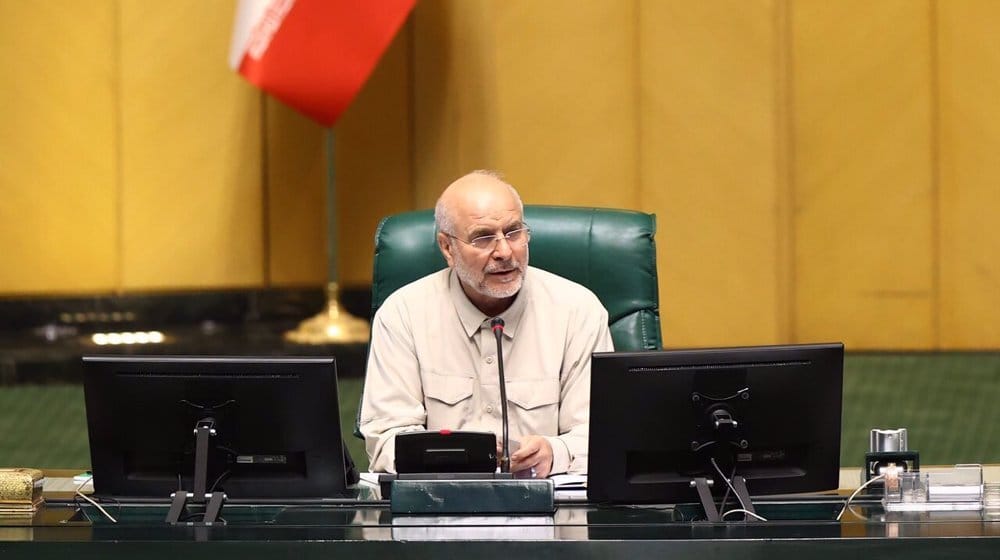
TEHRAN – At Saturday’s open session in Tehran, Parliament Speaker Mohammad Baqer Qalibaf characterized the joint letter by Iran, Russia and China to the United Nations as a clear expression of “strategic solidarity” between the three countries.
The letter, protesting European efforts to reimpose pre-JCPOA UN sanctions on Iran, was delivered to the UN Secretary-General and the President of the Security Council. Foreign Minister Khalibaf said this diplomatic achievement is a significant achievement of Iranian foreign policy and is due to the enduring resilience and progress of the Iranian people in the face of years of undue pressure and international sanctions.
“The letter from the foreign ministers of the Islamic Republic of Iran, the Russian Federation, and the People’s Republic of China to the Secretary-General of the United Nations and the President of the United Nations Security Council symbolizes the strategic solidarity of these three powers and clearly states that the move by the three European countries to trigger the so-called ‘snapback mechanism’ fundamentally lacks legal basis,” the top lawmaker said.
The joint document signed by the three foreign ministries has become a symbol of cooperation between the countries. The report clearly states that the attempt by the three European countries (the UK, Germany and France, collectively known as the E3) to trigger the snapback mechanism has no legal basis.
The core of the letter confirms that October 18, 2023 is the official end date of UN Security Council Resolution 2231. The resolution was originally the document approving the 2015 nuclear deal, which the United States unilaterally withdrew from. As a result, with the expiration of this resolution, the three allies insist that Iran’s nuclear document is no longer on the Security Council’s agenda.
The E3 initiated a 30-day snapback process on August 28, but the Iranian government quickly rejected the move as unwarranted. Iran’s position is that since the United States abandoned the Joint Comprehensive Plan of Action (JCPOA) in 2018, it has no legal standing to invoke the terms of the agreement. Moreover, Iran claims that E3’s coordination with Washington’s illegal sanctions campaign further invalidates its position.
Despite claims by the United States and its European partners in late September that UN sanctions against Iran had been reinstated, a tripartite letter from Iran, Russia, and China argues that such procedures are fundamentally flawed from both a legal and procedural perspective.
Mr. Qalibaf elaborated that in accordance with paragraph 8 of the expired resolution 2231, all restrictions and provisions in the document have been legally terminated. “Based on Article 8 of (Security Council) resolution 2231, all restrictions and obligations in this resolution are terminated, the invalidity of all previous resolutions remains in place, and with the recognition of (Iran’s) official enrichment rights, Iran’s nuclear document has been removed from the agenda of the UN Security Council,” it stressed.
In a related diplomatic move, Mr. Khalibaf also referred to a separate communication sent by the ambassadors of China, Iran, and Russia to International Atomic Energy Agency (IAEA) Director-General Rafael Mariano Grossi. The letter clarified that the termination of Resolution 2231 also formally ended the mandate given to the IAEA Director-General to report on the verification and monitoring of Iran’s nuclear activities.
As a result, Mr. Khalibaf said, the IAEA now has a legal obligation to operate under the framework of the Board’s decision from December 2015. The decision allowed verification activities for up to 10 years or until the IAEA could issue broad conclusions about Iran’s nuclear program, whichever came first. The Speaker insisted that the IAEA must adhere to this specific mandate, rather than succumbing to unilateral interpretations promoted by Western countries. He declared that these two joint letters not only represent a legal victory for Iran, but also serve as strong evidence of changing global power relations.
Qalibaf further praised the Non-Aligned Movement (NAM) whose member states expressed support for Iran on the snapback issue. “From a legal perspective, China, Russia, Iran and the coalition of 120 NAM member states have effectively prevented abuse of the framework of international institutions,” he said. This collective action will undoubtedly play an important role in mitigating the impact and effectiveness of sanctions against the Islamic Republic of Iran, Qalibaf concluded.