
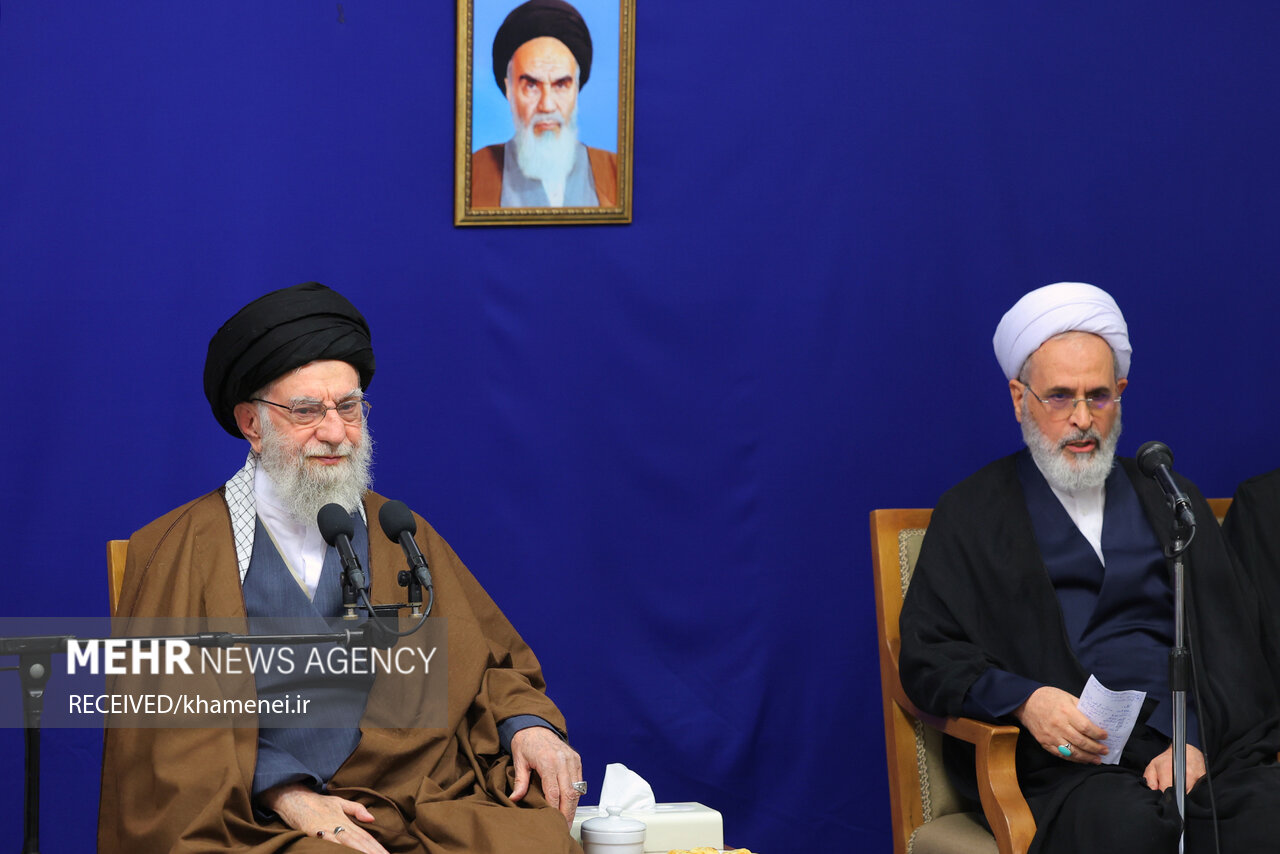
Islamic revolutionary leader Seyyed Ali Khamenei’s latest speech, delivered at a gathering of Iran’s scientific elite and young medal-winning scholars, was much more than a ceremonial speech. It was a comprehensive declaration about Iran’s future in a changing world order.
At this gathering, he presented an intelligent and civilized portrait of Iran. In his view, Iran is no longer just a regional actor, but the bearer of a new design for reshaping the concept of power in today’s world. His recent statements must be understood within the framework of his timeless ideas of faith, knowledge, and steadfastness. These three intertwined concepts together define the geometry of Iranian independence discourse.
On the surface, Khamenei’s remarks praised Iran’s youth, intellectuals, and defenders of science. But at a deeper level, they conveyed a strategic message to the world. Modern Iran, in the midst of a multifaceted war on both soft and hard fronts, has become a model of what he calls “active independence” in the international system through its religious faith, scientific progress, and spirit of resistance. His words reflect a worldview in which knowledge without faith leads to domination, faith without knowledge leads to stagnation, and firmness without either leads to defeat.
Faith: The axis of self-belief and national psychological regeneration
In Khamenei’s view, faith is not just a personal virtue, but a social asset that protects the nation from despair and cultural erosion. He referred to what he called “soft war,” reminding the audience that the enemy’s main goal is to undermine the morale of the population. For him, this war is a kind of psychological engineering of the state, and faith is an armor to protect against it.
“In a soft war, the enemy seeks to make the population depressed, hopeless, and disillusioned with its own capabilities. By winning these medals, you have gone in the exact opposite direction.” In this formulation, faith becomes the strategic antidote, the energy that lifts the population from passivity to confidence.
In his discourse, faith is not opposed to knowledge, but rather is its source. By integrating faith and knowledge, Iranian leaders offer a model of indigenous development that avoids blind imitation of the West. He believes that faith in God and in oneself frees a nation from intellectual and economic dependence. Seen from this perspective, the “revolutionary youth” is not just an ideal figure, but the foundation of Iran’s future civilization.
While global media often portrays Iran’s youth as hopeless and isolated, Khamenei spoke of a generation “on the cusp”. The summit, he argues, was not just a symbol of athletic or academic triumph, but a symbol of spiritual strength, the strength of a nation convinced that it could stand firm against the ruling structures. Faith here is the inner driving force of national movements, the force that has lifted nations from the depths of crisis throughout history.
Knowledge: the combination of science and power
The second major axis of the leader’s speech was knowledge, but not in an abstract academic sense. Rather, it is knowledge as a source of power. He described science as “the basis of national deterrence” and a key element of independence. In his words, Iran’s scientific achievements in areas such as nanotechnology, laser technology, defense industry, and especially nuclear science symbolize the coming of age of a country that has chosen to produce its own security rather than import it.
He declared: “These missiles were manufactured by Iranian youth. This is the identity card of Iranian youth.” That sentence has a deep meaning. In Khamenei’s worldview, missiles are not just weapons, but symbols of scientific progress and national will. He said that Iran’s missile technology is a product of faith, knowledge and the determination of its youth, and that the combination of these creates true deterrence.
In an international environment dominated by great power monopolies over defense technology, the progress of Iran’s indigenous peoples poses a challenge to global power structures. This challenge is not merely technical but epistemological, a declaration through action that knowledge is not exclusive and faith can be the driving force of science.
It was in this same context that the Iranian leader harshly criticized then-US President Donald Trump. Referring to President Trump’s boast about attacking Iran’s nuclear facilities, he said: “That’s OK. You can buy into that fantasy. But who decides what a country will or won’t do with respect to its nuclear industry? These interventions are unlawful, false and arrogant.” This response was more than political rhetoric. It was a defense of the very principle of scientific sovereignty among nations.
For Khamenei, scientific progress is part of Iran’s national identity, an achievement built on the blood of martyrs and the efforts of young people. Any attack on it is therefore an attack on the country’s independence. In this light, he condemned the assassination of an Iranian scientist by agents of the US-backed Zionist regime as a crime against humanity, stressing that “you can assassinate a scientist, but you cannot kill their knowledge.”
In his view, true science is not just the accumulation of data, but emancipatory knowledge, knowledge that liberates humanity and nations from subjugation. He has repeatedly insisted that Iran should never put its scientific capabilities in the service of the West, but rather in the service of human dignity and world justice. In this sense, scientific progress is a moral weapon, and technological deterrence is an earthly expression of faith.
Steadfastness: A rational logic of resistance to coercion.
Continuing his speech, Khamenei defined fortitude as “the logic of survival in an unjust world.” Referring to President Trump’s threats and his talk of “making a deal with Iran,” he said, “He says he’s a negotiator, but a coercive deal with a predetermined outcome is not an agreement, it’s an imposition, and the Iranian state will never succumb to imposition.” This statement reflects the political philosophy of the Islamic Republic over the past four decades, one that draws a clear line between dialogue and obedience.
In this framework, robustness does not mean isolation, but independence in decision-making. In Aytaollah Khamenei’s view, a nation is defeated not when an enemy crosses its borders, but when an enemy invades its heart. Resistance is therefore primarily cultural before it is military. “The enemy is trying to make Iranian youth lose confidence. This is what they are trying to do,” he said. This exposes the soft war blueprint of stripping nations of belief in their own abilities. To this plan, steadfastness is not an emotional reaction, but a rational reaction of an awakened nation.
“The United States is the main partner in the crime in Gaza,” he declared, adding: “You killed more than 20,000 children. Were they terrorists? No, you are the terrorists!” With these words, he removes the term “terrorism” from the semantic monopoly of Western media and restores its moral meaning. Terrorism is not an act of the weak, but an instrument of dominant power.
Khamenei also pointed to the domestic unrest in the United States and the millions of people protesting against the Trump administration, saying, “If you are so capable, instead of interfering with other countries, please calm down these millions and send them back to your homeland.” This line is both ironic, a satire at power that is collapsing from within, and a warning to a world still fooled by its facade of strength.
From his perspective, the policies of the United States and its allies are a mixture of coercion, deception, and warmongering. In response to President Trump’s claim that “the Middle East is a place of war and death,” he said, “You are the ones who start the wars. America is provoking warmongers, causing conflicts in addition to terrorism. Why do we have so many U.S. military bases in this region? What are we doing here?” These questions come not from anger but from moral inquiry. It is a challenge to the world’s conscience: who is truly responsible for instability?
Ultimately, he concluded, “Coercion may affect some countries, but by the grace of God it will never affect the Iranian people.” This is essentially an unwavering philosophy. It is not resistance as a tactic, but resistance as the very essence of a people of faith.
Independent Iran: Redefining power in the 21st century
Taken together, these statements paint a new picture of modern Iran. In the words of Ayatollah Khamenei, this is a nation that seeks meaning, not just survival. In a world where great powers are experiencing a crisis of legitimacy, he presents the concept of an “independent Iran” as a moral and rational alternative to the existing world order. In this model, independence is not limited to economic self-sufficiency, but extends to intellectual autonomy, cultural identity, and scientific sovereignty.
Ayatollah Khamenei claims that Iran’s youth, scientists, and elite must be “stars that turn into the sun.” This metaphor evokes a continuum in which nations are moving away from dependence on foreign powers toward domestic production of both faith and knowledge. Recalling the years of imposed war, he sees today’s young people as successors to the same generation who faced Western-backed forces with their bare hands and won.
At the geopolitical level, this worldview implies the formation of a multi-layered deterrence force for Iran. Scientific deterrence to prevent dependence on technology. and cultural deterrence born of faith and national trust. Within this framework, the idea is that modern Iran is no longer just a country in the region, but is capable of becoming independent and progressive without abandoning its values.
At the conclusion of their speeches, the leaders reiterated that the Iranian people are a people of resistance and will continue on this path with hope. He said to the young people: “You are a manifestation of action, of hope, of progress.” Among his warnings and criticisms, this sentence radiates optimism, a hope that, in his words, is “the most powerful response to the enemy.”
Khamenei’s latest remarks can be seen as a summing up of Iran’s 45 years of experience, from revolution to sanctions, from war to progress. In a world where many nations have succumbed to great powers, he continues to hold fast to the timeless triad of faith, knowledge, and steadfastness. These three elements not only shape the internal structure of Iranian power, but also provide a model for countries seeking a path between dependence and isolation—a path to dignified independence.
Above all, recent speeches by leaders are a reminder that when power is separated from faith and knowledge, it degenerates into domination. But a nation based on indigenous science, moral beliefs, and national honor will not crumble under the heaviest pressures. Amidst the global noise and media distortion, his message resonates quietly but deeply. Through its faith and knowledge, Iran has chosen a path different from that of the world’s great powers. That path may one day become a new direction in history.