
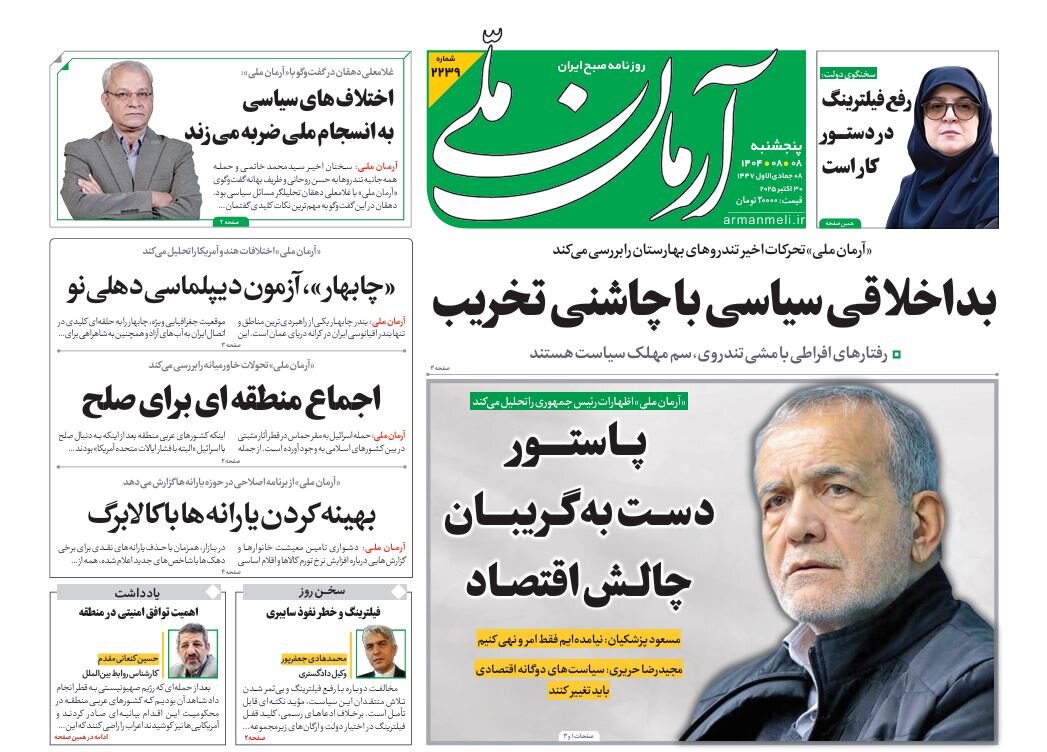
TEHRAN – In a recent article, Arman-e-Meri highlighted the strategic importance of Chabahar Port for India. As Iran’s only maritime port on the coast of the Sea of Oman, Chabahar occupies a unique strategic position.
This geographical advantage makes it an important link between Iran and the high seas and an important transport corridor for goods between Central Asia, the Middle East and the Indian subcontinent. From Iran’s perspective, Chabahar serves as an important gateway for the economic development of the underprivileged southeastern regions, especially Sistan-Baluchestan province. The port also offers Iran the opportunity to reduce its dependence on the Strait of Hormuz and diversify its maritime trade routes. Chabahar’s importance extends beyond Iran, drawing strong interest from regional actors, particularly India and Afghanistan. The port is also a point of contention between New Delhi and Washington. For India, Chabahar is not just an economic route, but a geopolitical tool to expand its regional influence and counter China’s Belt and Road Initiative and the Gwadar port that China has developed in Pakistan.
Khorasan: Development Agreement or Roadmap
In his memo, Khorasan analyzed: 25-year comprehensive cooperation agreement between Iran and China. The paper argues that this long-term plan includes areas such as energy, infrastructure, technology, industry, and financial and security cooperation. This is a strategic framework that outlines a collaborative path for the coming decades. The deal’s flexible structure allowed Iran to leverage the capabilities of China, the world’s second-largest economy, even in the face of sanctions and global political changes. Moving this agreement from memorandum to actual implementation requires a national coordinator with cross-sectoral authority and a precise timeline. This person will be responsible for managing collaboration between ministries, the private sector, and Chinese partners, and overseeing project execution from negotiation to final delivery. If Iran can capitalize on this partnership through careful management and gradual transparency, it may be possible to say that the new century could mark the end of Western monopoly in terms of development.
Etemad: controversial agreement
In his commentary, Etemad considered the recent US-China agreement and its impact on Iran. The world has yet to recover from the long-running trade war between the two largest economies, the United States and China, but the relationship is beginning to show signs of diplomatic flexibility. The recent agreement signals a kind of temporary truce in this economic conflict. In this context, Iran, as a major regional player, faces a duality of opportunities and threats. On the other hand, the Sino-American agreement could open new avenues for economic cooperation between Iran and the East. On the other hand, a decline in tensions between the two superpowers could narrow Iran’s options to avoid sanctions. Under such circumstances, Iran’s natural inclination toward alliances with anti-interventionists and cooperation within an “axis of resistance” is likely to increase. For countries like Iran, this period presents an opportunity to rethink foreign policy and diversify exports from traditional energy to emerging technologies. Ultimately, the fate of the world order rests in the hands of leaders who think beyond borders and speak the language of justice and cooperation. Perhaps this marks the biggest change of our time.
Jawan: Strengthening regional cooperation is Iran’s strategic policy
In his commentary on Iran’s acceptance as a member of the ECO, Jawan emphasized that welcoming the Economic Cooperation Organization (ECO) for the first time in 15 years is an expression of a renewed commitment to regional cooperation and a strategic focus on deepening ties with neighboring countries. In an effort to counter political and economic pressure from the United States and its European allies, Iran has adopted an active dialogue and foreign policy with its regional partners. One of Washington’s key strategies to put pressure on Iran has been to isolate it within its own region, aiming to surround it politically. Amid Western sanctions and pressure from the United States, the presence of the 10 ECO member states, along with ministers from neighboring non-member countries, at the ministerial summit in Tehran will send a clear and strong message to the West: Iran cannot be deterred by sanctions, and the West cannot isolate Iran using nuclear or human rights pretexts. Iran shares important security, economic and cultural interests with ECO member states, and these commonalities provide a strong basis for expanding future cooperation.