
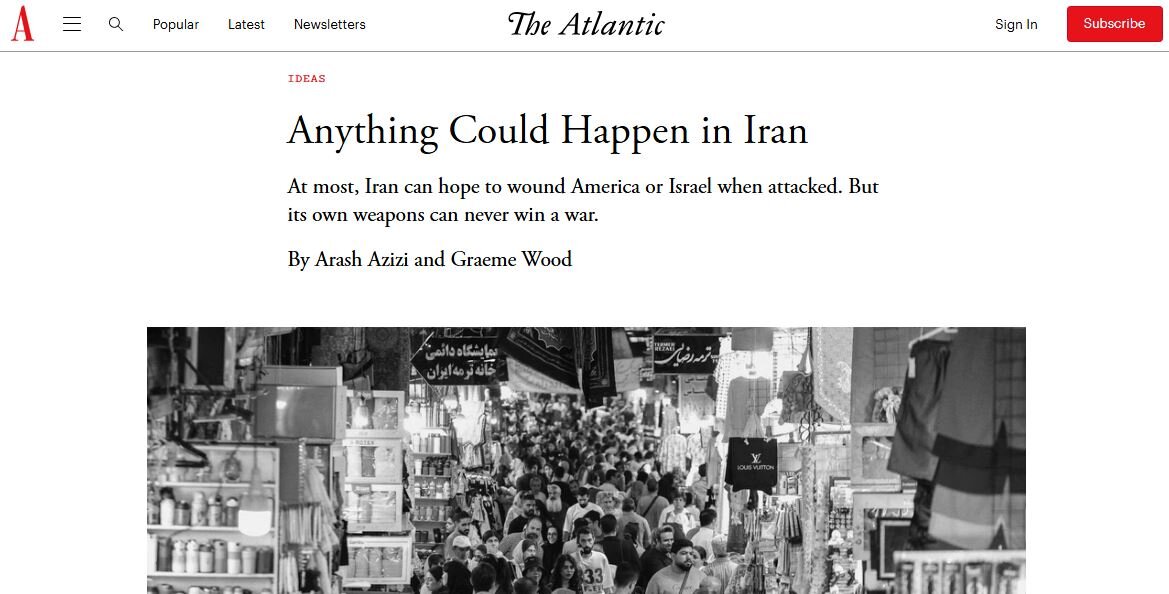
A recent article in the American magazine The Atlantic titled “Anything Happens in Iran” echoes the same prejudice and colonialist gaze that Western countries have long held towards Iran and its people.
In this work, the authors attempt to portray Iran as a confused, isolated, and indecisive nation. It is a nation faced with three stark choices: give up its independence, build a nuclear bomb, or accept economic collapse. But this analysis relies less on the realities of modern Iran than on the unfulfilled aspirations of those in power who are still unable to accept a state that stands tall and independent of the West in the heart of West Asia.
Contrary to the Atlantic’s biased coverage, Iran is not a country of crisis, but of survival and creation. The country has grown into a regional power through four decades of sanctions, wars, and pressure, and the West Asian equation would be unsolvable without its presence. Today, Iran is not a target of Western foreign policy. It will play a decisive role in shaping a new world order, one that no longer revolves around dollars and weapons, but is based on independence, regional cooperation, and mutual trust between nations.
Sanctions are effective, but their effectiveness is limited.
Atlantic reporters refer triumphantly to the activation of the so-called “snapback mechanism,” as if Iran were about to come under economic pressure for the first time. However, since the early years after the Iranian revolution, Iranians have lived under some of the harshest sanctions in modern history. From trade embargoes in the 1980s to banking and oil sanctions in the 2010s, from President Obama’s economic pressure to President Trump’s “maximum pressure” policies, no other country has faced more diverse and layered restrictions.
However, sanctions did not stop Iran or stop its development. Over the past decade, despite all restrictions, Iran has made undeniable progress in science, technology and industry. This is even reluctantly acknowledged by Iran’s critics.
Currently, Iran ranks among the top 10 countries in the world in drone technology. It has a global position in the fields of nuclear medicine, nanotechnology and biotechnology. We also produce more than 95% of our pharmaceutical needs domestically. In the field of space technology, launch vehicles such as Simurgh and Qaseed demonstrate Iran’s ability to develop orbital launch systems. In the defense industry, the country built an indigenous long-range missile system within two decades, a technology once monopolized by a handful of world powers.
Sanctions were intended to defeat Iran, but they actually became a catalyst for self-sufficiency and innovation. This is the truth that the West refuses to see. Sanctions no longer work the way they used to. Iran’s economy is shifting eastward through energy cooperation with Russia and China, trade with India and Indonesia, and membership in the Shanghai Cooperation Organization and BRICS. These moves freed Iran from the orbit of the Western economy and placed it on a new path of multilateral engagement.
These member states are clear evidence that Iran is no longer isolated. In the same year that Western economies were struggling with debt and inflation, Iran recorded positive growth despite pressure, with non-oil exports exceeding $50 billion. This number may seem modest, but its meaning is clear. Despite all the restrictions, Iran’s economy is alive and evolving along its indigenous path.
Iran’s nuclear program
An analysis by The Atlantic describes Iran’s nuclear program as “the root of the crisis.” However, what the authors deliberately ignore is that Iran’s nuclear program has been developed from the beginning under the framework of the NPT and the supervision of the International Atomic Energy Agency (IAEA). No official IAEA report has ever suggested a military deviation. Inspectors have repeatedly confirmed the peaceful nature of Iran’s activities.
Unlike many countries, Iran maintained cooperation with the agency even at the height of external pressure. All of Iran’s nuclear facilities are under IAEA surveillance, and Iran receives more surprise inspections than any other NPT member state. But for Western countries, the problem was not really a “bomb.” The real issue is technical independence. Any country that enriches uranium without Washington’s permission is considered a “threat,” even if that activity is completely peaceful.
If the West is genuinely concerned about nuclear proliferation, why are they silent about Israel, a regime that has hundreds of nuclear warheads, is not an NPT member, and refuses IAEA inspections? This double standard exposes the political nature of Western concerns more clearly than any other argument.
Despite deep mistrust, Iran has repeatedly demonstrated goodwill. The signing of the Joint Comprehensive Plan of Action (JCPOA) in 2015 clearly symbolized this. Despite its skepticism, Iran sat at the negotiating table and fulfilled all its obligations. The IAEA has confirmed Iran’s full compliance in more than 10 consecutive reports. However, in 2018, the United States broke all of its commitments and unilaterally withdrew from the agreement.
Even after this violation, Iran did not abandon diplomacy. On the eve of Israel’s 12-day war against Iran, indirect negotiations between Tehran and Washington were still underway. At the very moment Iran was seeking a new agreement through dialogue, the Israeli regime, with US logistical and intelligence support, attacked Iranian soil. Is that a sign of good faith in negotiations, or evidence of the old idea that diplomacy only works if Iran makes concessions?
Nevertheless, Iran did not close the door to negotiations even after these attacks, as it believes that stability in West Asia can only be achieved through diplomacy and mutual respect. The JCPOA taught us a clear lesson. The problem lies not in Iran’s actions, but in its policy of treating independence itself as a threat.
Iran’s defense power
The authors of The Atlantic argue that Iran’s missile and drone capabilities “can inflict damage, but not victory.” But if that’s true, why are Western countries so afraid of them? Why is limiting Iran’s defense capabilities one of the main pillars of Western negotiations?
The answer is simple. Through indigenous knowledge, Iran broke the Western military monopoly in the region.
Iran’s missile and drone technology is a direct product of sanctions and isolation. When denied the purchase of even basic defense equipment, Iranian engineers built an independent defense industry from within. Currently, Iran is an advanced country not only in ballistic missiles but also in combat drones, electronic warfare, and air defense systems.
This deterrence has shifted the balance in proxy wars in the region. Iran’s precision missile strikes against terrorist sites in Syria and measured retaliation against US forces in Ayn al-Assad demonstrated that Iran is capable of responding decisively and proportionately when threatened. No regional power, not even Israel, dares to attack Iran directly, knowing the consequences would be dire. That is the true meaning of deterrence.
In today’s world, you can’t buy safety. It has to be built. Iran did not obtain its security through oil money or dependence on foreign powers, but through the blood, knowledge, and determination of its people. That is what infuriates the Western powers, the nations that have become powerful without their permission.
Iran and the new world order
One of the West’s biggest analytical errors is its insistence on viewing the world through the unipolar lens of the past. Today’s reality is completely different. The world is moving toward multipolarity, and Iran is at the center of this transformation. Iran’s accession to the Shanghai Cooperation Organization and BRICS represents not just membership but a historic shift in direction. Non-Western countries are regaining confidence, and Iran is one of the pillars of this new order.
The new north-south and east-west transport corridor will not be completed unless it passes through Iranian territory. China’s new Silk Road, links between India and Russia, and energy routes to Europe all depend on Iran’s geography. This is why instability in Iran has direct implications for global energy and trade security. Western countries know this. And that is precisely why the West remains obsessed with containment rather than constructive engagement.
However, this policy is doomed to failure. The new world order is built on voluntary cooperation and common interests, rather than coercion and sanctions. Within this framework, Iran is not a “problem” but a natural bridge and partner between East and West Asia. Regional powers from China and Russia to India and Indonesia now clearly understand that security and development cannot be maintained without Iran’s participation.
The truth that Western countries fear
What the Atlantic ignores is not just Iran’s political reality, but also the historical spirit of its people, which endured war, siege, and terror, but never gave in. Time and time again, this country has shown goodwill, sat down to the negotiating table, and delivered on its commitments. But each time, the Western response was not respect but betrayal and sanctions.
Iran is not an enemy of peace, but it will never succumb to domination. The Iranian government’s policy is based on two principles: resistance to aggression and dialogue to respect. Sanctions and threats may slow progress, but they cannot stop a nation’s future based on knowledge, faith, and identity.
The Atlantic article may be a reflection of the West’s traditional view of Iran and an attempt to portray the country as in crisis. But the truth is different. Iran is a living, resilient and thoughtful people, a people who built strength from siege through self-reliance and faith.
The world stands on the threshold of change, and Iran is not on the periphery, but at the center. Those who still view Iran through the walls of a colonial mentality will eventually learn that the truth cannot be accepted. The future belongs to countries that remain independent, and Iran is definitely one of them.