
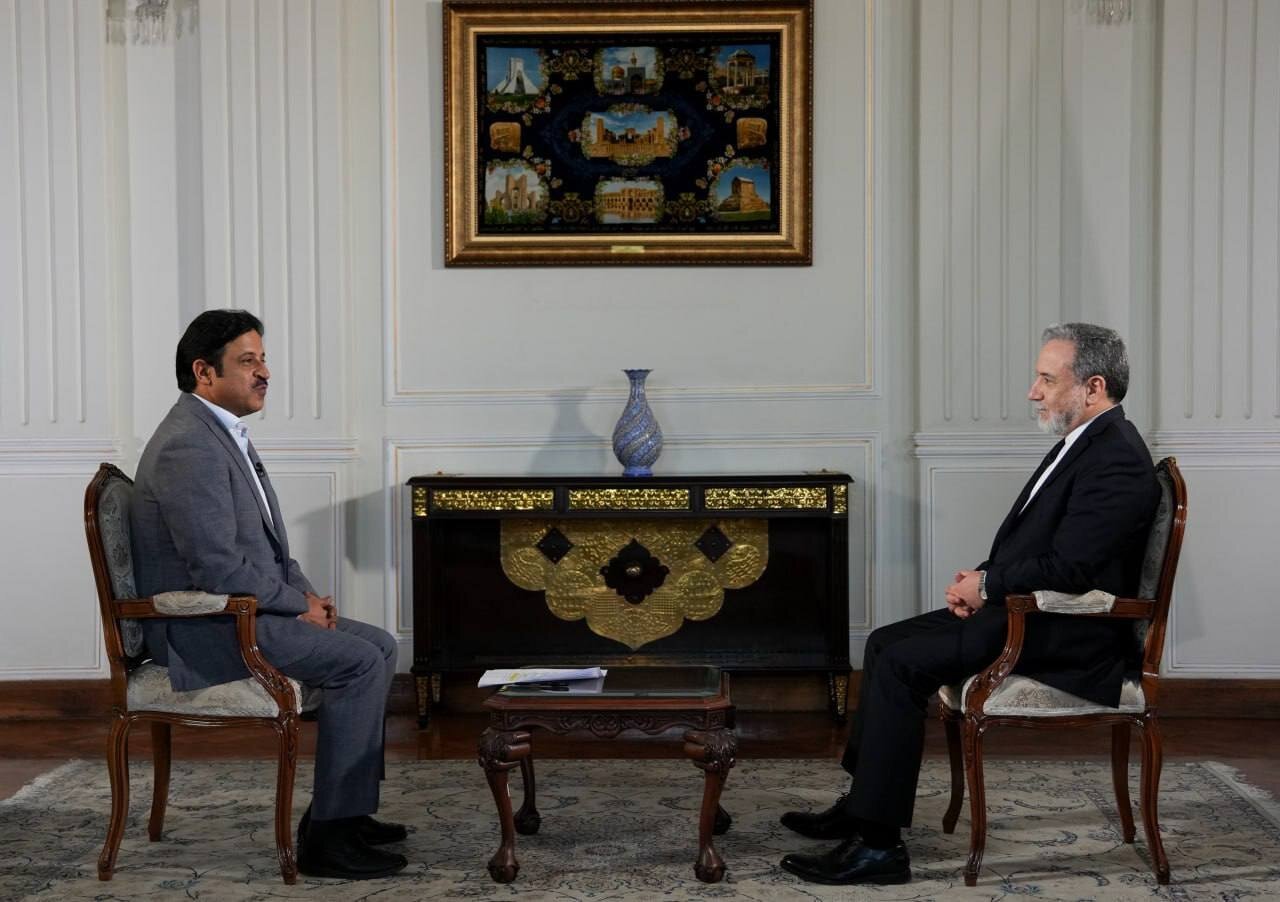
TEHRAN – Iran’s foreign minister reiterated in an interview with Qatari media what has essentially been the country’s position for decades: the United States cannot blink at Iran. Neither sanctions nor threats, nor even a war like the one waged by the US and Israel against Iran in June, will succeed. A win-win agreement remains the only way out of escalating tensions.
The full interview had not been published by Saturday night. But a fragment of the discussion published by Al Jazeera shows Abbas Aragushi saying, “What could not be achieved by war cannot be achieved by politics.” Araghchi added that Iran is willing to re-enter talks on its nuclear program but will never agree to halt uranium enrichment. “We are ready to address concerns about Iran’s nuclear program and are confident in the peaceful nature of our nuclear program,” he asserted.
The top diplomat was recorded as saying that Iran would never negotiate on missiles. The missiles are the very weapons Iran used four-and-a-half months ago to force a halt to 12 U.S.-Israeli incursions, and the United States is seeking to limit its range to less than 500 kilometers. Such restrictions would prevent Tehran from attacking occupied territory if Israel launches a new offensive. “No rational actor would accept disarmament,” Araghchi said.
Iran’s nuclear program has been a point of contention between the country and Western powers since the early 2000s. In 2015, Iran agreed to limit its nuclear activities in exchange for sanctions relief and signed the so-called Iran nuclear deal, formally known as the Joint Comprehensive Plan of Action (JCPOA), along with the US, UK, Germany, France, Russia and China.
However, in 2018, during President Donald Trump’s first term, the United States withdrew from the JCPOA and reimposed sanctions on Iran. It then launched a so-called “maximum pressure campaign” that included secondary sanctions targeting Iran’s trade with other countries. Washington has insisted that if Iran wants sanctions lifted, it must make non-nuclear concessions, such as capping its missile program and severing ties with regional resistance groups.
This position continued in US policy circles even under the Biden administration. However, Trump’s special envoy Steve Witkoff, who was involved in indirect negotiations with Iran during Trump’s second term, seemed to understand that Iran would not budge on non-nuclear issues. He reportedly believed that Iran remained willing to make nuclear concessions that could provide Trump with a deal he deemed “better” than the JCPOA.
The sixth round of these indirect talks was scheduled for June 16th in Muscat, Oman’s capital, but was canceled after Israel launched attacks on Iran’s nuclear, civilian and military infrastructure on June 13th. In his remarks to Al Jazeera, Aragushi pointed out that the Israeli attack could not have happened without the green light from the United States. The US government itself entered the conflict directly on June 22, using B2 bombers to attack three nuclear facilities that had already been targeted by Israel earlier in the war.
Araghchi said that despite the damage done to the ruins by the U.S. attack, Iran retains the technology needed to enrich uranium. This sentiment echoes remarks made by Islamic Revolutionary leader Ayatollah Khamenei in July, underscoring the dedication of the country’s thousands of scientists and experts to sustaining its nuclear program.
But what if Washington does not de-escalate tensions and instead chooses to continue to pressure Iran economically and militarily? Araguchi also had an answer for that. “We maintain the highest level of preparedness at all levels, and Israel will again be defeated in a possible future war,” he explained.