
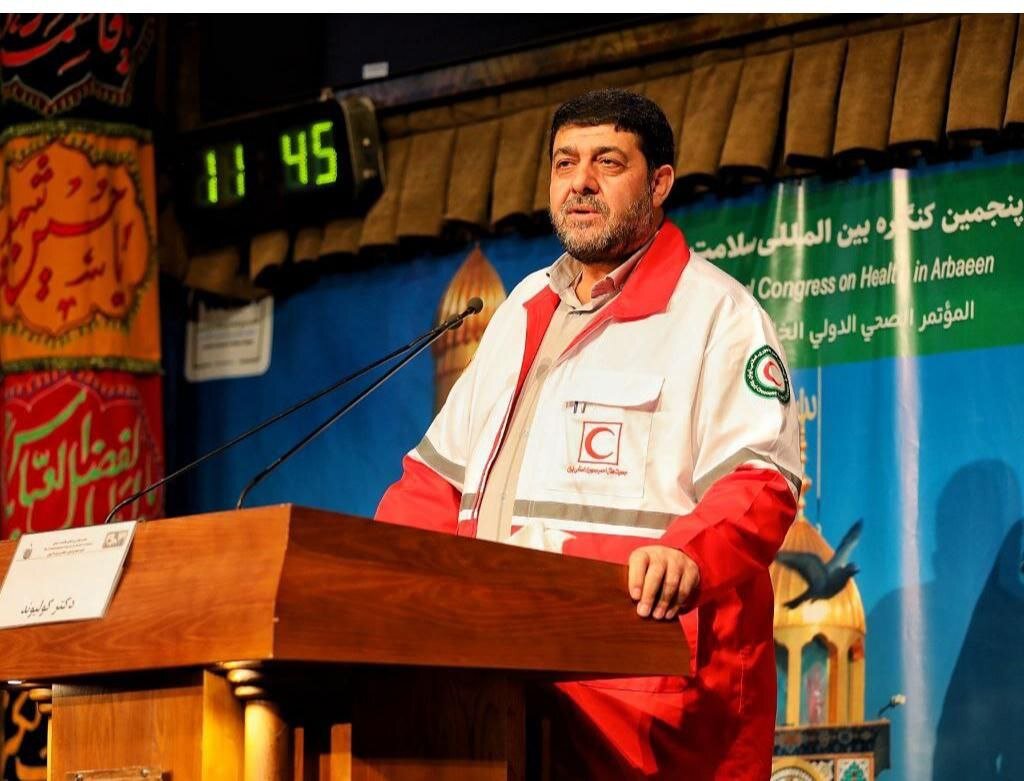
TEHRAN – Pirhossein Kolivand, Chairman of the Iranian Red Crescent Society (IRCS), elaborated on the eight main principles used to manage Arbaeen and improve services during the Hajj.
These principles, aimed at improving cultural, humanitarian and international coordination, have optimized the way services are delivered, the IRCS website quoted Kolliband as saying.
Unity management is key to Arbaeen pilgrimage. While speaking at the 5th International Conference on Health in Albaeen, Mr. Kolliband said that agencies, departments, as well as relief, service, cultural and security organizations must operate as a coordinated network.
The discipline of providing services and protecting the health of pilgrims is one of the most fundamental pillars of this great movement.
The official cited messages from the heads of the International Red Cross and Red Crescent Societies praising the measures and achievements of the Arbaeen conference as an example of the event’s international impact.
Improving medical, relief, cultural and welfare services on the route to Karbala is another key principle. This includes establishing new infrastructure such as hospitals, mobile medical centers, and smart systems.
The official emphasized the importance of citizen participation and developing people-centered activities, noting that all services are provided by volunteers, who are the backbone of the movement.
Responding to people’s demands and managing expectations are also important principles, he noted.
Another important principle is to respect Iraq as the main host country. “We are guests of Iraq, so we must take all measures in cooperation with the Iraqi authorities, the state and customs,” Kolliband further said.
Having a civilized, futuristic and global outlook was the last point mentioned by officials. All programs must be developed from a civilized perspective. Arbaeen is not just an annual event, but a global and civilizational movement that can serve as a model for expanding human synergy through goodness and peace.
IRCS sends over 8,000 rescue workers to Iraq for Arbaeen
A total of 8,200 rescue workers, including Iranian Red Crescent Society (IRCS) rescue workers, doctors and nurses, provided services to the Iraqi people during the 2025 Arbaeen Hajj, according to the head of IRCS.
“Additionally, about 7,000 IRCS troops are operating on internal routes and near the borders,” IRIB news agency quoted Pirhossein Kolivand as saying.
Arbaeen is the world’s largest annual pilgrimage commemorating the martyrdom of Imam Hussein on the 40th day after the death of Ashura. This year it was August 14th.
Every year, millions of Shia believers trek the 80-kilometre route from Najaf to Karbala in a faith-led, transnational movement that embodies Islam’s enduring call for unity, solidarity and justice.
“Four hospitals will provide services on the Najaf-Karbala highway. Also, the number of medical moqibs (volunteer stations) has been increased in Kabala, Najaf and Samara,” he added.
“Pilgrims can receive free medical, health and nutrition consultations through a mobile application,” Kolliband said.
The official went on to say that IRCS will use more than 200 special vehicles and ambulances to carry out its mission during the Arbaeen pilgrimage.
FM praises IRCS service
Foreign Minister Abbas Araghchi praised the services provided by IRCS to the people during the Arbaeen pilgrimage.
“The number of referrals to IRCS clinics in Iraq is very high,” Araghchi said, adding that around 800 pilgrims visited the center between 3 a.m. and 9 a.m., and the number of patients during the day could reach 4,000.
He made the remarks during a visit to a medical center run by IRCS in Iraq’s holy city of Najaf.
“They provide a wide range of services, including visiting patients and administering injections and serums, which is commendable. Words cannot express our gratitude and appreciation for their volunteer work,” the IRCS website quoted Arraguchi as saying.
From July 26 to August 14, IRCS provided medical services to approximately 4.1 million pilgrims. IRCS medical staff visited 1.05 million patients. Approximately 1.39 million pilgrims benefited from sub-clinic services (such as serum therapy and wound dressings), and another 1.6 million received medicines. During the same period, IRCS personnel transferred approximately 249 injured or dead people from Iraq to the country.
MT/MG