
TEHRAN – President Masoud Pezeshkian announced that Tehran would rebuild its nuclear industry, while Security Secretary Ali Larijani said the country was ready for talks that do not include “unacceptable conditions”, while the extent of the damage to Iran’s nuclear facilities from illegal attacks by the United States and Israel remains unknown to Western countries and the public.
The statement by two senior Iranian officials essentially stands firm on Iran’s decades-old position, despite extensive Western efforts over the past year to destabilize Iran, that it wants a domestic nuclear program and is willing to build confidence in the peaceful nature of its activities, but will never discuss denuclearization.
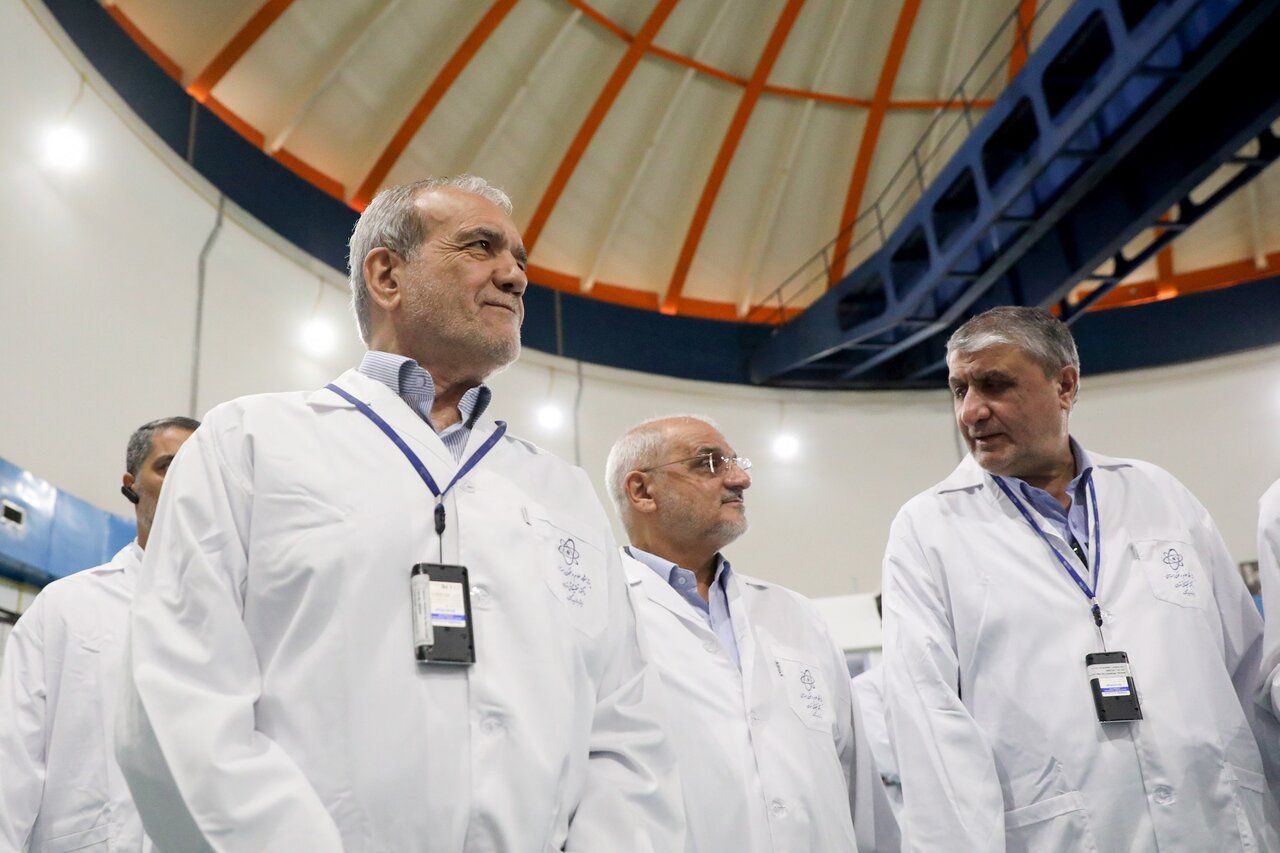
Pezeshkian, who visited the Atomic Energy Organization of Iran (AEOI) headquarters on Sunday, declared that the war that the United States and Israel launched against Iran in June had failed to destroy the country’s nuclear capabilities. “Knowledge is in the hearts of our scientists, and the destruction of buildings and factories will not matter. We will rebuild again stronger,” he told the organization’s leaders before touring an exhibition showcasing Iran’s latest nuclear achievements in medical, medical and radiopharmaceutical production.
The 12-day war has targeted numerous civilian and military facilities and killed at least 1,065 Iranians, but US President Donald Trump and Israeli Prime Minister Benjamin Netanyahu have said the main objective is to prevent Iran from acquiring nuclear weapons. However, this claim contradicted reports from the International Atomic Energy Agency (IAEA), which until last week had repeatedly stated that Iran had never pursued nuclear weapons.
President Trump has claimed at least 15 times since the war ended that Iranian nuclear facilities were “destroyed” by Israeli and American attacks. US media has cast doubt on these claims, pointing out that there is no guarantee that the heavily fortified ruins deep underground have actually been destroyed. Iranian Foreign Minister Abbas Araghchi acknowledged that the facility had been “damaged,” and Islamic Revolution leader Ayatollah Khamenei told President Trump in a speech last month to “keep dreaming” about destroying Iran’s nuclear capabilities. Despite this, the actual state of the damage site has not yet been made public.
Before launching war against Iran, President Trump succeeded in getting the country to engage in indirect negotiations over its nuclear program. This was in contrast to his first term, when Tehran had rejected such negotiations after withdrawing from the 2015 Iran nuclear deal and reimposing sanctions on Iran. But the U.S. president started the war just days before the sixth round of negotiations was scheduled to take place in Oman.
Despite growing opposition and skepticism within Iran about resuming diplomacy with the United States, Ali Larijani, secretary of Iran’s Supreme National Security Council, said on Sunday that Iran remains willing to engage in “genuine” negotiations with the United States.
“We are not saying that we are against negotiations. (Islamic Revolution leader Seyyed Ali Khamenei) has always emphasized that he knows how to negotiate. But real negotiations must take place, not negotiations with a predetermined outcome,” the veteran politician explained.
“President Trump has set several conditions for a potential deal with Iran, all of which Iran views as a no-go,” said American affairs expert Amir Ali Aboldofas. Further complicating matters, the US reportedly added normalization with Israel to its extensive list of demands for Iran, including zero uranium enrichment and a cap on its missile program.
“President Trump appears to be intentionally making it increasingly difficult for the two countries to reach a deal. Regardless of whether there is a deal or not, his desire appears to be Iran’s complete surrender,” the expert said.
In an interview published last week, Foreign Minister Aragushi told Al Jazeera that the only deal the Americans could hope to achieve with Iran was one that was “win-win.”