
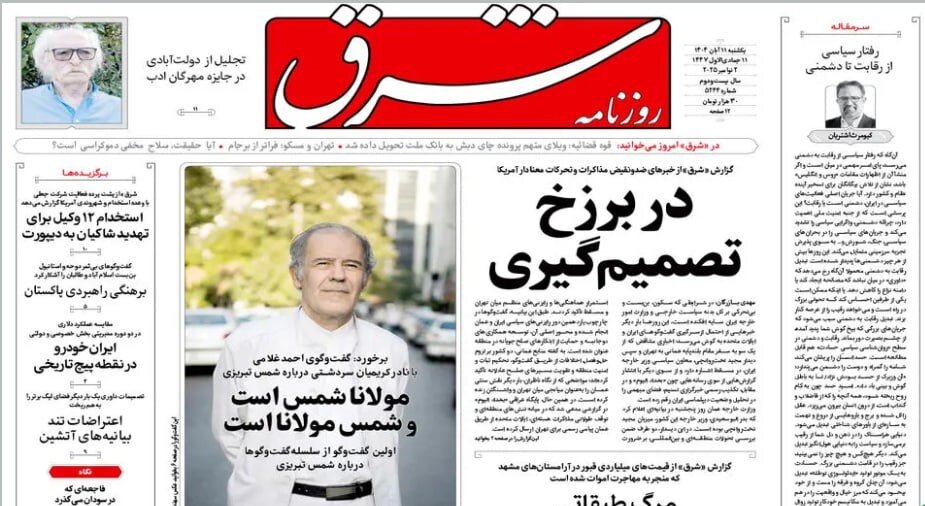
TEHRAN – In his memo, Foreign Minister Shahrugh addressed Iranian Deputy Foreign Minister Majid Takht Ravanshi’s visit to Oman and diplomatic talks between the two countries. “From a strategic perspective, the visit reflects the extraordinary relationship between Iran and Oman, which is built on trust and mutual respect, not on noise and confrontation,” the newspaper said. Over the years, Oman has consistently played the role of a bridge between Iran and Western and Arab countries.
What made this meeting so important was more than bilateral issues. The strategic dialogue between Tehran and Muscat shows that the two countries are institutionalizing their relationship within the framework of a sustainable regional partnership. Indeed, for Iran, Oman is not just an economic partner, but also a strategic ally that can keep important channels of engagement with the Arab world open. Majid Takht Ravanshi’s visit to Oman can be seen as an example of the Islamic Republic of Iran’s quiet, effective and positive diplomacy. Eventually, Muscat reaffirmed its long-standing role. The visit began with little media fanfare, but its impact on the future of Iran’s regional relations will undoubtedly resonate louder than many of the bombast speeches in domestic politics.
Armand-e-Emruz: Intensification of diplomatic efforts by Egypt and Oman. Is the deal coming?
In his analysis, Arman Emrouz examined two important separate calls made by Egyptian Foreign Minister Badr Abdellatti and IAEA Director-General Rafael Grossi to Abbas Aragushi. The paper argues that the call, which comes amid heightened tensions in the Middle East including the Gaza crisis, the Red Sea attacks and the Iranian nuclear issue, is part of a broader diplomatic effort to address developments in the Iranian nuclear document and support regional security and stability. The main purpose of these talks was to find a peaceful solution to the Iranian nuclear issue. The ultimate goal is to reach a comprehensive regional agreement that not only ensures the security of the Red Sea, but also contributes to resolving the Yemen crisis, establishing a ceasefire in Gaza, and easing tensions between Iran and Israel. The importance of these developments lies in the fact that the Middle East is moving toward multilateral diplomacy after years of proxy conflicts. If this trend continues, the region could be pulled back from the brink, the Red Sea calmed, nuclear negotiations resumed, and tensions eased.
Mr. Etelert: Will President Trump and Prime Minister Netanyahu attack Iran again?
Etelert reflected on Donald Trump’s controversial policies in an interview with international affairs analyst Fauld Izadi. According to Izadi, President Trump, through his unwavering support for Israel, laid the foundation for a 12-day war (against Iran) and targeted Iran’s nuclear facilities. Therefore, President Trump’s recent repeated appeals for peace are nothing more than a performance aimed at deceiving world opinion. Izadi argues that if Trump and Netanyahu conclude that a war with Iran offers strategic benefits at low cost, they will undoubtedly launch a new attack. For Trump, and for the broader West, the central issue is the “power” of the Islamic Republic. That is why they adopted a policy of pressure. Prime Minister Benjamin Netanyahu decided to go to war, believing that the attack would cause unrest among the Iranian people. Thus, Iran’s adversaries are doing everything they can to create division within the country. In response, the article emphasizes the need to avoid any actions or actions that could undermine national unity.
Hamshahari: Iran has not withdrawn its principled position
In his article, Hamshafri referred to Iran’s recent stance toward the West. The magazine said: “After the 12-day war imposed by the Zionist regime against Iran, the Israel-Western axis, through a massive media campaign, sought to portray the Islamic Republic in a ‘weak position’ in the post-war context and suggested that negotiations with Iran could now proceed from a position of superiority.” However, the position expressed by Foreign Minister Abbas Araghchi reiterated that Iran has no intention of retreating from its strategic principles and will continue to adhere to the red line in negotiations. Recent statements by Iran’s top diplomats indicate that, contrary to media reports, measures such as invoking the snapback mechanism and tightening sanctions have not weakened Iran’s resolve to assert its rights. Iran’s clarification of its position with an eye to “future scenarios” comes as international analysts and media have repeatedly acknowledged in recent weeks and months that the Israeli-Western axis’ hostile strategy has failed to force Iran to abandon its core principles.