
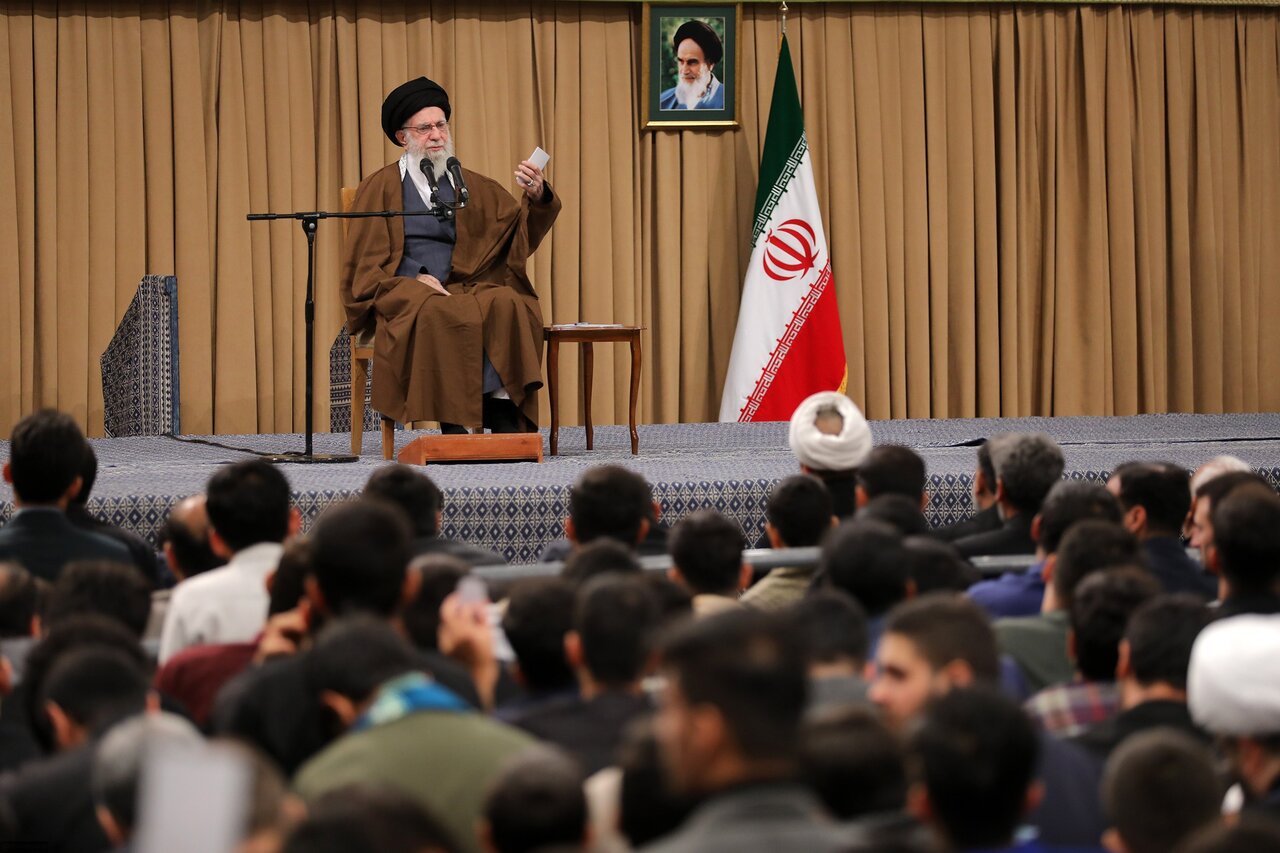
TEHRAN – Leader of the Islamic Revolution Seyyed Ali Khamenei on Monday addressed the prospects of Iran-US normalization, saying that the two countries represent two different currents and that the US needs to take some necessary steps before establishing relations with Iran.
The leader’s remarks came during a meeting with Iranian students to commemorate Nov. 4, the day Iranian students seized the U.S. embassy in Tehran more than 45 years ago. The embassy was used to orchestrate the 1953 coup against the democratically elected Mossadegh government, and was also where U.S. officials plotted against the newly victorious Islamic Revolution in 1979.
“Cooperation with Iran is incompatible with U.S. cooperation and support for the cursed Zionist regime,” Khamenei said, referring to several U.S. statements expressing its intention to cooperate with Iran.
Khamenei said that Washington’s continued support for the Zionist regime, despite its public exposure and condemnation around the world, is meaningless and unacceptable when requesting cooperation from Iran.
The leader of the Islamic Revolution further emphasized that “the United States sometimes says that it is ready to cooperate with Iran. If they stop supporting the Zionist regime, remove military bases from the region, stop interfering in the region, then these issues could be reconsidered. This is not foreseeable at the moment, and it is not foreseeable in the near future.”
In his speech, Khamenei elaborated on the historical hostility between the US and the Iranian state and the scale of the takeover of the US embassy on November 4, 1979. “The takeover of the US embassy by young people can be examined from two perspectives: historical and identity-based.”
From a historical perspective, Khamenei described November 4, 1979 and the courageous actions of the students in the occupation of the US Embassy as a day of honor and victory for the Iranian nation. He stressed that “Iran’s history has had days of victory and days of weakness and decline. Both must be remembered by the people.”
Discussing the identity aspect of this important event, the leader said, “The embassy occupation revealed the true identity of the US government and the true nature and essence of the Islamic revolution.”
Referring to the etymology of the word arrogance (itakbar) in the Qur’an, he explained that it means superiority of oneself. “Nations, like the United Kingdom in one era and the United States today, sometimes grant themselves the right to interfere in their vital interests, to dictate their terms to them, to establish military bases in countries with weak governments or ignorant peoples, to plunder their oil and resources. This is the very arrogance we oppose and protest.”
The Islamic Revolution leader also mentioned the plots of Britain and its allies to neutralize the Mossadegh regime, recalling Mossadegh’s naive approach and dependence on the United States to save Iran from Britain. He added: “The United States smiled at Mossadegh, but behind the scenes it conspired with Britain to orchestrate a coup, overthrow the central government, and extradite the fugitive Shah to Iran.”
Khamenei said that the first encounter between the United States and the Islamic revolution was the hostile resolution passed by the United States Senate. He highlighted the public anger that arose after allowing Mohammad Reza Pahlavi to enter the United States, saying, “The Iranian state felt that by welcoming the Shah there, the Iranian state was repeating the coup of August 19, 1953 and preparing for a return to Iran. As a result, the people took to the streets, demonstrations that included students, and some popular movements led to the occupation of the U.S. embassy.”
The leaders pointed out that the students had originally intended to occupy the embassy for a short period of two to three days in order to reflect the Iranian people’s anger on the world stage. However, “students discovered documents at the embassy that revealed the depth of the problem was greater than expected, and that the U.S. embassy was at the center of a conspiracy plotting to destroy the Islamic revolution.”
Referring to the standard functions of embassies around the world, he explained, “The problem was not intelligence gathering. Rather, by setting up a ‘conspiracy room,’ the embassy tried to organize the remnants of the Shah’s regime, some military personnel, and others to take action against the revolution. Understanding this, the students maintained control of the embassy.”
Khamenei stressed that it is inaccurate to interpret the embassy seizure as the root of the problems between the United States and Iran. “Our troubles with the United States began on August 19, 1953, not on November 4, 1979. Furthermore, the embassy occupation revealed a serious conspiracy and threat to the revolution. By taking this important action and compiling this document, the students exposed the true nature of that conspiracy.”
The leader explained that the main reason for the various hostilities and conspiracies against the Islamic revolution was to remove juicy prey from the hands of the United States and end the United States’ control over Iranian resources. “They are not going to give up on Iran easily and from the beginning they started provoking not only the Islamic Republic but the entire Iranian state,” he said.
He further said that the continued hostility of the United States toward the Iranian people even after the Islamic revolution is proof that Imam Khomeini’s statement, “All cries should be directed toward America,” is true. Khamenei stressed that “American hostility was not just lip service. Since America’s essentially arrogant nature is incompatible with America’s independence-seeking nature, they used all their capabilities: sanctions, intrigues, support for the Islamic Republic’s essential enemies, inciting and supporting Saddam in attacking Iran, downing an Iranian airliner with 300 people on board, propaganda wars, and even direct military attacks.” Islamic revolution. The differences between the United States and the Islamic Republic are not tactical or situational, but substantive. ”
The leader of the Islamic Revolution criticized those who claim that the slogan “Death to America” is the reason for America’s hostility to Iran, calling it a misunderstanding. He clarified: “This slogan is not a reason for the United States to oppose our country. The issues between the United States and the Islamic Republic are essentially irreconcilable and a conflict of interest.”
Referring to questions about whether Iran would engage in relations with the United States, he said, “The inherently arrogant nature of the United States does not accept anything but submission. All American presidents wanted this, but some did not say it openly. The current president has clearly expressed it and revealed the true nature of the United States.”
The leader of the Islamic Revolution said that it was pointless to expect obedience from the Iranian people, considering Iran’s capabilities, wealth, intellectual and spiritual background, and the level of its cautious and motivated youth. He added: “We cannot predict the distant future, but for now everyone should know that the solution to many problems lies in becoming stronger.”
The leader of the Islamic Revolution also took this opportunity to mention Mrs. Fatima (Pbuh) and Mrs. Zainab (Pbuh), encouraging young people to follow the example of these illustrious figures in practice and advising them to “encourage those around you to pay attention to the actions of these great figures and learn from them.”