
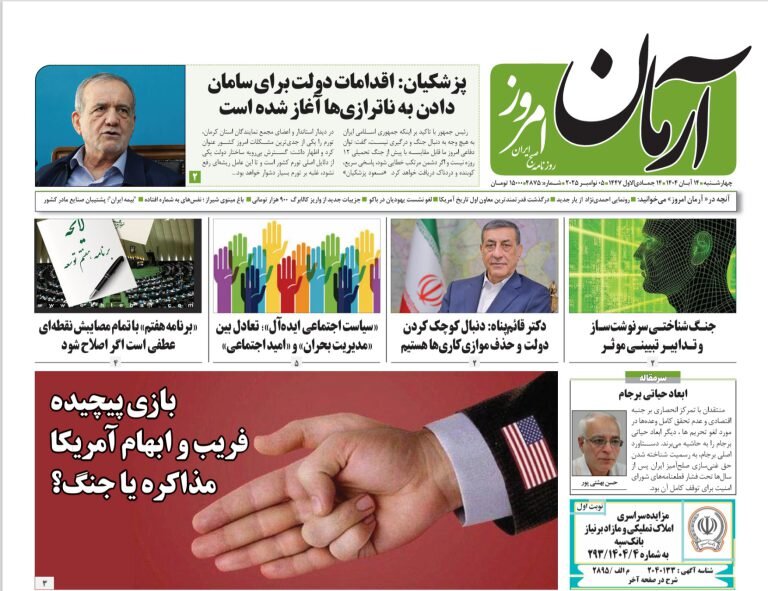
TEHRAN – In a memo, Arman-e-Emrouz reflects on the role of consensus in foreign relations.
The report highlights how the United Arab Emirates has developed into an important economic partner for Tehran, despite having issued multiple public statements against Iran in international forums over the past decade. This coexistence model, characterized by the simultaneous occurrence of tension and cooperation, shows that states can temporarily put aside their fundamental differences and focus on their common interests. The paper argues that this model can also be applied to Iran-US relations. With a population of 85 million people, Iran is young, educated, and passionate about high-quality goods, making it a great opportunity for the American economy. Removing barriers could allow U.S. companies to invest in areas such as technology, the auto industry, agriculture, pharmaceuticals and infrastructure. As a result, Iran will benefit from technology transfer, job creation, and reduced dependence on China. Such cooperation requires a temporary suspension, not a resolution of the conflict. This pragmatic approach not only reduces tensions but also allows both countries to take advantage of economic and security opportunities. Over time, the foundation for building trust and dealing with more serious conflicts can be laid. Diplomatic history shows that practical cooperation often precedes a de-escalation of hostilities.
Mr. Sazandegi: Warning to Iraq
Mr. Sazandegi analyzed the recent telephone conversation between Iraqi Defense Minister Thabet al-Abbasi and US Secretary of Defense Pete Hegseth. Hegseth warned of an impending military operation in the area and urged Iraqi insurgents to refrain from any response, according to the report. The meeting reportedly took place in a “tense but diplomatic” atmosphere. Experts believe the U.S. government is trying to curb the operational autonomy of Iraqi insurgents and prevent Iran’s continued strong influence in Iraq. From Tehran’s perspective, Mr. Hegseth’s tone calling for control of militias against Baghdad could be interpreted as a prelude to justifying unilateral military action by the United States. Iran has consistently warned against violations of Iraqi sovereignty and considers such moves a threat to regional stability. Tehran argues that U.S. military action, even if limited in scope, could increase tensions, strengthen resistance, undermine the effectiveness of Iraqi government forces, and ultimately endanger regional security. Iran argues that this path not only risks destabilizing Iraq, but could undermine Iran’s deterrence and strategic position both in Iraq and the broader Middle East.
Iran: Strategic dialogue must not signal weakness
Javad Mir Golui Bayat, a senior expert on Oman issues, discussed Iran’s strategic approach towards the (Persian) Gulf Cooperation Council in an interview with an Iranian newspaper. He stressed that starting a strategic dialogue between Iran and the (P)GCC is crucial, but it must be based on realistic measures and frameworks that simultaneously recognize the security and political concerns of both sides. He warned that (P)GCC member states must not perceive Iran’s position as a sign of weakness. Such a perception could embolden the other side and lead to exploitation, undermining regional balance and Iran’s power. He stressed that Iran has consistently advocated regional cooperation and taken a number of diplomatic and practical steps to strengthen relations with neighboring countries. Peaceful coexistence and security cooperation between Iran and (P)GCC countries requires deeper mutual understanding, respect for each other’s concerns, and removal of political and military obstacles, but efforts are still in the early stages.
Siasate Rous: US aims to weaken and disarm Iran
Siasate Roos claimed that the United States seeks to dismantle the global anti-imperialist front and seeks cooperation through deception. This goal cannot be achieved without weakening Iran. This article argues that cooperation with the United States requires ending hostility toward the Zionist regime and withdrawing support for the Axis of Resistance. As long as the US government continues to support Israel and interfere in the region, normalization and cooperation will remain impossible. The article argues that the United States ultimately aims to dismantle Iran’s missile, military, and nuclear capabilities and views disarmament as a strategic goal. But Iran has acquired and is actively strengthening the tools it needs to pursue its own path. Greater autonomy, evident in the military, nuclear power, nanotechnology, and medicine, is seen as a driver of national capacity and problem-solving. This spirit of determination and self-confidence is deeply rooted in Iran’s youth, and its fruits will soon be seen, the article concludes.