
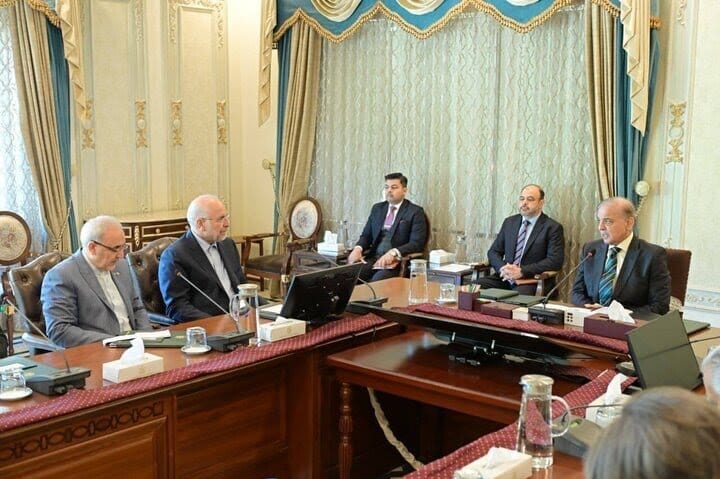
TEHRAN – Iranian Parliament Speaker Mohammad Baqer Qalibaf, who is leading a high-level parliamentary delegation to Pakistan, called for a new phase in Tehran-Islamabad relations, one centered on deeper economic, political and security cooperation.
In a series of meetings with senior Pakistani officials, Prime Minister Qalibaf proposed raising bilateral trade to $10 billion, urging both sides to translate existing agreements into concrete actions and create practical mechanisms to promote economic exchanges.
The visit by Prime Minister Khalibaf and his delegation via Islamabad and Karachi comes at a crucial time for both countries. Regional tensions, changing geopolitical alignments, and the fallout from the recent 12-day standoff between Iran and Israel all highlight the importance of close cooperation between neighboring countries. Qalibaf’s message during his visit was clear. Iran and Pakistan share not only borders and histories, but also strategic interests, and “now more than ever” they need stronger cooperation.
“Trade needs to reach $10 billion – practical measures needed in banking, barter and border markets”
In a meeting with Prime Minister Shehbaz Sharif in Islamabad, Prime Minister Khalibaf stressed that both Iran and Pakistan have the political will and economic capacity to achieve a new level of partnership. “Now more than ever, we need to expand economic, political and security cooperation between our countries,” he told the prime minister, stressing that the agreement reached during the Iranian president’s recent visit to Pakistan should not remain on paper but be actively pursued and implemented.
He proposed a clear roadmap to expand trade to $10 billion by expanding banking partnerships, creating barter and offsetting systems, revitalizing border markets, and streamlining customs procedures. Mr. Khalibaf stressed that the two countries’ economies are complementary in nature, and Iran’s strengths in energy and manufacturing could match Pakistan’s agricultural and industrial needs. What is needed, he said, is “political determination to remove barriers and create mechanisms to make this natural partnership work.”
The Iranian parliament speaker also expressed gratitude for Pakistan’s political support in the recent 12-day standoff between Iran and Israel, calling it a “sign of deep friendship between the two countries.” He briefed the prime minister on details of the conflict, including the timing of the operation, Iran’s response to deterrence and subsequent diplomatic relations with European countries and the International Atomic Energy Agency (IAEA). Khalibaf said regional stability depends on countries like Iran and Pakistan working more closely together on security issues and confronting common threats.
Prime Minister Sharif reaffirmed the strong friendship between Pakistan and Iran, saying that their relationship is rooted in history, faith and mutual respect. He welcomed Iran’s proposals for enhanced economic cooperation and emphasized Pakistan’s support for Iran’s right to peaceful nuclear energy and uranium enrichment. Sharif also rejected European attempts to trigger the so-called “snapback” mechanism, arguing that such measures are unjust and harmful to diplomacy. “Pakistan supports Iran as a partner in peace, progress and regional security,” he said.
“Historic ties between Iran and Pakistan must be transformed into practical cooperation.”
President Qalibaf also met with Acting President and President of the Senate Syed Yusuf Raza Gilani, and the two countries emphasized the historical, cultural and religious ties that bind the two countries. Discussions focused on strengthening parliamentary diplomacy as a means of deepening cooperation on political, economic and security issues. Mr. Gilani supported the government’s decision and emphasized the role of Parliament in ensuring that bilateral agreements lead to practical results.
Both sides reviewed ongoing projects in the energy and trade sectors and discussed ways to strengthen border security to combat cross-border challenges such as smuggling and terrorism. Mr. Khalibaf reaffirmed Iran’s commitment to supporting Pakistan in maintaining peace and stability along its shared border and expressed confidence that strengthened parliamentary cooperation would help the two countries “transform friendly relations into a lasting partnership.”
“Long live the friendship between Iran and Pakistan”
In a separate meeting with Parliament Speaker Sardar Ayaz Sadiq, Prime Minister Qalibaf expressed gratitude to Pakistan’s parliament for its solidarity with Iran during the recent conflict with Israel. He praised public statements and parliamentary resolutions by the Pakistani people and parliamentarians condemning the Iranian attack, calling such actions “proof that our brotherhood transcends politics.”
Sadiq said Iran is a reliable neighbor and consistently supports Pakistan in difficult times. He announced plans to form an Iran-Pakistan Friendship Parliamentary Group tasked with drafting a new roadmap for strategic cooperation. In the coming months, senior parliamentary officials from both countries will prepare a joint framework to expand economic, political and security cooperation.
Mr. Khalibaf signed the parliamentary guestbook and presented Mr. Sadiq with a souvenir featuring symbols of Iranian and Pakistani culture. Later, in a post on X (formerly Twitter), he said, “Long live the friendship between Iran and Pakistan,” and asserted that strengthening bilateral relations was the central purpose of his visit.
“Israel is a common enemy of Iran and Pakistan.”
On the third day of his trip, Qalibaf visited Karachi, Pakistan’s largest commercial hub, where he was received by provincial officials, including Syed Owais Qadir Shah, and Akbar Issazadeh, Iranian Consul General in Karachi. After arriving, Mr. Qalibaf visited the mausoleum of Pakistan’s founding father Muhammad Ali Jinnah, paid his respects and laid flowers.
He is scheduled to meet with the Speaker of the Provincial Assembly and address the Iran-Pakistan Business Forum, where he will present Iran’s vision for economic cooperation centered on trade facilitation, energy integration and industrial linkages. The business forum will bring together key figures from the private sector from both countries to discuss investment opportunities in the energy, construction, manufacturing and transportation sectors.
Karachi’s role as a regional trade gateway gives Qalibaf’s presence there both symbolic and practical importance. The visit aims to move economic cooperation from rhetoric to reality by highlighting Iran’s willingness to expand direct trade routes, banking institutions, and industrial joint ventures.
“Unification of the Islamic world is the only way to fight against aggression.”
In a speech to academics, clerics and politicians at the Iranian embassy in Islamabad, Qalibaf praised the Pakistani people’s support for Iran in the recent military conflict, saying “Pakistan’s voice of unity has resonated throughout the Islamic world.” He said this support was one of the main reasons he chose Pakistan as his first overseas destination after the conflict.
Mr. Khalibaf called for greater unity among Islamic countries and asked for cooperation not only in politics and defense, but also in science, technology, and education. “A strong and independent Islamic world must be strong in all areas, from knowledge and industry to culture and defense,” he said. He criticized the “dual policy of imposed peace and imposed war” and warned that normalization with Israel under such circumstances would weaken the independence of Islamic countries. Instead, he appealed for solidarity, mutual respect and cooperation among Islamic countries as the basis for long-term regional stability.
Mr. Qalibaf’s visit is a combination of diplomacy, economic advocacy, and a symbolic gesture of solidarity, reflecting Iran’s renewed push to expand its regional partnership through practical engagement.
“Our two countries have always come together in difficult times. Now is the time to move together towards building a future of shared strength, stability and prosperity,” Prime Minister Khalibaf concluded in Islamabad.