
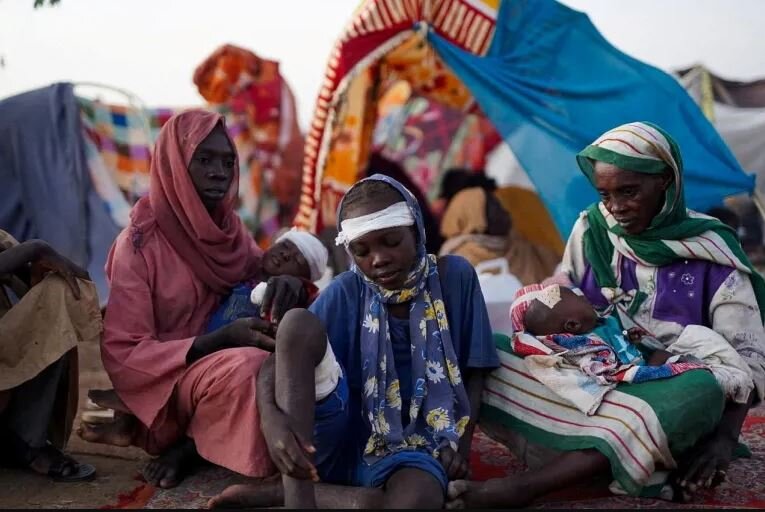
TEHRAN – In days when the sounds of gunfire and the cries of defenseless children in the city of El Fasher shattered the silence of the world, the Islamic Republic of Iran once again demonstrated that politics and morality can be linked in moments of human tragedy.
The recent telephone conversation between Iranian Foreign Minister Seyyed Abbas Araghchi and Sudanese Foreign Minister Mohi al-Din Salem was more than just a diplomatic exchange, it was a reflection of Iran’s moral and people-centered diplomacy in the international arena, a diplomacy that relies on human dignity and national sovereignty rather than power games.
While many Western countries have been limited to issuing performative statements or speaking behind the scenes, Iran continues to fuel the conflict itself, publicly condemning the killing of civilians and reaffirming its support for Sudan’s territorial integrity. This position is a natural continuation of the Iranian government’s consistent policy in other crises, such as Syria, Yemen, and Palestine: to protect legitimate governments from separatism and foreign interference.
Today, Sudan is the victim of regional and transregional rival states that proclaim human rights but in reality seek resources, influence, and new markets. But Iran approaches this issue not because of its oil or power base, but from a position of respect for the Muslim Brotherhood and the right of nations to self-determination. This stance distinguishes Iran from the interventionist policies of the West and positions it as a responsible actor within the Global South.
The message of Araghchi’s call to Khartoum was unmistakable. The Islamic Republic of Iran condemns violence, genocide and injustice wherever it occurs and stands firmly with the oppressed. Iran aims to be a voice for justice and humanity in a region that has long been exploited by the greed of global power brokers. At a time when Western countries have turned even human rights into a tool of political pressure, Iran speaks of peace and unity in Sudan in the language of dignity and Islamic principles, speaking not out of temporary gain but out of deep faith in humanity.
Ups and downs in Tehran-Khartoum relations
Iran’s return to Khartoum has far deeper implications than the resumption of normal diplomatic relations at a time when the world order is undergoing transformation and countries from Asia to Latin America seek to establish independence from traditional spheres of power. It represents a political and civilizational awakening in the Global South against hegemonic systems that have imposed an unjust world order through media control, economic coercion, and military force for decades.
Iran and Sudan share a long history of bilateral relations, with roots dating back to the years after Iran’s Islamic Revolution and when both countries sought to establish independent identities free of colonial dependence. In the 1980s, the Tehran-Khartoum partnership was established not simply on the basis of mutual benefit, but on the basis of shared anti-colonial ideals. While Iran, reborn after the revolution, emerged as a model of resistance and independence for many Islamic and African countries, Sudan was guided by its own Islamic rule and drew inspiration from its example.
In the 1990s and 2000s, cooperation between the two countries expanded to include education, agriculture, health care, and even defense. The partnership became part of Iran’s broader cultural and political presence in Africa, an entity aimed at countering Western-imposed isolation and strengthening the unity of the Islamic ummah.
However, the path was not always smooth. From 2014 to 2016, political and financial pressure from Saudi Arabia and the United States forced Sudan to sever ties with Iran. Its participation in the Saudi-led coalition in the war in Yemen was also a result of that pressure, reflecting external coercion rather than domestic will.
After the ouster of Omar al-Bashir and the subsequent political reorganization of Sudan, Khartoum aimed for a more balanced foreign policy. At the same time, Iran, which adopted an “East and South” strategy in response to Western sanctions and pressure, saw it as an opportunity to restore historic relations with African countries. This process culminated in the resumption of official diplomatic relations between Tehran and Khartoum in October 2023, a symbolic moment marking not only Iran’s return to Africa but also the reassertion of an Islamic vision of justice on the continent.
A focus on the newly discovered Red Sea
The significance of Iran’s new presence in Khartoum cannot be understood without recognizing Sudan’s geopolitical position. Located along the western coast of the Red Sea, Sudan is blessed with one of the world’s most strategic corridors, the maritime route linking the Gulf of Aden and the Bab el-Mandeb Strait to the Suez Canal. Whoever has influence here will control key arteries of world trade and energy.
In recent years, the United States, the Zionist regime, Saudi Arabia, and the UAE have built military bases and networks of influence along the Horn of Africa in an effort to control the region. Against this background, Iran’s presence in Khartoum represents a strategic and indigenous response. Rather than seeking domination, Tehran advocates cooperative security and emphasizes that peace in the region must be built by the countries themselves, not through foreign militarization.
Iran’s successful experience in the Persian Gulf and the Sea of Oman shows that true stability comes from regional cooperation, not from external intervention. These same principles could guide Iran’s involvement in the Red Sea, where cooperation with Sudan, Eritrea, and other African countries can ensure maritime security, curb smuggling, and protect trade routes without Western interference.
Beyond the geopolitical realm, the intellectual and civilizational aspects of Iran-Sudan relations are of equal importance. Our partnership represents the foundation of the broader South-South Cooperation movement, a global trend rooted in equality, shared growth and mutual respect between developing countries. Originally conceived as a response to the unequal distribution of wealth and knowledge between the developed North and the poor South, the movement has been reinvigorated by the participation of Iran, China, India, Brazil, and many African countries.
Within this framework, the Iran-Sudan partnership could evolve into a new development model that does not rely on the dictates of the IMF or World Bank and instead focuses on local capacity, renewable energy, education, and affordable technology. Iran’s achievements in pharmaceuticals, nanotechnology, and agricultural engineering will be invaluable to Sudan’s recovery. Meanwhile, Sudan’s vast mineral wealth, fertile land, and access to public waters make it a natural partner for Iran in building an interconnected Global South.
justice against supremacy
In today’s world, where the media has become a battleground for world powers, Iran’s soft power is more essential than ever. In parallel with the deterioration of relations with Tehran and Khartoum, Western media outlets have launched waves of negative propaganda, ranging from claims of drone supply to allegations of military intervention. These narratives are part of a broader Western campaign to suppress independent voices from the Global South.
However, the reality is clear. Iran’s objectives in Sudan are neither military nor expansionist. The Iranian government seeks stability, unity, and resistance to outside interference. The condemnation of the massacre of civilians in El Fasher and the call for dialogue and reconciliation reaffirm that Iranian diplomacy is based on moral, just, and humanitarian principles consistent with its stance on Yemen, Syria, and Palestine. This is the essence of Iran’s moral diplomacy. A policy inspired by Islamic teachings and cultural integrity, aimed not at domination but at liberating humanity from exploitation and oppression.
Tehran’s return to Khartoum is therefore more than a bilateral milestone. It is part of a broader transformation that will reshape the future world order. The world no longer revolves around the West. As Asia rises economically, Latin America asserts its independence, and Africa awakens politically, Iran seeks to build bridges of justice and solidarity between the East and Africa.
In this evolving landscape, Khartoum stands as a symbol of Iran’s globalization of justice, proving that true power lies not in weapons and wealth, but in truth and humanity. Iran’s return to Khartoum is a return to its own historical and civilizational essence and a reaffirmation of the revolution’s founding principles of an Islamic Republic, neither East nor West.
This is not a tactical choice, but a natural continuation of Iran’s enduring path of pursuing justice, unity, and independence. Today, the echoes of this slogan resonate stronger than ever on the shores of the Red Sea and across the African continent. Iran and Sudan can become two wings of a single flight into a world where power is measured not by force but by conscience and compassion. In fact, Tehran’s return to Khartoum is a step toward reviving the world’s moral conscience, the conscience of nations determined to resist domination and build a new, just world order.