
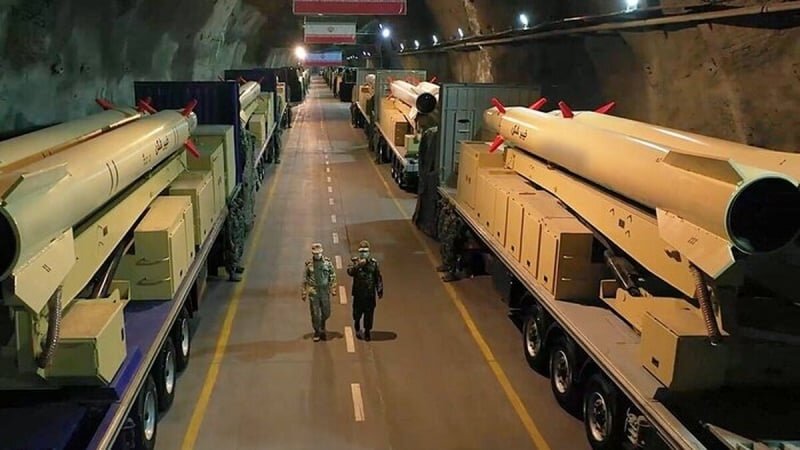
TEHRAN – A senior Iranian military commander said the Iranian military has not yet demonstrated much of its capabilities.
Brigadier General Hassan Hasanzadeh, commander of Iran’s Islamic Revolutionary Guard Corps (IRGC) in Tehran, added that during the 12-day war against Iran imposed by Israel, Iran stood up to the Israeli regime and the United States, which was tantamount to defeating the entire NATO.
He said the United States is furious with Iran’s military power, adding that the Israeli regime is on the brink of collapse and will do whatever it can to survive.
On June 13, Israel launched an open and unprovoked act of aggression against Iran, sparking a 12-day conflict that claimed the lives of at least 1,064 people, including military commanders, nuclear scientists, and civilians. The United States also entered the war by bombing three Iranian nuclear facilities, a blatant violation of international law.
In retaliation, the Revolutionary Guards carried out a series of precisely planned missile and drone strikes over 12 days. These targeted attacks, deployed in 22 different operational waves, effectively dismantled critical Israeli military, intelligence, and technological infrastructure, ultimately forcing a cessation of hostilities. Since then, Iran has consistently affirmed its readiness to respond vigorously to any military aggression or any move that threatens national security.
Over the past few decades, Iran has made remarkable progress in its missile industry, successfully developing a comprehensive range of state-of-the-art missiles domestically. The Iranian military deployed these locally developed missiles to counter the Israeli regime’s acts of aggression. Throughout the 12 days of this forced war, Iran launched more than 500 ballistic, cruise, and hypersonic missiles. These included missiles like the “Emad”, known for its pinpoint accuracy. Highly maneuverable “Keival Shekan”. “Hajj Kasem” in the middle distance. The first deployed “Segil” boasts a range of 2,000 kilometers and hypersonic speed. These attacks had a serious and multifaceted impact on Israel’s military-industrial infrastructure.
However, analysts argue that Iran refrained from using a significant portion of its available weapons during the conflict. Iranian attacks succeeded in hitting several key targets in the occupied territories, including Kirya (often referred to as Israel’s “Pentagon”), Camp Moshe Dayan (a training and operations center for military intelligence officers), Tel Nof (one of the most fortified air bases in the occupied territories), Nevatim (Israel’s main base for operating US-made F-35 stealth fighter jets), and Hatzerim (another important air base). and Ovda Air Base, an important Israeli military facility that reportedly houses command and control systems and electronic warfare capabilities.
Iranian Foreign Minister Abbas Araghchi said in an interview with Al Jazeera published last week that Tehran now has greater preparations and capabilities than it did during the 12-day war. “The only way to prevent war is to prepare for war,” he told a rally in Iran’s western Hamedan province days later.