
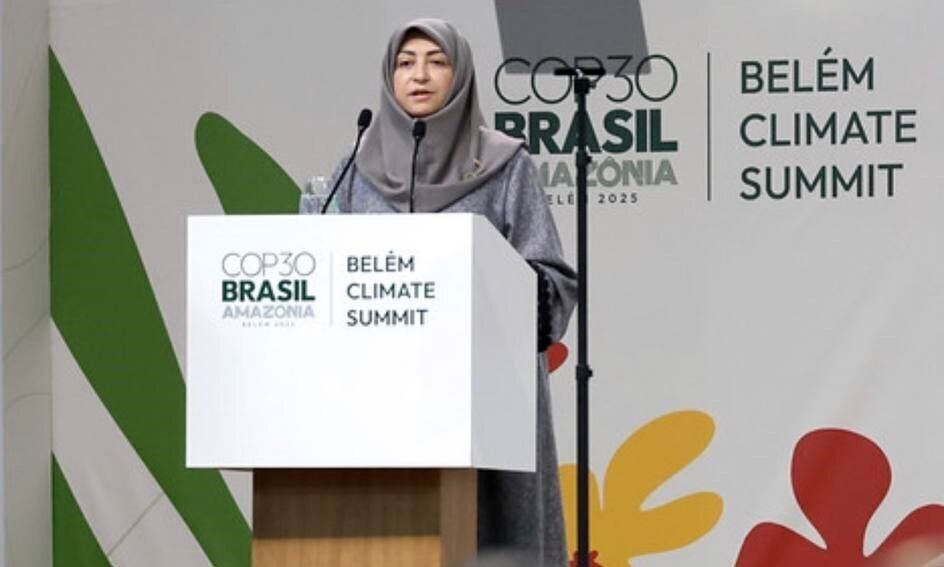
TEHRAN – Despite facing unilateral coercive measures and limited access to modern technology, knowledge, financial support and foreign investment, the Islamic Republic of Iran has made significant progress in adapting to climate change, the head of the Department of Environment (DOE) said, while considering further steps to take in the coming years.
“In recent years, all countries participating in this conference have pledged to protect the environment by reducing greenhouse gas emissions, adapting to climate change and moving towards the use of renewable energy sources,” said Sina Ansari.
The official was speaking ahead of the 2025 United Nations Climate Change Conference, commonly known as the 30th Conference of the Parties (COP30), scheduled to be held in Belem, Brazil, from November 6 to 21.
The full text of Mr. Ansari’s speech is below.
in the name of god
Mr. President,
Distinguished heads of state and representatives,
Ladies and gentlemen,
First of all, I would like to express my sincere gratitude to the government and people of Brazil for hosting COP-30 in Belem.
This gathering could provide countries with a rare opportunity to take real, fair and comprehensive action to address the environmental crises and challenges facing the planet.
In recent years, all countries participating in this conference have pledged to protect the environment by reducing greenhouse gas emissions, adapting to climate change, and moving towards the use of renewable energy sources.
The Islamic Republic of Iran has achieved remarkable development despite facing unilateral coercive measures and restrictions on access to modern technology, knowledge, financial support and foreign investment, while considering further steps to take in the coming years.
In the past year alone, Iran has increased solar energy capacity by 75 percent, expanded wind power generation, added to previous nuclear power capacity growth targets, joined the BRICS carbon market, and reduced carbon emissions through efficient flaring management in its oil and gas fields, including a reduction of 10 billion cubic meters and a further reduction of 12 billion cubic meters planned over the next four years.
Therefore, transitional fuels and enhanced energy efficiency management projects are underway to strengthen the country’s resilience to the negative effects of climate change.
These measures demonstrate Iran’s firm commitment to environmental protection. It also underlines that, despite the challenges mentioned, the Islamic Republic of Iran continues to strive to protect the right of its citizens and others to a clean and healthy environment.
This doesn’t mean we’re overlooking major environmental challenges, such as prolonged drought, an approximately 1.8 degree rise in temperature, and a 50 millimeter decrease in rainfall over the past 50 years.
Rather, it emphasizes that the Islamic Republic of Iran continues its efforts despite all obstacles and despite being deprived of the guaranteed technology transfer envisaged in the treaty.
Mr. President,
The United States, in coordination with its regional proxy, the Zionist regime, launched a military invasion against the Islamic Republic of Iran.
This act not only violated international law and constituted a war crime, but also caused widespread and lasting environmental damage. The most severe impact was that more than 50,000 tons of carbon emissions were released in Tehran alone. The reckless attack on Iran’s peaceful nuclear facilities was a blatant and premeditated crime that could have caused one of the world’s greatest environmental catastrophes.
Ladies and gentlemen,
The Islamic Republic of Iran continues to believe in the power of international cooperation, while remaining firmly aware of the inherent environmental and humanitarian threats.
Iran stands ready to share local knowledge and experience and engage constructively with other countries and international organizations to advance common environmental goals.
We are the inheritors of one earth and one destiny. May we act with respect and justice so that we can pass on a sustainable legacy to future generations.
environmental diplomacy
On the sidelines of COP30, the Energy Secretary has previously met with counterparts, officials, representatives of other countries and the United Nations.
Doe.ir reported that Ansari met with the United Nations Framework Convention on Climate Change (UNFCC) Secretary-General Simon Steele and detailed the country’s steps to curb greenhouse gas emissions and expand renewable electricity generation capacity over the past year, despite unjust sanctions that have deprived Iran of access to international funding and cutting-edge technology.

Other measures the official mentioned include reducing flaring at oil fields and approving climate change management plans.
Mr. Steele praised Iran’s efforts and announced that the UNFCC Director-General would hear the country’s voice and support its measures and efforts.
In a meeting with Ana Claudia Rosbach, Executive Director of the United Nations Human Settlements Program (UN-Habitat), Ansari stressed the need for comprehensive urban planning to mitigate the effects of climate change and improve the sustainability and resilience of cities in the face of rising heat.

“Despite economic and climate challenges, Iran is doing its best to leverage regional and global scientific capabilities to make cities more sustainable,” she said.
Mr. Rosbach emphasized the effective role of the United Nations Resident Office in Iran. The official stressed the need to strengthen joint efforts in improving urban management and climate risk management, as well as improving the quality of urban life.
In a meeting with Croatian Minister of Environmental Protection and Green Transition Marija Vukovic, both sides emphasized the need to promote environmental cooperation between the two countries. IRNA reported that Ansari noted that promoting scientific interaction would improve national capacity in environmental conservation and expressed Iran’s readiness to share expertise on protected areas, water and wetland resources, and industrial pollution control.

Mr. Vukovic said that expanding environmental cooperation would help promote Croatian-Iranian relations. She invited Ansari on an official visit to Croatia.
Ansari also discussed environmental issues in a meeting with Amna bint Abdullah Al Dahak Al Shamsi, UAE Minister of Climate Change and Environment.

Minister Ansari noted the increasing impacts of climate change on the environment, biodiversity and urban areas, particularly in West Asia, and called for strengthening bilateral relations to increase adaptive capacity and resilience.
Mr. Al Shamsi reaffirmed the push for joint efforts and called for the implementation of last year’s agreement, which focused in particular on combating sand and dust storms.
COP30 brings together world leaders, scientists, non-governmental organizations and civil society to discuss priority actions to tackle climate change.
It will focus on the efforts needed to limit global temperature rise to 1.5°C, the presentation of new National Action Plans (NDCs), and progress on financial commitments made at COP29.
The COP30 action agenda will be organized around six key areas that reflect the breadth and urgency of action needed to fulfill the collective commitments under the Paris Agreement and previous COPs. Forest, ocean and biodiversity management. Transforming agriculture and food systems. Building resilience in cities, infrastructure and water. Promote human and social development. Cross-cutting enablers and accelerators.
MT/MG