
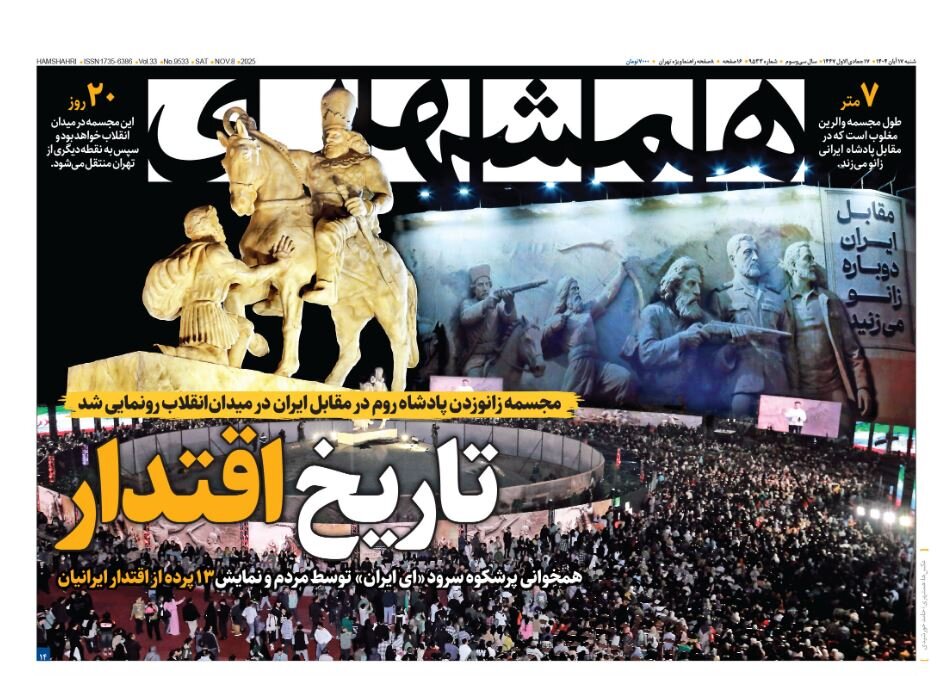
TEHRAN – Hamshahari analyzed Donald Trump’s recent statements. President Trump declared in a recent statement that “I was largely responsible” for Israel’s attack on Iran.
The US president made the remarks during a meeting with reporters at the White House on Thursday night. His remarks further completed the puzzle of the negotiation trap set before Iran. It is a trap with two main methods: sanctions and military invasion. While President Trump has sought in recent months to portray himself as a peace negotiator, his admission of involvement in the Zionist regime’s 12-day war against Iran reveals a more complete picture of the bellicose posture of the Trump-Netanyahu axis. A key aspect of this posture is the strategic use of negotiations as a trap for Iran. Moreover, the president’s latest comments add another element to the domino chain of falsehoods he has spread about Iran. Falsehoods that have surfaced in various forms over recent weeks and months. The Israeli regime’s current admission of direct involvement in the attack on Iran is in stark contrast to the US’ previous denial that it had “nothing to do” with the attack.
Kayhan: “Don’t look to American synagogues for solutions to Iran”
Examining Trump’s failed approach, Kayhan writes: Following his own unique model, Trump believes that threats will force rivals to agree. However, the United States’ unilateral strategy of extracting concessions from China, Russia, and Iran has failed. Even military attacks on Iran’s nuclear facilities have not led to a change in Iran’s nuclear policy, much less a change in its fundamental political position. Interestingly, some people still believe that America is so powerful that it can impose its desired policies on its enemies and rivals with no escape. It is surprising to hear such claims in Iran, given that few countries have experienced as much conflict with the United States as Iran, and have emerged as a regional power by rejecting the United States. Those who, despite America’s hostility, still look to American synagogues for a solution to the Iranian problem are not only on the wrong path, but will never reach their destination. America today lacks the ability, even if it has the will, to solve the Iranian challenge.
Mr. Arman e-Meri: Iran’s dialogue-oriented approach
In his commentary, Arman-e-Meri emphasized Iran’s commitment to peaceful engagement. “While the State strives to prevent tension, conflict and war, it attaches equal importance to peaceful dialogue and negotiations to reach mutual agreements in the pursuit of peace and reconciliation,” the newspaper said. The Islamic Republic of Iran has long supported regional and global stability, consistently championed negotiation and dialogue, and demonstrated its commitment on a variety of international issues. This approach is evident not only in Iran’s position on the nuclear deal (JCPOA), but also in its active participation in various treaties, treaties, and organizations. Iran’s engagement with the Shanghai Cooperation Organization, BRICS, and the D-8 group of developing countries reflects Iran’s enduring diplomatic stance. Nevertheless, it is Iran that remains committed to negotiations while Western countries have repeatedly abandoned the negotiating table.
Mr. Sharg: Ignoring the Caucasus is a dangerous gap in diplomatic strategy
While Iran’s foreign policy has largely focused on key issues such as nuclear negotiations, tensions with the United States and Europe, the possibility of a new conflict with Israel, and broader Middle East power relations, the South Caucasus issue has been sidelined. However, development on Iran’s northwest frontier is progressing rapidly and, if left unchecked, could have long-term costs to national security. Azerbaijan is taking advantage of the distraction from Iran and Russia to advance its project to shift the region’s geopolitical balance in favor of the West. In this context, Iran urgently needs to recalibrate its Caucasus policy along three strategic axes: strengthening political ties with Armenia and expanding economic cooperation with Armenia as Iran’s only land route to the north. Furthermore, in order to curb the expansion of NATO’s influence in the region, Japan should activate multilateral diplomacy with Russia, China, and Central Asian countries, and take a deterrent stance against geopolitical changes that threaten Iran’s interests. The Caucasus is no longer a peripheral region. It has become a direct arena for global competition. Delays in decision-making could pave the way for strengthening the NATO corridor and strategically containing Iran.