
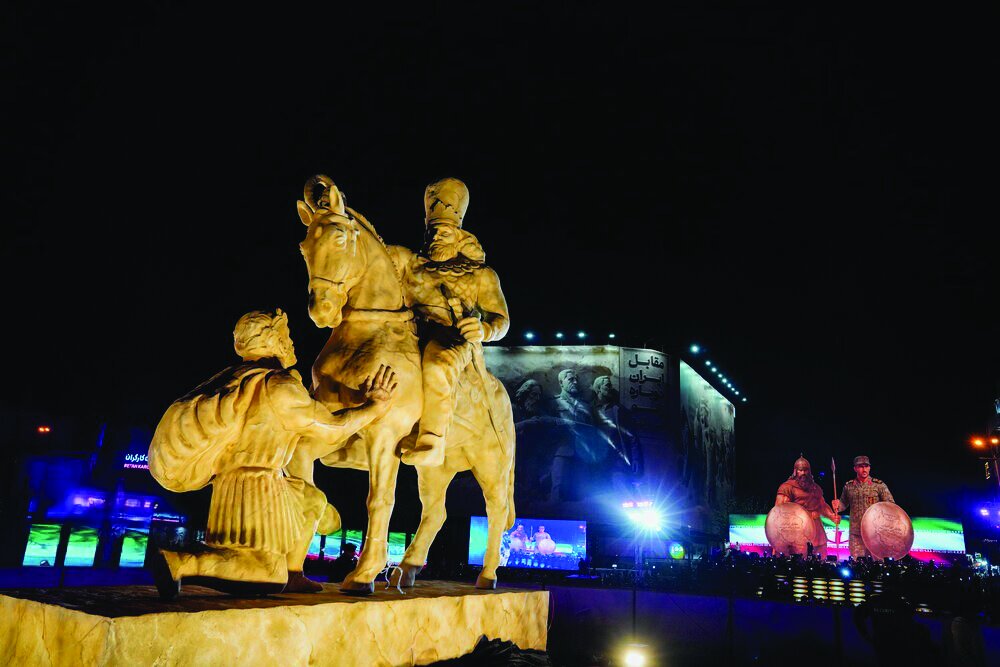
TEHRAN – Hundreds of people spent Friday night in Tehran’s Enherab Square, waiting for the unveiling of a statue depicting events from nearly 2,000 years ago.
As the curtains were pulled back and the fireworks started, carved stones imitating the ancient rock reliefs of Naqsh-e Rustam were revealed. It depicted the Sassanid Shahpur I of Iran seated on a horse, with the Roman emperor Valerian (some historians suggest the Arab emperor Philip) kneeling before him. Behind the statue was a large mural that read, “You will kneel again.”
Iran is the oldest continuously existing country, with a history spanning at least 4,000 years. It is no surprise that a civilization that has lasted this long has faced many enemies throughout its history. Greeks from 492 to 490 BC. Arab invaders in the 640s. and the Mongols in 1219 AD. The Roman Empire was Iran’s main rival and enemy for several centuries of Iran’s history, especially during the Sasanian period. The statues in Tehran specifically depict the Battle of Edessa, which took place in 260 AD. There is an important reason why this particular event was chosen for exhibition in Tehran in 2025.
“We need to understand the scale of this event. Shapur I accomplished something previously unthinkable,” said Dr. Solor Khorashadi, associate professor and head of archeology at Tarviat Modares University. “He not only defeated the Roman army, but captured the Roman Emperor himself along with his senior commanders and senators. It was an unprecedented humiliation for Rome and an unprecedented victory for Iran. Shapur recognized this legacy and ordered that this victory be made permanent. The rock relief was his answer, and now this statue continues that act of remembrance.”
This was not an isolated battle, the professor added. This was a pivotal chapter in a much older epic story that is often seen as an implicit struggle between East and West, dating from the time of Herodotus to the Persian-Greek Wars.
“In the Roman worldview, the Orient was considered a space in need of “civilization.” The concept of “savage” was used to justify domination. So when Shapur brought the proud emperor to his knees, it was more than just one king capturing another. It was a powerful symbol of Eastern fortitude in resisting Western expansion. As the reliefs show, it was the fall of Western pride in the face of the indomitable spirit of the East,” Dr Khorashadi explained.
The idea for the “Defeated Valerian” statue arose from expert discussions about national identity and how to express the story of resistance, said Davud Ghoudarji, Tehran’s deputy city services and environment officer.
“Here at the Department of Urban Services and the Urban Beautification Organization, we have long been interested in projects that not only fill physical spaces, but also imbue cities with cultural meaning,” he explained.
Gowdarji said that during a meeting to consider designs related to Iranian and Islamic history, the conversation turned to the battle between the Sasanian King Shapur and Emperor Valerian, and the famous rock carvings at Naqsh-e Rustam commemorating it. “This event is a powerful expression of Iran’s historical strength. We then collaborated with renowned artist and sculptor Peyman Ghanem, who helped us transform this concept into a concrete design. Ghanem’s deep understanding of history and command of modern artistic language enabled us to reinterpret this historical story as a contemporary public art piece.”
Goudarzi said local authorities hope that Tehran residents will encounter more than just sculptures as they pass through Enhrab Square and head toward Azadi Square. The local government wants them to experience a piece of living history. This story connects them to their roots and serves as a powerful reminder that the Iranian people have never and will never bow to any foreign power.
“Our message is about dignity, national confidence, and hope. When public art is fused with a thoughtful identity, it becomes a powerful voice for a nation’s resilience and strength. Our goal is to carry this spirit from ancient sculpture to the heart of modern cities, reminding everyone that Iran is a nation that has always stood strong.”
Citizens gathered at Enherab Square on Friday seemed to have mixed emotions. Pride was certainly one of them. “It’s amazing how history repeats itself. We fought against the West thousands of years ago and we continue to do so today,” said Hamed, a 17-year-old high school student who filmed much of the event. “But I believe that we can win again precisely because history repeats itself. I believe that the pressure and aggression that we experience today from the Western world will eventually subside, just as it was felt during the reign of King Shahpur.”