
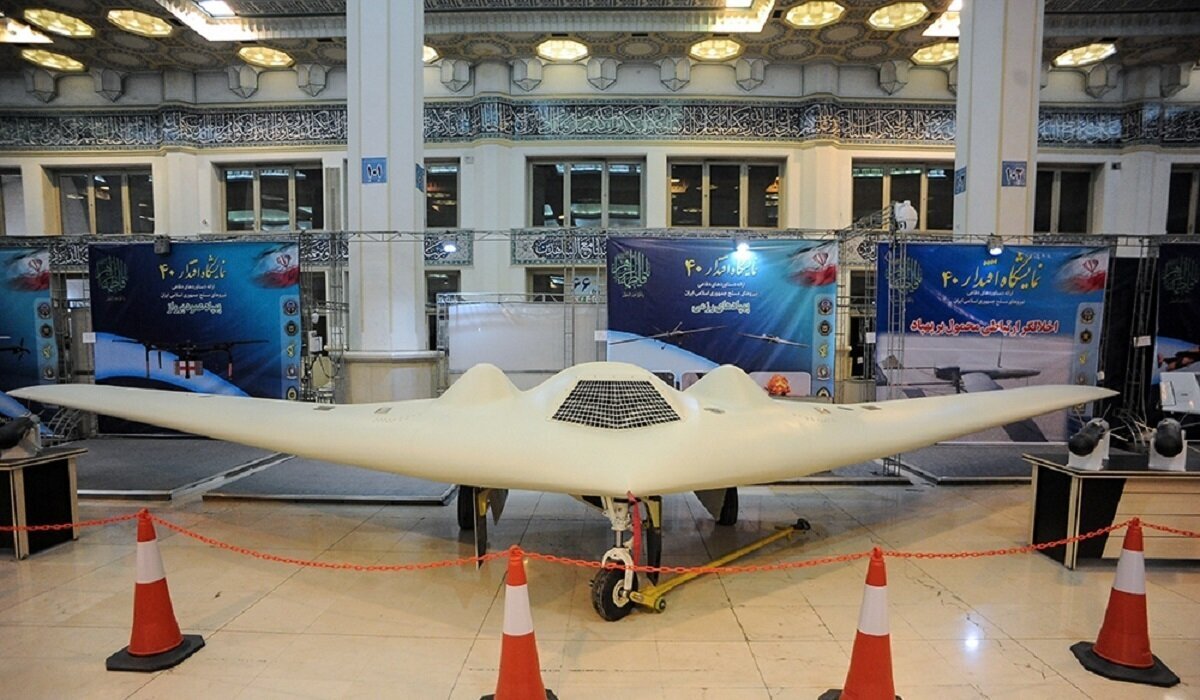
TEHRAN – Experts from Iran’s Islamic Revolutionary Guards Corps (IRGC) aerospace department tested the engine of the domestically produced unmanned aircraft Shahed-161.
The unmanned aerial vehicle has a range of 150 kilometers, a flight duration of two hours, and a maximum flight altitude of 26,000 feet. Designed for reconnaissance, surveillance and combat missions. Although the Shahed-161 was first introduced many years ago, Iranian scientists and engineers have continued to fine-tune the weapon and incorporate new innovations.
The test was conducted during an exhibition showcasing the achievements of the IRGC’s aerospace sector, held at the National Aerospace Park.
At the exhibition, IRGC also displayed advanced versions of other drones in the Shahed family, including Shahed 131, Shahed 171, Shahed 191, and Shahed 238.
Iran deployed indigenous drones against Israel alongside missiles during the Iranian regime’s 12-day military invasion of the Islamic Republic in June.
Iran’s advances in drone technology come against the backdrop of illegal Western sanctions against the country.
How did the headline-grabbing drone come about?
Deprived of access to global defense markets, the Islamic Republic’s security establishment was forced to look inward after the Western-backed Shah was overthrown more than four decades ago. It became a matter of strategic survival rather than a political choice. National plans such as the Comprehensive Aerospace Development Plan and the Sixth Five-Year Development Plan formalized that direction, turning technological self-sufficiency into a guiding principle. That pressure has given rise to a domestic drone industry that is adaptable and efficient, capable of producing functional and affordable systems that combine simplicity, low cost, and operational efficiency.
Drones thus became the answer to Iran’s structural defense dilemma. This enables low-cost intelligence, surveillance, and reconnaissance. Projection of force without human casualties. And domestic production is protected from external constraints.
The Shahed family embodies this philosophy of sufficient technology, mass production, and industrial resilience. In a world of global asymmetry, Iran has managed to turn scarcity into a strategy and sanctions into an incentive to innovate.
The role of Iranian drones cannot be understood without looking at the geopolitical chessboard on which Iranian strategy plays out. Surrounded by U.S. military bases and facing regional rivals such as Saudi Arabia and Israel with privileged access to Western technology, Iran has articulated the principle of deterrence by denial, rooted in asymmetric warfare. Within this framework, UAVs have become the most versatile and effective means of defensive posture.
According to the report, Iranian drones are sold to countries in Europe, Asia, Africa, and South America. American media claims that countries that cannot purchase weapons from Tehran, like the United States, are trying to replicate its designs.