
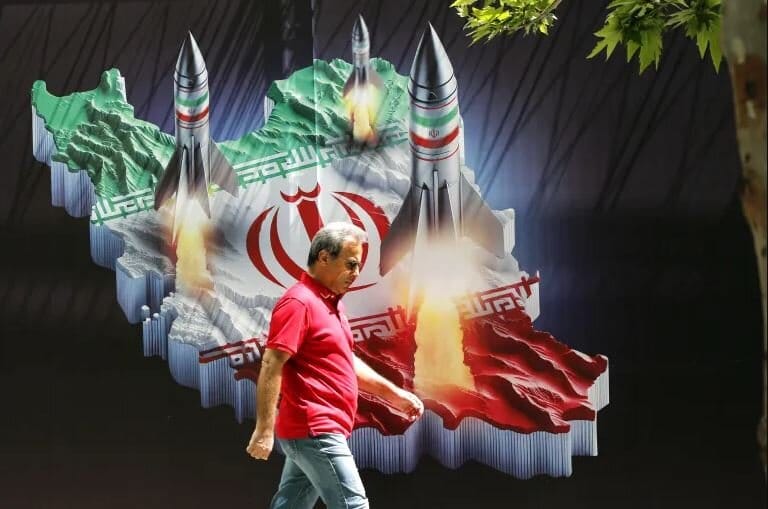
MADRID – In West Asia, the illusion of control is often more convincing than control itself. Iran policy, characterized by external pressure and an obsession with “regime change,” has repeatedly shown that simple solutions are actually dangerous mirages.
A recent leak to Israeli public broadcaster KAN, in which a senior official called for the “overthrow of the Iranian regime” by the end of the Trump administration in January 2029, adds a new chapter to a strategy whose ineffectiveness has repeatedly been proven. But behind the belligerent rhetoric, a more sober argument is emerging. In other words, Israel’s strategy based on coercion and destabilization is not only failing, but actively strengthening the very system it seeks to destroy. What remains is a desperate gamble, a show of force launched after Israel exhausted its capacity for surprise attacks during the June war without causing a single significant defection.
The dominant narrative in Washington and Tel Aviv depicts the Islamic Republic as a colossus with feet of clay, constantly on the verge of implosion. That’s a dangerously simplistic reading.
Iran’s political system has repeatedly demonstrated an often overlooked resilience. To assume that a combination of threats, sanctions, and targeted attacks could precipitate its collapse is to ignore four decades of adaptation and consolidation under near-constant external pressure. Far from collapsing, the Islamic Republic has learned to turn external aggression into a source of internal legitimacy. This is because each challenge is seen not as an attack on its power, but on the revolutionary sovereignty of the state.
The June 2025 war marked a turning point, an event that goes beyond the headlines and deserves sober consideration. This attack was undoubtedly significant and was presented as a devastating blow to Iran’s capabilities. But what happened next was more revealing than the impact of the bomb itself. There were no popular uprisings, no protests demanding the dismantling of the defense program, no signs of rifts in organizational loyalties.
In contrast, the national response was systematic, including rebuilding facilities, relocating critical infrastructure, and accelerating underground projects. Satellite images of the Natanz crater, now covered in dirt, do not symbolize defeat, but rather a will to resist and bounce back, something Iran’s adversaries cannot seem to appreciate accurately.
This episode highlighted Israel’s major strategic failure. For decades, Israel’s security principles have relied on reliable deterrence through overwhelming military superiority.
However, the large-scale attack in June exposed the limits of that approach. It did not deter Iran from continuing its nuclear activities within the framework of its civilian program, nor did it change Iran’s strategic resolve. Worse, it may have had the opposite effect, accelerating and strengthening Iran’s defense program, now more dispersed, protected, and determined than ever before.
Even more revealing was the ensuing intimidation campaign, which was notable for both its scale and ineffectiveness. Widely reported reports say Mossad made cruel phone calls to Iranian officials, and direct threats even extended to their families.
This level of pressure, more reminiscent of a spy thriller than a realistic security operation, failed to achieve its objective. It did not cause defections, leaked recordings, or visible signs of panic. On the contrary, it probably strengthened the target’s resolve. When enforcement reaches such extremes and still fails, it indicates that it has encountered a much stronger wall of resistance than expected. This episode highlights the uncomfortable truth that Iran’s loyalty to its security establishment is stronger than any external threat.
Israel’s strategy appears to be based on a fundamental misdiagnosis. It confuses the existence of domestic tensions with national dishonesty. Certainly, there are conflicts within Iranian society related to the economy and government management. But recent regional experiences from Iraq to Libya offer clear warnings. External intervention, especially by actors perceived as hostile, tends to strengthen cohesion in the face of foreign pressure. The majority of Iranians do not want their future to be decided in Tel Aviv or Washington. Sovereignty remains a central pillar of modern Iranian national identity.
The nuclear issue exemplifies this conflict of narratives. From Tehran’s perspective, the uranium enrichment program and missile development are essential elements of its autonomy and deterrence principles, respectively. This stance is rooted in lessons learned from the Iran-Iraq war of the 1980s, when the world largely ignored the use of chemical weapons against the country, and the subsequent invasions of Afghanistan and Iraq by U.S. forces that besieged Iran.
It is no empty bravado when President Massoud Pezeshkian claims, “We seek peace, but we will not be forced to abandon nuclear science or the right to self-defense.” He articulates a national security posture deeply rooted in traumatic historical experience.
Iran’s refusal to allow IAEA inspectors unrestricted access to facilities such as Fordow must be understood in this context. This is not just an opaque act, but a calculated response to what could be seen as covert espionage disguised as verification. According to Tehran’s logic, every location data point, every structural blueprint, could be used to plan a potential attack. In an environment where it is seen as an existential threat, complete transparency is seen as strategic suicide.
Meanwhile, the economic pressure mechanism continues to operate. The US sanctions, which Iran has persistently requested to be lifted, are having a serious impact on the economy and the daily lives of its people. Again, the strategic outcome is ambiguous. If the aim was to distort Iran’s foreign policy or provoke an internal revolt, it has failed. Rather, sanctions have fostered an economy of resistance, encouraged Iran to deepen its ties with extra-regional actors such as Russia and China, and contributed to strengthening a multipolar world order that is less susceptible to Western pressure. The end result will be Iran becoming more self-sufficient and less integrated into the Western system, but not necessarily weaker or more amenable.
The idea that Israel could attempt a decisive attack on the Islamic Republic, perhaps in the final push of the Trump administration, is in fact a dangerous chimera. There is no magic wand that can bring about what Western countries call “regime change” in a country with deep historical and political roots.
What exists is a clear risk of uncontrolled escalation. A large-scale attack on Iran’s nuclear facilities will not overthrow the government in Tehran. It could spark a regional war on a devastating scale far exceeding the scale of the 12-day war. Iran’s precision missiles provide a significant, but not complete, defensive capability, sufficient to deter direct invasion. To any rational observer, the cost-benefit calculations emphasize Iran’s resilience to external pressure and the improbability of externally imposed regime change.
Israel’s obsession with overthrowing local governments is a mirage that obscures a realistic understanding of the situation. Iran is not a “fragile regime” on the verge of collapse, but a political structure with deep historical memory and a remarkable capacity for resistance. The June war and its aftermath revealed not Iran’s weakness but the limits of Israel’s coercive power. Far from intimidating Iran’s elites, the Mossad threat is perceived as a symbolic act that highlights the strategic and moral bankruptcy of this approach. Following this path is not a policy. It is a dangerous illusion that will only bring more conflict, instability and suffering to the people of the region.
The first step to lasting security is not to overthrow a government, but to abandon the illusion that it is possible and face the complex realities of a region where coercion has largely exhausted its usefulness.