
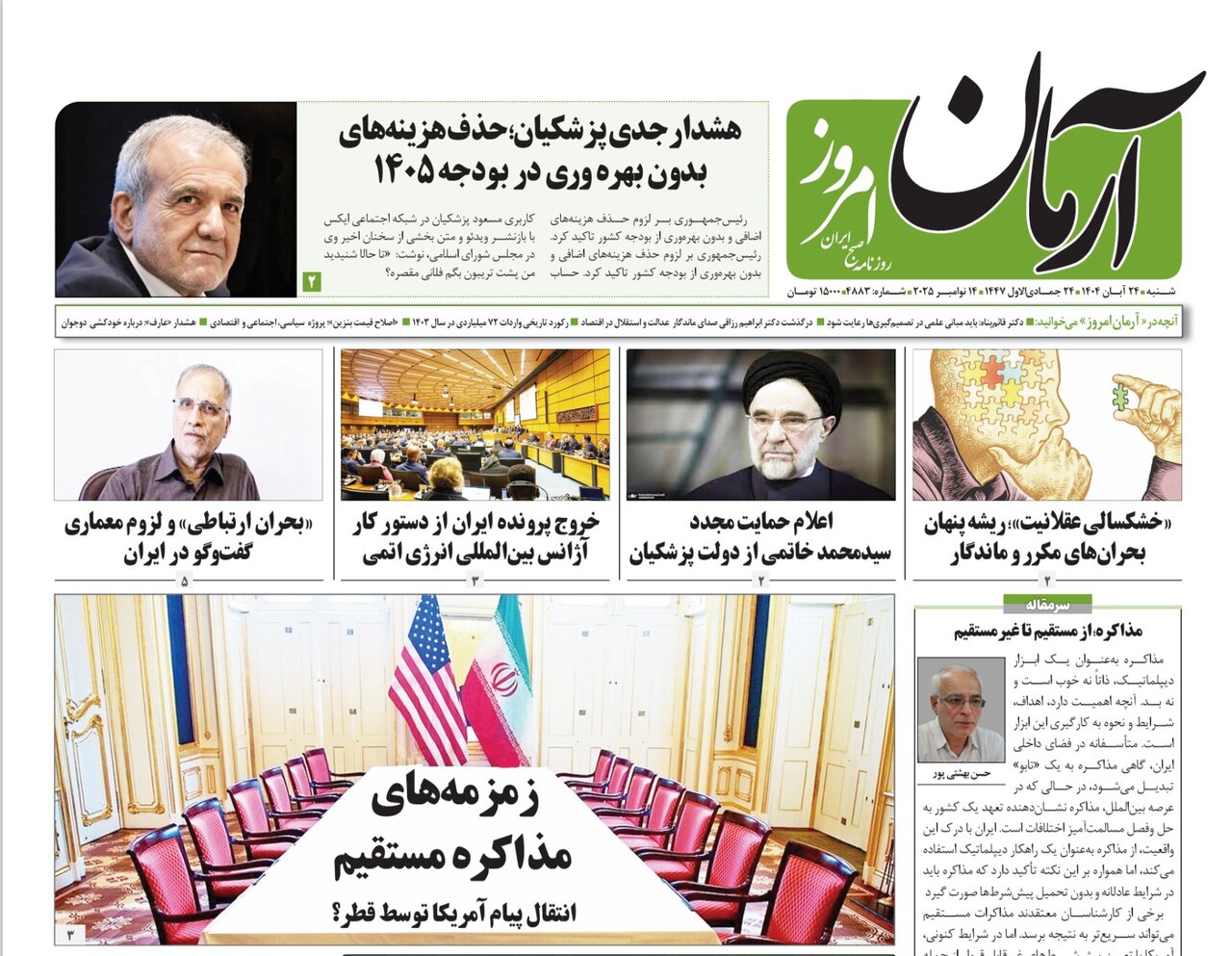
TEHRAN – In his commentary, Foreign Minister Arman Emrouz addressed the recent telephone conversation between Russian Foreign Minister Sergei Lavrov and Iran’s Abbas Aragushi.
The report states: In a complex world diplomacy where every phone call and meeting acts as a piece of a larger puzzle, new signs are emerging that Iran will continue nuclear negotiations. During the meeting, the two countries shared views on relations and regional issues and discussed “snapback” sanctions sought by France, Britain and Germany at the United Nations Security Council and the International Atomic Energy Agency. As one of the key partners in the Joint Comprehensive Plan of Action (JCPOA), Russia has consistently played the role of mediator, and this call sends a clear message to the West that Iran is willing to negotiate but will not be subject to unilateral pressure. This dialogue shows that despite the shadow of military threats looming over the Middle East, communication channels with Moscow remain open and active. Reports of a secret meeting of European foreign ministers on Iran’s nuclear file have sparked a wave of speculation. Europe still believes that diplomacy is the first option, despite verbal threats.
Jawan: The essence of Israel without America
The jawan wrote about America’s true position towards Iran: Regional events and the Zionist-American Front’s attack on Iran clearly prove that the most dangerous enemy for the region is not the Zionist regime, but America. Seen from this perspective, the Zionist regime lacks an independent identity to confront the resistance front. Devastating military raids across regional countries are a product of American will, intent, and support. In reality, the Zionist regime has become simply a regional arm for implementing US foreign policy. America’s record of occupation, crime, and colonialism in the region spans more than 100 years, and its actions are part of the natural flow of foreign policy. Regarding Iran, President Trump’s admission that he led an aggressive attack on our country (quoting President Trump as saying that he was “very responsible” for Israel’s attack on Iran) confirms that all actions of the Zionist regime originate from the White House think tank and cannot be independently determined. President Trump’s slogans and advocacy for regional peacebuilding are an example of an attempt to rebuild the United States’ image and regain influence over regional public opinion. Responsible institutions must therefore work together against America’s latest strategy and thwart its political agenda.
Mr. Armand et Meri: IAEA efforts to restart negotiations
Mr. Armand E. Meri analyzed recent developments surrounding the Iranian nuclear issue. The paper claimed that negotiations between Iran and the West over its nuclear file have reached a deadlock. Although France has recently expressed a desire to play a role in the issue, Tehran remains distrustful of European countries after they bowed to US pressure and triggered a “snapback” mechanism despite the US and Israeli attack on Iran’s nuclear facilities in June. Iran is trying to create a process by which countries opposed to the actions of the three European nations at the United Nations Security Council would coordinate their language on the nuclear issue. Therefore, great efforts have been made to ensure that representatives of Iran, China and Russia take a unified position. In the days following the 12-day war, both Russia and China took positions in line with Iran, showing that they are striving to forge a united front against the West to balance the nuclear issue diplomatically, even as Tehran has scaled back talks with Europe and suspended negotiations with the United States. This time, the Iranian government intends to negotiate with the West from the standpoint of China and Russia. This is because President Trump’s abandonment of the JCPOA destroyed previous deals with Europe, ultimately leading to European default and the near collapse of the agreement.
Resalat: great stone
In his article, Resalat discussed Iran’s strength against superpowers, especially the United States. “For 22 years, the United States has held military exercises rehearsing plans to attack Iran, but each time the Pentagon opposed the attack, and no U.S. president dared order an attack,” the paper said. But President Trump recklessly tested the possibility of a U.S. military strike against Iran during the 12-day war. American warmongers realized that they could not attack Iran militarily or politically, much less culturally, because in recent conflicts Iran had demonstrated its power not only at home but culturally and geographically around the world. The important point of the 12-day war was that no military power in the world, nuclear or non-nuclear, would dare to open fire on the United States and Israel, but Iran was determined to do so. This determination places Iran at the top of the global power pole, from which no force can topple it. Today, “Cultural Iran” is the great millstone of world power and represents the flag of justice and freedom among the nations of the world.