
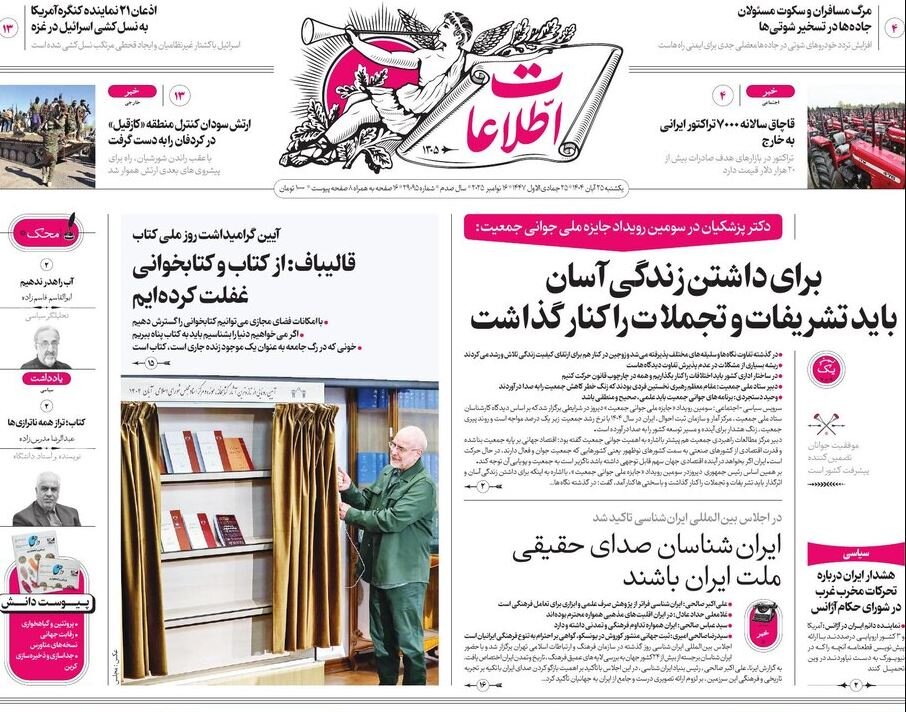
Tehran-Foreign Minister Ettelat analyzed the postponement of referring the Iranian nuclear issue to the United Nations Security Council.
The paper writes: The IAEA Board of Directors meeting will begin on November 19th and run until November 21st. According to reports, there has been a delay in referring the Iran issue to the UN Security Council. This is a decision that temporarily distances diplomacy from escalating tensions. Europe still has two active paths to take this issue to the Security Council. One concerns suspected undeclared nuclear material and the other concerns Iran’s failure to report since June. The suspension comes as the council prepares to convene to discuss a wide range of topics on Iran, from inspections and the state of its uranium stockpile to an assessment of Tehran’s actions after the June attacks. Three European countries (the UK, France and Germany, known as E3) have also called for a complete halt to enrichment and research activities. In these circumstances, suspending the referral of the case to the Security Council is more of a time-buying measure than an exoneration measure. Both Iran and the West have been given a window to decide whether to continue on a path of tension or return to diplomacy.
Mr. Etemad: Iran’s effective presence at the Riyadh summit
Foreign Minister Etemad highlighted Iran’s prominent participation in the 26th United Nations World Tourism Organization General Assembly held in Riyadh. The newspaper argued that Iran’s Minister of Cultural Heritage, Tourism and Handicrafts, Seyed Reza Salehi-Amiri, had succeeded in putting Iran at the center of global tourism attention through extensive and effective activities. According to Professor Gholamreza Zarifian of Tehran University, the minister’s active and influential presence at the Riyadh summit was a valuable opportunity to redefine Iran’s position in global tourism. In the midst of a complex political and economic situation, cultural and tourism diplomacy can break political deadlocks and foster constructive interactions between countries. This visit was a clear example of the country’s cultural and historical capabilities being used wisely on the international stage. This demonstrated that by leveraging its cultural, historical and geographical assets, Iran can redefine its role in global tourism and enhance regional and international exchanges. Experts believe that the visit heralds a new era of sustainable cooperation, economic and cultural development, and enhanced tourism diplomacy for Iran, and could serve as a model for Iran’s active presence in international forums.
Sob-e-no: Negotiations no longer bring results
Mr. Sobouenou referred to the suspension of negotiations between Iran and the IAEA following airstrikes by Israel and the United States against Iran’s nuclear facilities. “Iran’s cooperation with the agency is limited in the wake of unlawful attacks against Iran by the United States and Israel,” the newspaper said. In addition, Europe’s move to invoke the snapback mechanism halted implementation of the JCPOA provisions. Even though the West never fulfilled its JCPOA commitments and Iran alone adopted strategic patience and remained faithful to the agreement, the IAEA Board consistently issued biased reports resulting in statements and resolutions against Iran. Although the JCPOA was initially necessary to manage the complex international environment of the time, it can be concluded that any negotiations with Western countries would be fruitless. Western countries, especially the United States, never sought to use the JCPOA as an opportunity to improve economic or political relations with Iran. Despite Iran initially taking voluntary steps to limit its nuclear activities, Western countries chose to abandon the deal. In reality, their actions forced Iran to pursue resistance, concluding that negotiations were futile and diplomacy had reached an impasse.
Doña e Ektesad: Western countries are trying to give more time to diplomacy
Doña Extesad, discussing the upcoming IAEA Board of Directors seasonal meeting, wrote: “It is unlikely that any concrete action will be taken at the next meeting and will result in constant warnings from the West so that there is still an opportunity for diplomatic efforts with Iran, as the situation is sensitive and given the attacks on Iranian strongholds, At the next Council meeting, Iran will likely be asked to resume cooperation with the body, while Tehran will be implicitly threatened with possible referral to the UN Security Council. Legally, however, whether the matter is referred to the Security Council matters little to the West, as the six sanctions resolutions against Iran are already considered valid and enforceable by the West and the United Nations. There is some cautious optimism about the possibility of Iran resuming cooperation with the agency. Over time, some opponents of cooperation may soften their stance. Since it is clearly stated that Iran will not withdraw from the NPT, Iran must implement Article 3, ensure the deweaponization of its nuclear program, and cooperate with the organization to guarantee its peaceful nature.