
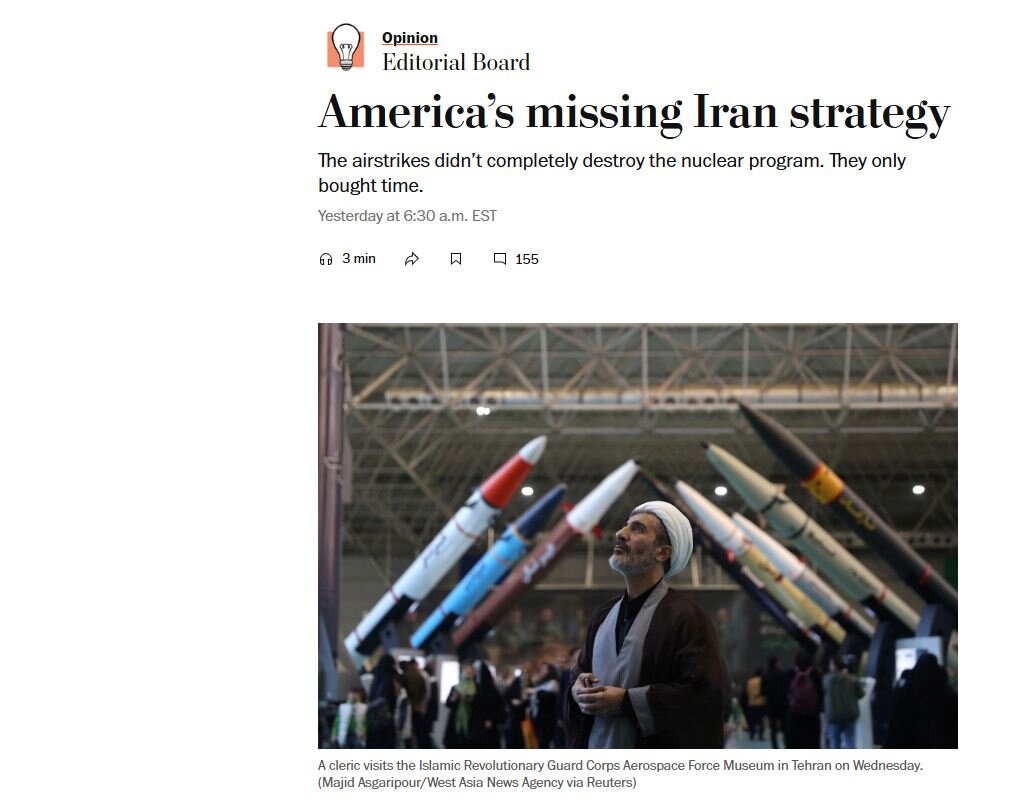
TEHRAN – A Nov. 15 editorial in the Washington Post on the U.S. attack on Iran’s nuclear facilities claims to illustrate “the U.S.’s missing Iran strategy.” But what it really reveals is the disturbing thinking that continues to drive U.S. policy in the region.
From its opening sentence, the Post acknowledges that the bombing of Iranian territory was never about Iran alone. The paper notes that the attack “sent a useful deterrence message to adversaries.” Washington’s attacks on Iranian territory have been openly justified as a warning to global rivals such as Russia and China. Iran is treated not as a sovereign nation with its own rights and concerns, but as a geopolitical arena for the United States to project its power.
Equally problematic is the tone of the work. The Washington Post expresses unconditional support for U.S. and Israeli military action, saying the bombing is justified and even necessary, but it never stops considering the legal and moral implications of attacking other sovereign countries. There is no remorse for international law, no recognition of the human or political consequences, and no even the slightest attempt to justify on ethical grounds the invasion that claimed the lives of at least 1,100 people. Instead, Iran is portrayed as a “belligerent” actor, and the countries carrying out airstrikes are portrayed as guardians of stability. This would call into question the independence of the US media, even its most prominent outlets, as they appear to be mere amplifiers of Washington’s security narrative.
The editorial also selectively employs facts in a way that distorts the overall picture. This highlights Iran’s limited cooperation with the IAEA and the deepening relationship between Iran and China. However, it omits the context that access to the IAEA was blocked after a foreign military attack, and that cooperation with China is neither illegal nor unusual as a country under heavy Western sanctions. It also fails to mention that U.S.-imposed sanctions deliberately target all sectors of Iran’s economy, insisting that Iran’s economic woes are solely due to domestic failures. Perhaps most disturbing is the editorial’s assertion that “there have been no negotiations with the United States since the United States bombed Iran,” completely ignoring the fact that the United States stopped the diplomatic process by “bombing” Iran. Iran participated in five rounds of indirect nuclear talks with the United States in April and June. Those Oman-brokered talks were due to continue into a sixth session in Muscat, before starting a 12-day war in which Israel and the US boasted they were “very much in control”.
The solution proposed in the editorial is also a farcical claim. In other words, maintain overwhelming military pressure, tighten sanctions, and then proceed with negotiations from a position of strength. This is not diplomacy in any sense of the word. This is coercion, not unlike the “peace through force” doctrine embraced by Donald Trump’s administration. This is a process in which one side is expected to come to the table, weakened, financially strapped, and scared, and sign documents that have already been written in Washington.
Iran has repeatedly declared its readiness for genuine dialogue. But true dialogue cannot occur under shelling, economic siege, and the threat of future attacks. Iranian officials have repeatedly asserted that Iran is willing to negotiate if a partner country makes a reasonable request. After all, no negotiation can be considered genuine as long as diplomacy is defined by coercion rather than mutual respect.
Equally overlooked is the basic fact that Iran has never pursued nuclear weapons. This reality is recognized by the IAEA. But this claim continues to be recycled as a convenient excuse for pressure and escalation, including in an editorial in the Washington Post.
Ultimately, the Post argues, the United States lacks a coherent strategy toward Iran, suggesting that a “credible threat of force” must remain at the center of policy. Perhaps the problem is not just strategy, but integrity. If the United States truly seeks stability, basing its diplomacy on intimidation will only increase mistrust. Policies built on selective narratives, unconsidered aggression, and demands for unilateral concessions will not produce peace and will only deepen conflict.