
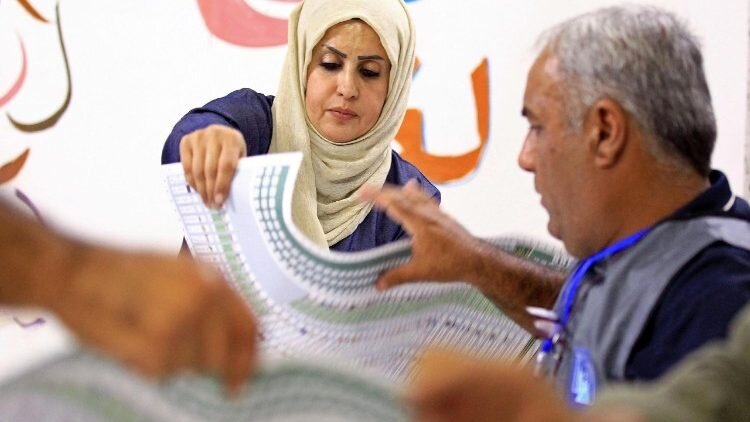
MADRID – The announcement of the preliminary results of Iraq’s parliamentary elections has begun the complex process of forming a new government in Baghdad.
From Tehran’s perspective, these elections are more than just a routine democratic exercise. These represent a strengthening of the post-ISIS political order, which, despite its limitations, has succeeded in stabilizing the country and securing strategic relations with its neighbors. Far from being uncertain, the election results confirm predictable trends and reaffirm the viability of Iraq as a sovereign nation that prioritizes natural regional partnerships.
Western narratives often focus on the concept of “Iraqi nationalism” defined in opposition to Iran, but do not capture the complexity of the political situation. What is unfolding in Baghdad is a refinement of coalition government, with factions that understand the strategic importance of relations with Tehran forming the axis around which any governing majority must necessarily revolve. At the same time, Washington’s approach, focused on containing Iran and protecting immediate energy interests, lacks the long-term vision and commitment needed to change this structural reality.
An important aspect that is often overlooked is that the successful conduct of these elections with broad and diverse participation is an important diplomatic achievement in itself. Unlike previous periods marked by electoral violence, this process unfolded under conditions of institutional normality. This stability reflects the maturation of a basic political agreement on the rules of the game. While some outside observers expected chaos and division, Iraq’s political system has shown remarkable capacity for self-regulation.
Despite the inevitable minor conflicts, the relative transparency and order of the process shows that state institutions have developed resilience. For strategists in Tehran, this stability is an encouraging development, as an institutionally strong Iraq is seen as a more reliable strategic partner than a fragile, crisis-prone state.
Understanding Iran’s stance requires going beyond a simple sectarian analysis. Confessional relationships provide historical and cultural foundations, while strategic relationships are based on more concrete pillars of national security and economic interdependence.
Security is the focus. The experience of the war imposed by Saddam Hussein in the 1980s and the subsequent invasion in 2003 reinforced the doctrine of defense in depth in Tehran. Iraq cannot be allowed to become the scene of an existential threat again. The Popular Mobilization Forces, integrated into the state apparatus, embody this doctrine. They serve as a bulwark against a resurgence of terrorism and form an important element of Iraq’s sovereign security architecture. Any outside attempt to undermine these institutions will be perceived as interference that destabilizes Iraq and endangers regional security.
Economic interdependence is equally important. Iran and Iraq have built deep economic ties. Iraq is an important market for Iranian products and services, a major customer in the energy sector, and an important land route to the Mediterranean Sea. Stability in Iraq is therefore in Tehran’s strategic interest. Iranian policy does not call for the collapse of Iraq, but for its unification under a government that can maintain these economic flows and critical infrastructure.
The goal of Iranian diplomacy is not to impose a particular prime minister, but to ensure that the person in charge understands the core principles of preserving Iraq’s security institutions, respecting its sovereignty against external interference, and maintaining a strategic economic partnership that benefits both countries.
The election results reflect the continued dominance of the Coordination Framework (Takatul at-Tansik) as the most cohesive political force with the greatest mobilization capacity. Its resilience derives not only from its grasp of Iraq’s geopolitical realities, but also from the discipline and unity it has shown since the election. While other groups have shown internal rifts, this group has remained steadfast in key negotiations.
This adjustment is no coincidence. This is the result of years of trust-building and strategic coordination between components, recognizing the value of presenting a united front at critical moments while preserving their individual identities. The ability to act in concert gives this bloc a significant negotiating advantage over more fragmented groups. In Iraq’s complex governmental chessboard, unity of purpose is often more important than simple parliamentary calculations.
Some Iranian analysts, such as Mostafa Nafazi, say that Mohammad Shiite al-Sudani has solidified his position as a key figure in Iraq’s stability. His coalition government, which gained the most support in the 2025 elections, reflects his ability to balance different political blocs, including resistance groups, and ensure a pluralistic and functional parliament.
Al-Sudani embodies the delicate balance that defines contemporary Iraqi foreign policy. His leadership has resisted persistent US pressure to dismantle or significantly weaken the Popular Mobilization Forces (PMF). Under his administration, these forces remain integrated within the national security apparatus and are recognized as a fundamental part of Iraq’s defense architecture. This position is not a deference to outside interests, but a pragmatic understanding of Iraq’s complex security realities. Al-Sudani has consistently argued that dismantling these structures would weaken the state’s ability to combat remaining terrorist threats and maintain internal stability.
What is noteworthy is his diplomatic tact. While maintaining the framework of the PMF, he sought to strengthen their professionalism and subordination to civilian command, partially addressing international concerns without compromising core security objectives. This approach allowed him to retain support from mobilization groups while maintaining open channels of cooperation with Western partners.
Some Iranian analysts, including Mostafa Nafazi, say al-Sudani has adopted a strategic approach to external pressure, based on a pragmatic interpretation of national sovereignty. He recognizes that stability in Iraq depends on a delicate balance in which security institutions reflect the country’s socio-political realities rather than external interests. This stance strengthened his credibility at home, projected an image of regionally independent leadership, and strengthened his position as a key figure in Iraq’s stability and governance.
A stable and connected Iraq is the center of regional stability. It serves as a vital strategic corridor for trade and economic integration between the Persian Gulf and the Mediterranean Sea. Weakening this connectivity could give an advantage to external actors with destructive plans.
However, Iraq’s post-2003 power structure is filled with actors and interests that recognize the value of regional stability. Deepening economic ties and strategic alignment within the political class make Iraq a natural partner in promoting a secure and predictable regional order.
The 2025 elections do not signal a fundamental change in Iraq’s strategic direction, but rather a continuation of a policy of balance and pragmatic engagement. The stability of the electoral process, coordination between political blocs, and the strengthening of al-Sudani demonstrate that Iraq is sovereign, functioning, and strategically connected to its regional environment, particularly Iran.