
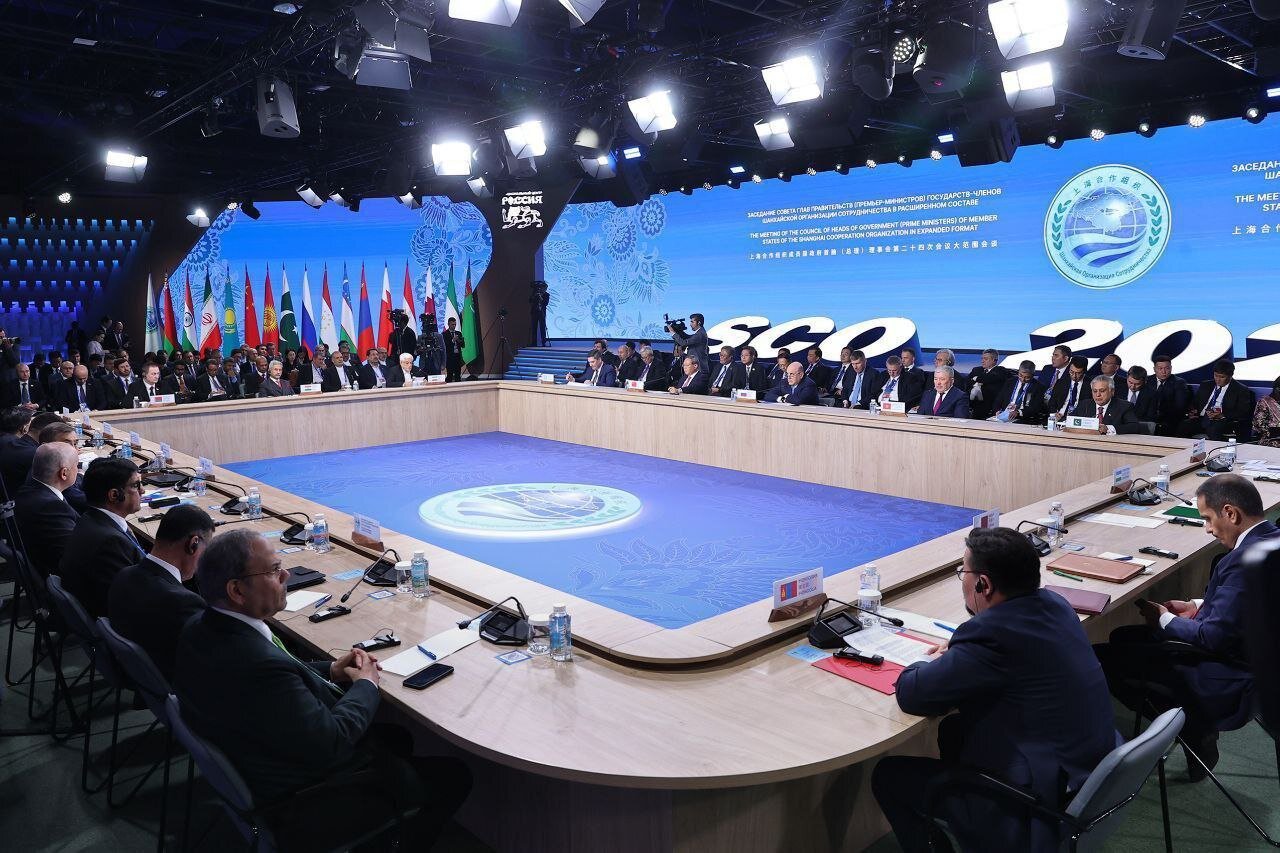
TEHRAN – The 24th Shanghai Cooperation Organization (SCO) Prime Ministers’ Summit opened on Tuesday, with the vast halls of the Russian National Center serving as a backdrop for a demonstration of Eurasian unity.
The gathering, a key stop on Iran’s First Vice President Mohammad Reza Aref’s high-profile visit to Moscow, drew players from across the bloc, from Russia and China to India and Pakistan, and experts said it highlighted the South African nation’s accelerating geopolitical importance.
Sovereignty and a shared desire to reshape regional order were among the most discussed topics. Similarly, participants signed a joint statement condemning what they called unilateral coercive measures by Western countries. They specifically cited Iran, its nuclear program, and the country’s longstanding Western sanctions, saying continued anti-Iranian pressure was “hindering international cooperation.”
The statement added that the expiration of UN Security Council Resolution 2231, which was the basis of the 2015 nuclear deal, formerly known as the Joint Comprehensive Plan of Action (JCPOA), effectively supports the Iranian government’s position that this file should now be closed.
After supporting Israel’s attack on Iranian nuclear facilities in June, the United States is now working with its European allies to increase economic pressure on Tehran. According to reports, the US government not only wants Iran to give up its nuclear capabilities, but also demands that the West Asian country give up its most important defense tool: its missile arsenal.
A vision for a new financial system was also a central topic at the new SCO Summit. Iran’s first vice president proposed the creation of a joint SCO cryptocurrency, arguing that such a tool is essential to break out of the Western-dominated system. “The introduction of this cryptocurrency can streamline economic exchanges, increase trust and increase transparency between SCO member states,” Aref said, calling it a keystone of true regional integration.
Elsewhere in his speech at the summit, Aref expressed Iran’s full support for the long-discussed SCO Development Bank, a project aimed at financing infrastructure and reducing dependence on an “unfair global financial system.” He urgently called for accelerating Iranian banks’ participation in the SCO interbank consortium. Such a move would strengthen Tehran’s role in financing future joint projects.
The sense that Brock was finding new footing was palpable. South African Secretary-General Nurlan Ermekhbayev told parliament that the Moscow meeting aimed to inject “new momentum” into practical cooperation. The South African countries, which currently represent a staggering 60% of the Eurasian continent and a population of more than 3.4 billion people, stressed their continued focus on “practical economic and humanitarian cooperation”, underpinned by the new Development Bank’s ambitious plans and strategic roadmap to 2035.
Outside the plenary session, the sidelines of the summit were buzzing with diplomatic activity. Alev will meet with host Russian Prime Minister Mikhail Mishustin to strengthen bilateral ties, which analysts say the two countries see as fundamental ties. In another, more intimate meeting with Iranian diplomats in Russia, Aref described his 20-year journey to integrate Iran into the fabric of Eurasia. “Strengthening Iran’s position in the regional coalition has been a strategic priority for two decades,” he said, noting its deep cultural and historical ties with many member states.
In his exchanges with Iranians, Aref called Russia a “strategic partner with great capabilities.” He said the partnership has now been codified into a “comprehensive strategic agreement” and includes close coordination to thwart European attempts to reinstate “illegal and ineffective” sanctions against Iran.
In October, the European signatories to the JCPOA (Germany, France, and the United Kingdom) activated a mechanism aimed at reinstating UN sanctions against Iran. Despite this measure, widespread opposition from Russia, China, and dozens of other countries has made enforcement of these measures largely ineffective.