
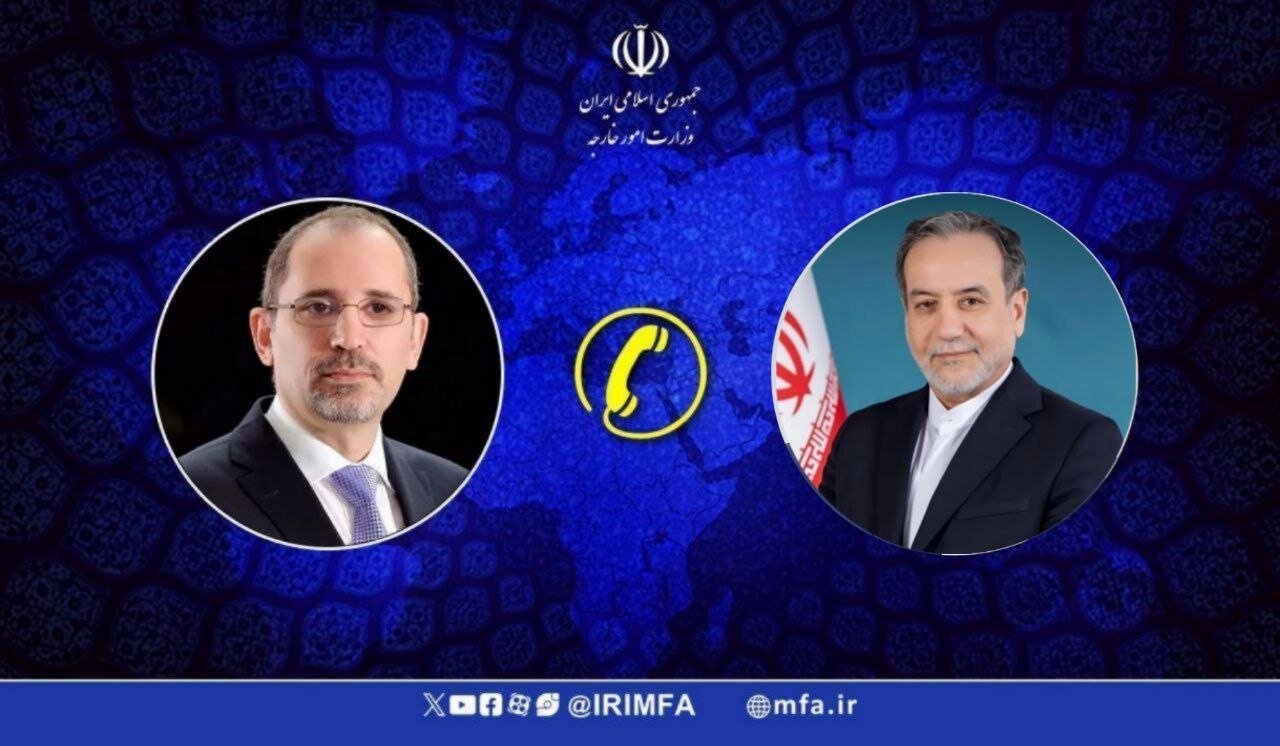
TEHRAN – Iranian Foreign Minister Abbas Araghchi and Jordanian Deputy Prime Minister and Foreign Minister Ayman Safadi reviewed the deteriorating humanitarian situation in the Gaza Strip and discussed the impact of newly adopted United Nations Security Council resolutions.
The two ministers held a telephone conversation on Tuesday afternoon, with the Gaza crisis and recent United Nations Security Council actions particularly highlighted in the discussion.
Both sides stressed the urgent need to stop the ongoing killings and genocide of Palestinians and ensure their full rights, including self-determination and the establishment of an independent Palestinian state.
The United Nations Security Council has approved a US-sponsored resolution calling for the deployment of the International Stabilization Force (ISF) to the Gaza Strip.
The measure, adopted on Monday, supports President Donald Trump’s Gaza initiative and allows the creation of a multinational peacekeeping force involving several Muslim-majority countries, including Egypt, Indonesia and Azerbaijan.
The Palestinian resistance group Hamas rejected the resolution, saying it amounted to placing Gaza under international surveillance, failed to protect Palestinian rights, and sought to strip resistance groups of their weapons.
A ceasefire agreement was reached between Hamas and Israel last month, brokered by the United States. The ceasefire agreement, which took effect on October 10, was aimed at halting Israel’s two-year war in the besieged region. However, Israel continues to violate the agreement by continuing airstrikes, ground invasions, shootings, and mass arrests.
According to the Palestinian Authority, Israel’s war since October 7, 2023 has killed more than 69,000 Palestinians, including at least 21,000 children.
Ministers also noted that the current ceasefire constitutes the first phase of US President Donald Trump’s 20-location Gaza plan, with further stages of negotiations expected to follow.
In addition to Gaza, Mr. Araghchi and Mr. Safadi exchanged views on ways to strengthen bilateral relations and expand cooperation in areas of mutual interest.
The two leaders also discussed Wednesday’s IAEA board meeting and a draft resolution submitted by three European countries regarding Iran’s nuclear program. The resolution is expected to be a major issue at the meeting.