
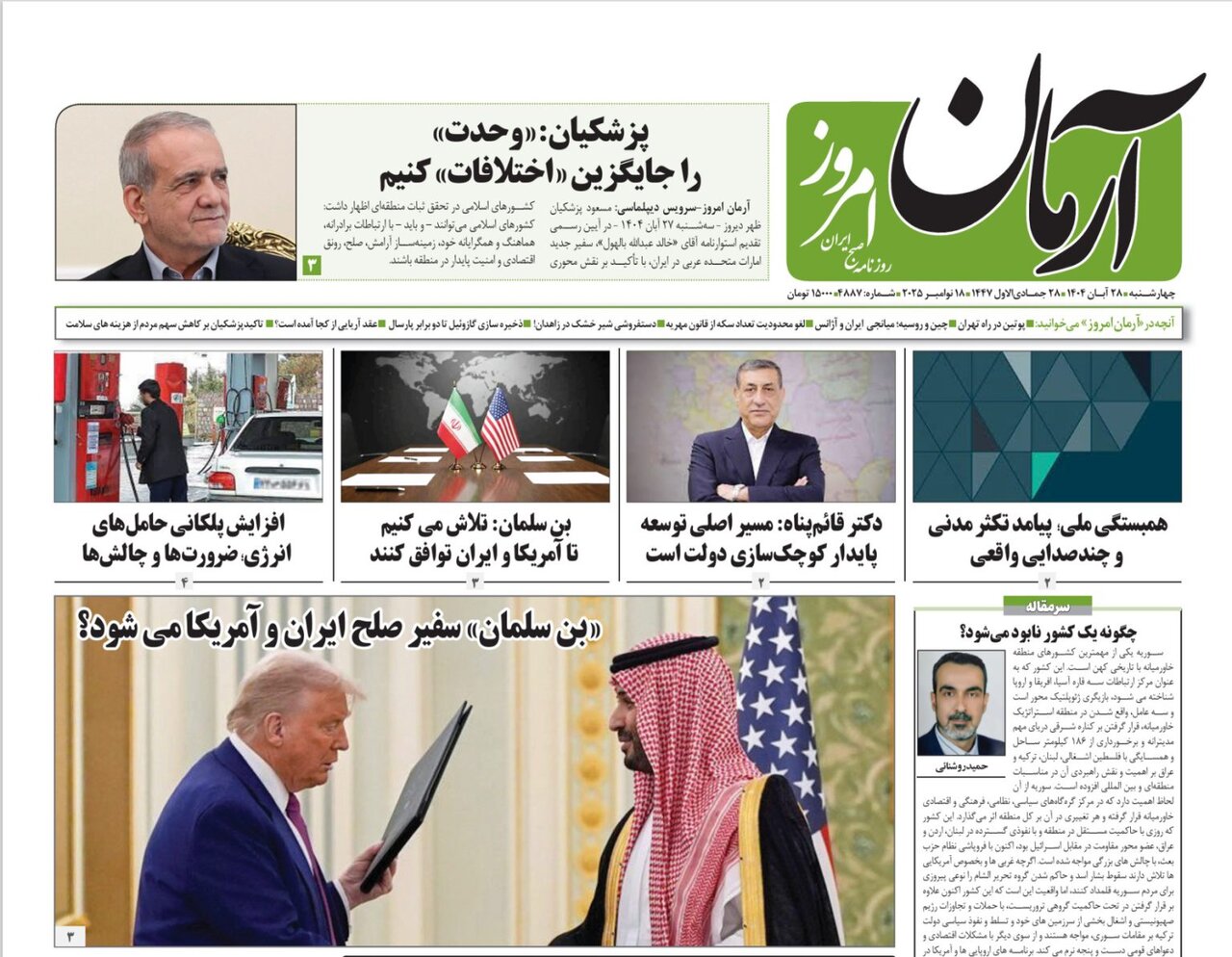
TEHRAN – Foreign Minister Arman Emrouz said it is necessary to reconsider the end of the war between Iran and Israel in June this year to understand why reaching a nuclear deal with Iran will be a central part of the talks between Crown Prince Mohammed bin Salman and the Trump administration, at least from Saudi Arabia’s perspective.
Importantly, after the 12-day war, Iran began rebuilding its military. Additionally, the war undermined hopes for a nuclear deal and deepened mistrust between the Iranian government and the Trump administration. However, Iran’s actions in the weeks and months following Israeli and American military operations indicate that it has not surrendered and continues to build up its military capabilities. This reality should concern Persian Gulf states, including Saudi Arabia. President Trump’s demands on Iran now appear in Tehran as demands for surrender, not compromise. Ignoring the Iranian issue in President Trump’s talks with the Saudi crown prince, known as MBS, could harm Saudi interests, especially given the growing likelihood of a recurrence of conflict in the Persian Gulf. Bin Salman must work to narrow the gap between Iran and the United States. If we don’t, we may end up paying the price for the next war ourselves.
Siasate Ruth: We shouldn’t rely on the West
In his analysis, Siasate Roos emphasized independence and avoidance of dependence on the West as a path to progress. The paper writes: Some voices in the country believe that the achievements of Western countries can serve as a model and argue that the West can solve the country’s economic problems. But we see that countries like China are now the world’s leading economies and the world’s largest producers, without relying on America or the West. Iran has also made great progress despite many challenges. Military advances in science, medicine, nuclear, and especially missile technology were achieved while the United States and Western powers sought to thwart them through sanctions, threats, and even military aggression. The idea that the West can serve as both a role model and a collaborator in Iran’s progress is an illusion. Indeed, if Iran turns to the West, everything that has been achieved through the efforts of young Iranian scientists will be lost. America and the West’s desire is for a weak and powerless Iran.
Etemad: Iran seeks positive balance between East and West
Regarding First Vice President Mohammad Reza Aref’s visit to Russia and Kamal Khalazi’s recent statements, Etemad Newspaper asked Maziar Barai of the People’s Trust Party for his opinion. He said that on the eve of Alev’s visit to Russia, Karaj made important statements regarding negotiations with the United States, which can be seen as an effort to establish a positive balance between East and West. Khalaj pointed out that Iran will never give in to bullying, but at the same time is always ready to engage in fair and honorable negotiations to resolve issues. Through these strategies and statements, the Islamic Republic has demonstrated that it seeks to create a positive balance in its relations with both the Eastern and Western countries, contrary to the view of some analysts that the Iranian government seeks unilateral relations with the Eastern bloc. While maintaining strategic ties with Russia, China, and even India and Pakistan, Iran also aims to establish constructive relations with Western countries. This is a course of action that has been called for and recommended by many of Iran’s allies, including Russia and China, which urges Iran to resolve its dispute with the United States and other Western countries.
Sob-e-no: President Trump’s admission is an official document of intervention and invasion
In an interview with Rep. Mohsen Mousavizadeh, Sob-e-No Rep. Validated Donald Trump’s recent admission in June that he played a direct role in the 12-day war against Iran. He said the confession was a clear and unprecedented political document. The Twelve Day War was planned and executed directly by the United States. Without the massive support of the American government, the Zionist regime would not have been able to resist Iran for even a single day. Every time America and its allies have confronted Iran, the result has been nothing but defeat, setbacks, and political humiliation for them. Mr. Trump’s recent confession cannot be viewed as a mere political position. It has direct legal consequences. Such statements may be prosecuted under international law. Iran’s diplomatic and international judicial institutions must register and pursue this confession as an official document of intervention and aggression, as silence in the face of such statements only encourages repetition. Legal pursuit at this level would not only strengthen Iran’s legitimacy but also significantly raise the international costs of future American adventurism. Iran must use this opportunity to spell out the “documented incident,” that is, America’s role in creating tension, inciting the Zionist regime, and attempting to destabilize the region, so that world opinion can learn the reality behind the 12-day war.