
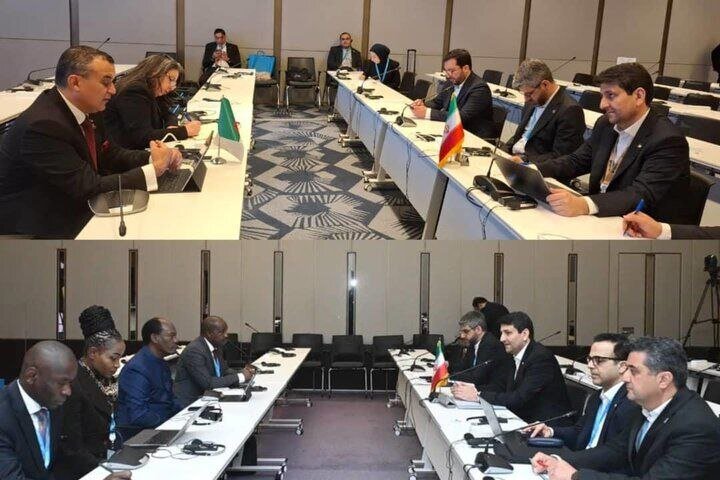
TEHRAN – Minister of Information and Communications Technology (ICT) Sattar Hashemi held separate talks with the ministers of Algeria and Kenya and discussed ways to increase synergies to develop markets and promote cooperation in smart government, space industry, digital economy and cybersecurity.
The officials met on the sidelines of the World Telecommunications Development Conference 2025 (WTDC-25), which will be held in Baku, Azerbaijan from November 17 to 28, ISNA reported.
In a meeting with Algeria’s Minister of Posts and Telecommunications Sid Ali Zerrouchi, the two countries emphasized improving their communications infrastructure as well as boosting cooperation in areas such as smart government, digital economy, space industry, cyber security and regional connectivity.
Zerlouki referred to a memorandum of understanding signed in 2023 between Algeria and Iran’s Nanotechnology Park and called for expanded joint efforts in artificial intelligence, space and cybersecurity, and undersea cables.
Elaborating on Iran’s priorities in digital transformation, Hashemi said that Iran plans to raise the share of the digital economy to 10% of gross domestic product (GDP) and develop a smart government ecosystem as one of the main pillars.
Noting Iran’s reliable progress in the space industry, the official said the two countries could also expand cooperation in the design of satellites, ground stations and space-based services.
The ICT Minister went on to propose implementing cooperation in Fiber to the Home (FTTH), fixed access networks, modern platforms and infrastructure. He also encouraged Mr. Zerrouchi to visit Iran to learn more about the capabilities of Iranian companies, smart government projects, and communications infrastructure.
He met with William Kabogo Gitau, Kenya’s Cabinet Secretary for Information, Communications and Digital Economy, and the meeting focused on sharing policy-making experiences and developing joint economic projects.
Gitau emphasized the need to promote cybersecurity, data networks, platform regulation and communications crisis management. He called for developing technical exchanges between the two countries’ experts in the digital economy and data centers.
Hashemi expressed Iran’s readiness to cooperate in the areas of internet governance, network resilience, countering hybrid threats, and cybersecurity.
The growth of the digital economy in Africa provides strategic opportunities for Iranian companies and Kenyan innovation centers to implement joint projects, Hashemi said.
He offered to share his expertise and knowledge through co-educational courses and organizing professional conferences.
Expansion of technology diplomacy
The Iranian delegation, led by Mr. Hashemi, is participating in WTDC-25, which will be held under the theme of “Universal, Meaningful and Affordable Connectivity for an Inclusive and Sustainable Digital Future.”
On the sidelines of the conference, Mr. Hashemi will hold meetings with his counterparts and a number of other high-level representatives to share expertise and promote technical cooperation in various areas such as fiber optic networks, G5 technology, and AI.
On the sidelines of WTDC-25, Mr. Hashemi met with Doreen Bogdan-Martin, Secretary-General of the International Telecommunication Union (ITU).
Officials discussed ways to foster cooperation in a variety of areas, including artificial intelligence (AI), communications infrastructure, digital multilateralism, and communications security.
During the meeting, Hashemi explained the country’s achievements in information technology, AI and communications. He emphasized the role of the ITU as a major platform for global coordination, and said that promoting multilateralism and fostering cooperation with specialized institutions are among the priorities of Iran’s digital foreign policy.
Bogdan-Martin praised Iran’s active participation in ITU meetings, committees and programs, saying that Iran is one of the influential members in policy-making and technical discussions.
He noted that the regular attendance of Iranian experts and the quality of their participation in meetings play an important role in pursuing the ITU’s goals.
She expressed the Union’s readiness to expand relationships in technical skills development, workforce empowerment and knowledge exchange in emerging technologies through joint efforts.
Bogdan-Martin noted Iran’s strong capabilities in AI, communications infrastructure, and digital services development, and said Iran could play a more prominent role in developing new standards and international programs.
Furthermore, she welcomed the invitation of the ICT Minister to visit Iran and stressed that cooperation between Iran and the EU can serve as an example for the sustainable development of communications in the region and the expansion of digital inclusion in countries. It strengthens network resilience and smart economy.
MT/MG