
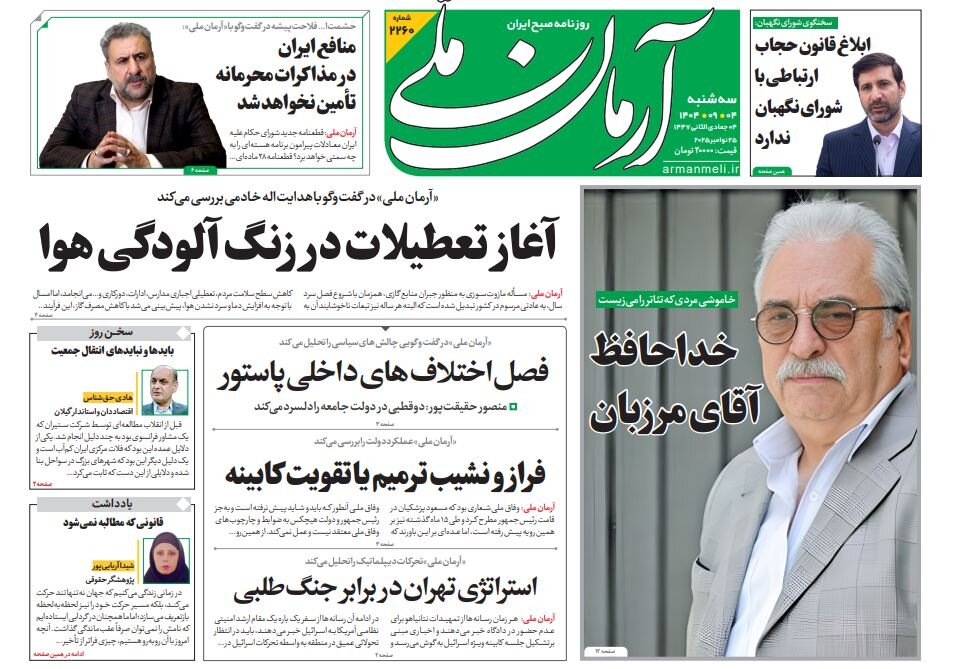
TEHRAN – Arman e-Meri analyzed the uncertain negotiation situation between Iran and the United States.
According to the newspaper, dialogue has been taking place in recent years against a backdrop of deep-rooted distrust. This distrust is not only based on the historical experiences of both sides, but also grows with each fruitless negotiation. In such an atmosphere, neither party intends to back down from their red lines. The US government continues to press and press its demands, but the Iranian government refuses to negotiate within a predetermined framework. This conflict of positions makes the process an iterative and exhausting cycle that does not lead to lasting agreement or easing of tensions. The continuation of this situation indicates that the previous mechanisms no longer have the necessary effectiveness. Moving forward, we need a new framework, a different atmosphere, and a creative approach. Unless we establish this new space, built on relative trust, a common understanding of interests, and mechanisms to secure commitments, we cannot hope to break the current impasse. Overcoming the current impasse is therefore only possible if both sides recognize and accept the need for changes in the environment and negotiation methods.
Jam-e-Jam: SCO, BRICS, EAEU provide opportunities for economic growth for Iran
In his analysis, Jam-e-Jam discussed opportunities that Iran can seize to strengthen its economy. “Iran is currently in one of its most geopolitically and geoeconomically sensitive periods,” the newspaper said. Western countries have long sought to isolate Iran and cut it off from global value chains, but now a historic window has opened for Iran towards the East, especially the Asian continent. Iran’s formal membership in the Shanghai Cooperation Organization (SCO) and BRICS, and the signing of a free trade agreement with the Eurasian Economic Union (EAEU) can be said to be the three pillars of the Islamic Republic’s “Look East” policy. They could change the course of Iran’s economic development for decades to come. In this environment, if a “balanced foreign policy toward Asia” is accompanied by domestic economic reforms, Iran can envision sustainable growth for at least the next 20 years. If we don’t, this historic opportunity, like so many before us, will be lost.
Khorasan: Western countries see collapsed Iran as a means of containment
In his commentary, Khorasan considered the US’ plans to confront China. The paper argues: Two blocs have been created in the world. On one side are the US and European troika, and on the other side are China and Russia. China, Russia and Iran are considered imminent threats in US national security documents. The United States recognizes that China is making strategic advances within the international system. The US government recognizes Iran’s collapse and submission as the path to containing China. Surrendering or collapsing Iran’s geography would jeopardize China’s economic interests in the region, which are considered major interests by the Americans. However, Russia and China understand that the way to overcome American plans is to maintain and strengthen the power of the Islamic Republic of Iran and Iran’s geographic integrity. Today, Iran is at the center of gravity of the anti-arrogance bloc and is therefore developing its power and authority in discourse at the regional level. The collapse of the Islamic Republic would be a nightmare and terrible for the national interests of Russia, China, Pakistan, and even the southern Persian Gulf states.
Iran: Regional diplomacy in Muscat
Iran’s Foreign Minister Seyyed Abbas Alaghushi marked a new diplomatic milestone by attending the Muscat Forum in Oman. The visit comes as Israel’s continued war plans against Lebanon, the suspension of nuclear negotiations, and the spiraling instability in West Asia are causing a shift in the region’s political landscape. In this context, Araghchi’s visit to Muscat highlights the Iranian government’s attempt to process multiple sensitive documents simultaneously, ranging from regional negotiations to pressing humanitarian and security challenges. It also highlights Oman’s enduring role as a traditional mediator in complex dialogues. He will meet with Oman’s Foreign Minister Badr Al Busaidi and discuss regional development. Engagement with Humanitarian Dialogue Center stakeholders on threats to international order. and his discussions with the United Nations Special Representative on Yemen, collectively demonstrate that Iran’s foreign policy apparatus is actively using diplomatic tools. These efforts are further linked to Araghchi’s subsequent visit from Muscat to The Hague, where his participation in the Conference on the Prohibition of Chemical Weapons will expand the scope of Iranian diplomacy from regional issues to the broader multilateral arena.