
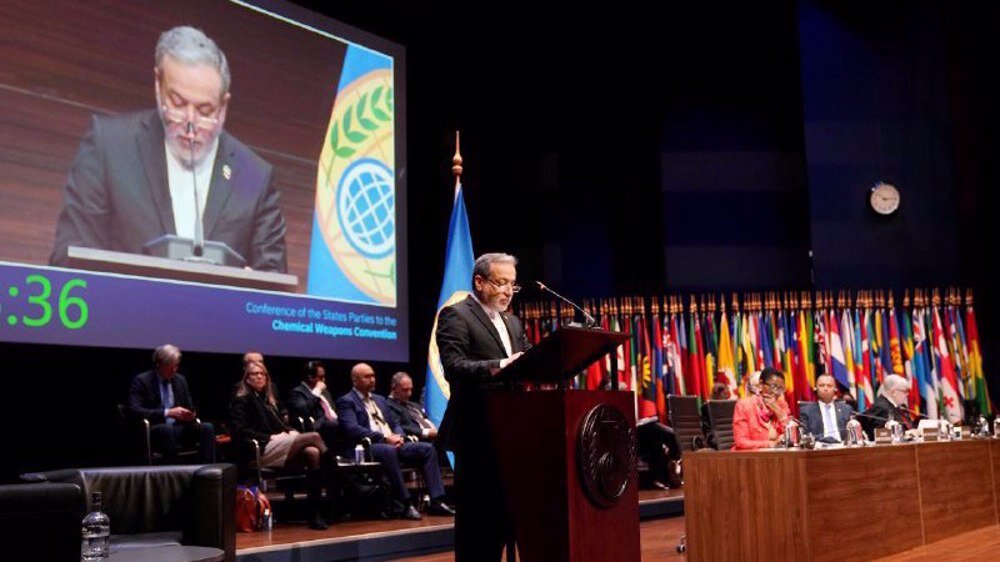
TEHRAN – Iranian Foreign Minister Abbas Araghchi on Tuesday condemned Israel for remaining outside the Chemical Weapons Treaty, calling it the main obstacle to regional stability.
He also criticized the United States for not fully complying with the Chemical Weapons Convention (CWC), highlighting the U.S. government’s selective enforcement and double standards.
Araghchi made the remarks at the CWC’s 30th Conference of the Parties in The Hague, underscoring the lasting impact of Saddam Hussein’s chemical attacks on Iran during the 1980-88 war.
He cited Kamal Hosseinpour, a member of parliament from Sardasht, one of the cities targeted by chemical weapons, and called Sardasht an “iconic name” in the global campaign to eliminate chemical weapons. He emphasized that many victims continue to suffer decades later.
The foreign minister appealed, “Truth must prevail and justice must be served,” and asserted that there is no statute of limitations for chemical warfare crimes. He called on countries whose companies supported Iraq’s chemical weapons program to conduct independent and transparent investigations into their and their companies’ roles.
Turning to current regional issues, Araghchi harshly criticized US policy, accusing the US of promoting an “international order based on force” that, combined with European “appeasement”, has enabled Israeli military operations in Gaza, Lebanon and other areas. He described the past two years in the occupied Palestinian territories as a time of “total genocide” and condemned the ongoing Israeli occupation of Palestine, Syria and Lebanon.
He also condemned Israel’s attack on Iranian territory in June, along with the involvement of U.S. forces, calling it a “clear violation” of the United Nations Charter and a threat to both the Nuclear Non-Proliferation Treaty and the CWC. Aragushi noted that President Donald Trump had authorized the U.S. participation, which he said provided “clear evidence” of U.S. responsibility.
Araghchi stressed that the OPCW must maintain a technical and impartial mandate, free from political pressure. He reiterated that Israel’s refusal to join the CWC is a major barrier to a West Asia free of weapons of mass destruction and called on the organization to force Israel to accept inspections.
He also expressed concern about the United States’ compliance with the CWC, citing delays in destroying declared stockpiles and a lack of transparency regarding chemical activities involving non-lethal substances. Araghchi criticized unilateral sanctions by the United States and some European countries, calling them a “double injustice” that prevents Iranian chemical weapons survivors from accessing medical supplies.
He thanked the Asia-Pacific Group for supporting Iran’s election to the OPCW Executive Board from 2026 to 2028 and pledged Iran’s “full cooperation and support” to the group’s president and member states.
“Iran is the biggest victim of chemical weapons since World War II.”
On Tuesday morning in The Hague, Foreign Minister Arraguchi met with OPCW Secretary-General Fernando Arias on the sidelines of the CWC meeting.
Araghchi reiterated that Iran is the biggest victim of chemical weapons since World War II and stressed the Iranian government’s determination to protect the rights of survivors. He said the international community, especially those states that directly or indirectly supported the arming of Saddam Hussein, must be held accountable for past atrocities.
He condemned U.S.-led sanctions that restrict Iran’s access to medicines and medical supplies for chemical weapons victims, calling the restrictions a “double injustice” and a “crime against humanity.” He stressed that those responsible for imposing and enforcing such sanctions must be held legally accountable.
Aragushi also briefed Arias on recent Israeli aggression against Iran, including attacks on industrial facilities monitored by the OPCW. He called on the organization to take the issue seriously, warning that Israel remains outside the Chemical Weapons Convention despite committing serious international violations.
Director-General Arias reaffirmed the OPCW’s efforts to prevent a recurrence of past chemical weapons tragedies and expressed the organization’s readiness to continue cooperating with Iran within the scope of the organization’s mandate.
Mr. Araguchi and Dutch FM talk about bilateral relations and chemical weapons responsibility
Later that day, Mr. Araghchi met with Dutch Foreign Minister David van Weel to discuss bilateral relations and regional developments.
Both sides welcomed the agreement to resume political and consular talks, calling it an important step towards strengthening cooperation, a move spurred by the recent visit of a high-level Dutch diplomat to Tehran.
Araguchi emphasized the rapidly evolving global environment and the spread of “militant unilateralism.” He stressed that all governments share the responsibility to uphold the rule of law and reject illegal or coercive actions in international relations.
Also present was Sardasht MP Kamal Hosseinpour, who highlighted the suffering of Iranian victims of Saddam’s chemical attacks. He reiterated that European countries played a direct or indirect role in enabling Iraq’s chemical weapons program. He called for serious cooperation in establishing an independent judicial investigation into the companies and individuals involved in Saddam Hussein’s chemical warfare crimes.