
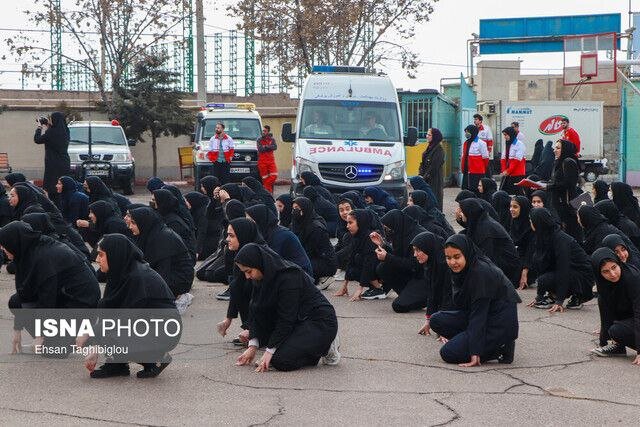
TEHRAN – The 27th National Earthquake and Safety Drill will be held in schools on Saturday to raise awareness among students, teachers and their families and strengthen safety behavior during and after earthquakes.
This training is held every year with the purpose of educating students about earthquakes, preparing them to respond correctly and quickly, and enabling them to face earthquakes.
The approach, known as “Safe Schools, Resilient Societies,” is being organized by the International Institute of Earthquake Engineering and Seismology in collaboration with the National Emergency Management Agency, student organizations, the Iranian Red Crescent Society (IRCS) and the Islamic Republic of Iran Broadcasting (IRIB), ISNA reported.
In addition to training students, this exercise aims to improve the preparedness of communities adjacent to safe schools and leverage the capacity of these schools as prevention and crisis management hubs.
It also focuses on safety and preparedness for students with disabilities and special needs, teaching them how to take appropriate actions in response to an earthquake.
The International Institute of Earthquake Engineering and Seismology began organizing nationwide training in nursery schools and elementary schools in Tehran in Iranian calendar year 1375 (1996). Two years later, it began to be implemented nationwide.
Since Iranian Calendar 1395 (2016-2017), the Ministry of Interior, Ministry of Education, Ministry of Science, Research and Technology, and IRCS have been working with the institute to conduct trainings across the country.
Iran is highly susceptible to earthquakes, with frequent earthquakes causing severe humanitarian crises.
The Iranian Plateau is located in a highly seismically active region of the world and is known not only for large and devastating earthquakes, but also for natural disasters, especially earthquake-related disasters.
Approximately 2 percent of the world’s earthquakes occur in Iran, but over 6 percent of the world’s earthquake casualties in the 20th century were reported to be due to Iranian earthquakes.
According to the Seismology Network of the Geophysical Institute of Tehran University, a total of 6,272 earthquakes were recorded across the country in the past calendar year (March 2024-March 2025).
Of the registered earthquakes, 150 were of Richter scale 4 or higher. The country experiences at least five earthquakes of magnitude 4.5 or higher each month.
Strengthening emergency preparedness for children with disabilities
Under a globally unique program called Earthquake Preparedness Education for Children with Disabilities, UNICEF and its partners have developed three books aimed at a variety of stakeholders, including parents/carers of children with disabilities, teachers, and policy makers.
Throughout this publication, UNICEF and UNESCO collaborate with IIEES to provide guidelines for disaster management, including mitigation, preparedness, response, and recovery, with a focus on children with hearing impairments, motor impairments, and autism spectrum disorders. So far, the UNICEF website announced in a press release on January 19th.
The development process for these books included consultations with children with disabilities and their families, organizations of persons with disabilities (OPD), teachers from special education institutions, social workers from national welfare agencies, and aid workers from the Iranian Red Crescent Society (IRCS).
In addition, four consultation training workshops were held where teachers, social workers, and aid workers learned about and provided feedback on strategies to support children with disabilities before, during, and after the earthquake.
Looking ahead, UNICEF Iran will work with partners to incorporate these resources into annual earthquake and safety drills in schools and develop comprehensive guidelines for the drills.
As a first step, and for the first time, an earthquake and safety drill was planned in a special school for children with motor disabilities. The aim was to advocate comprehensive training, strengthen children’s earthquake preparedness, and collect feedback on the guidelines developed.
The program’s journey doesn’t end here. Plans are already underway to update the guidebook to include guidelines for children with visual impairments and expand resources to accommodate all types of disabilities. This initiative represents a major step towards comprehensive earthquake preparedness that will ensure a safer and more resilient future for all children in Iran, regardless of their disability.
MT/MG