
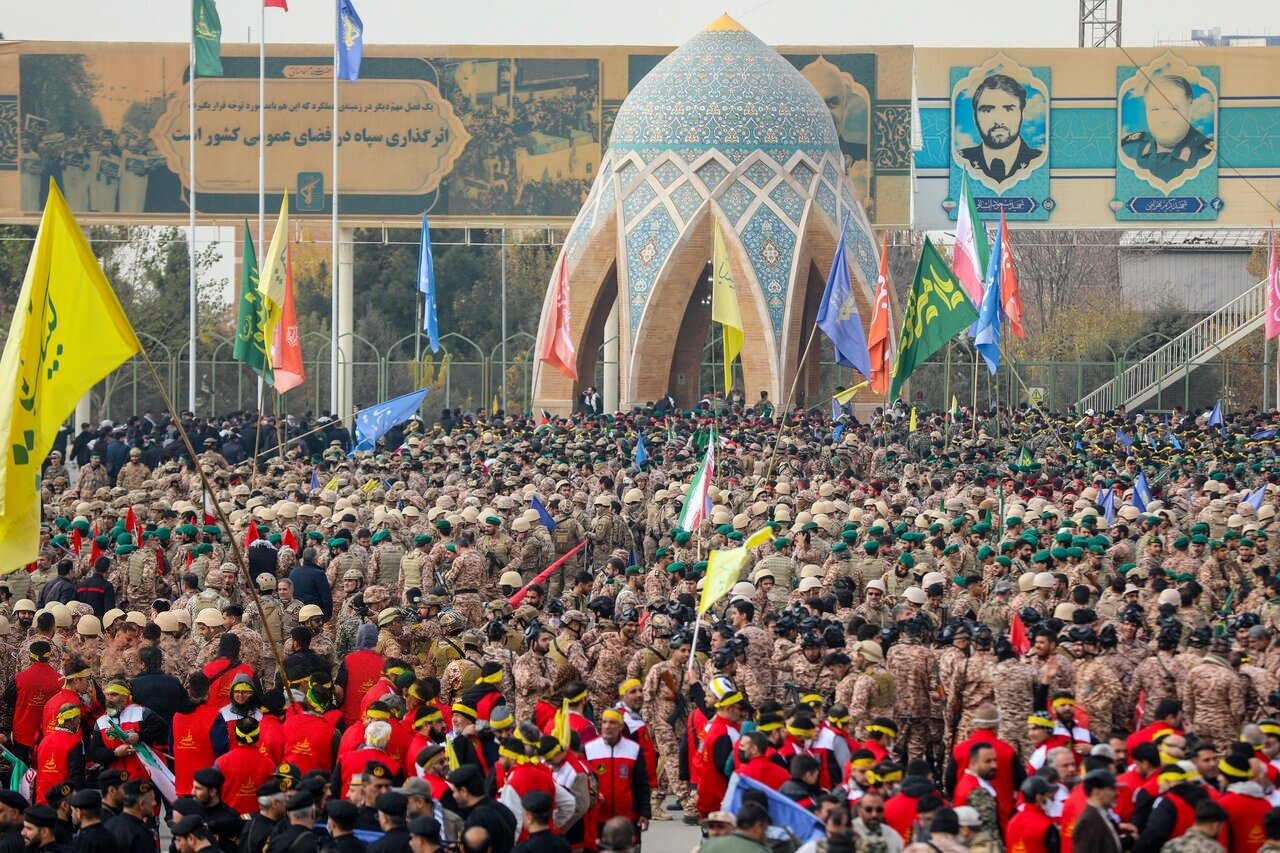
TEHRAN – A large-scale Basij readiness training was held on Thursday at Tehran’s Imam Hossein Officer and Basij Training College under the auspices of Greater Tehran Hazrat Mohammad Rasulullah Corps.
The event brought together senior military officials including Major General Mohammad Pakpour, Supreme Commander of the Revolutionary Guards, and Brigadier General Ahmad Vahidi, Deputy Chief of Army Staff.
Officials from the Armed Forces General Staff, the Tehran Revolutionary Guards Command, and the Basij organization also attended. Similar Basij drills were held in several other cities across the country as part of a nationwide show of force.
Basij presence ‘extremely important’ during 12-day war: head of the Revolutionary Guards
Speaking at the ceremony, Maj. Gen. Pakpour praised the performance of Basij forces during the recent 12-day conflict, saying their presence in security operations was “distinguished and well felt by the people.”
On June 13, 2025, the Israeli regime launched an unprovoked attack on Iranian territory, sparking a 12-day war that claimed well over 1,000 Iranian lives, including military commanders, nuclear scientists, and civilians. The United States also became involved in the war by bombing three Iranian nuclear facilities. The alleged justification for the invasion was to prevent Iran from acquiring nuclear weapons, but neither Israel nor the United States provided any evidence for that claim.
Maj. Gen. Pakpour opened his remarks by honoring the many senior Revolutionary Guards commanders and Basij figures killed in past operations, including the martyrs of Bagheri, Rashid, Hajizadeh, Shedemani, Mohaqqeq, Kazemi, Rabbani, and Merabi, as well as nuclear scientists and civilians killed in recent clashes. “We commemorate all those who, along with these great commanders, achieved the lofty status of martyrdom,” he said.
Pakpour went on to recount the historical circumstances that led to the creation of the Basij in 1979, noting that the country faced widespread separatist unrest in Kurdistan, West Azerbaijan, and the northern, southern, and southwestern regions. “The enemy did not know that Kurds, Baluchis, Turkmens and others had deep attachments to the Islamic Republic, and imagined that this could lead to the division of our peoples,” he said.
Pakpour emphasized the role of local Sunni Basij forces, which make up about 80% of Basij members in some border areas, in countering terrorist groups operating from outside Iran.
The head of the Revolutionary Guards acknowledged that public expectations for both the Revolutionary Guards and the Basij have increased significantly as the military expands its role beyond security, particularly in disaster relief.
“Today, whenever there is a flood, an earthquake or even shelling, it is the Revolutionary Guards that come to the rescue,” he said. “We will enter the field in our own ranks under the big banner of Basij.”
Pakpour stressed that this expanded role requires the Basij to strengthen its preparedness across all areas. He also noted the visible presence of Basij forces during the 12-day war, saying their presence at checkpoints and across major roads played an important role in maintaining security.
“The public welcomed them warmly and were fully aware that these troops were there for their safety,” he added.
In Zahedan, deputy commander of the Revolutionary Guards, Ali Fadavi, told a gathering of Basij members on Wednesday that the June clashes showed “the defeat of an arrogant front,” referring to the United States and Israel. Fadavi described the standoff as “the beginning of a new path” and claimed the US had moved to cease fighting after Iran attacked Qatar’s al-Udeid air base.
In Mashhad, Mohammad Reza Naghdi, a senior adviser to the Revolutionary Guards, issued a tough message at another rally on Thursday, saying Basij forces were opposed to ending any future conflict without “the complete destruction of Israel.”
“It is the Basij’s demand that even if a new battlefield begins, the war must not stop without completely eliminating the Zionist regime,” he said.
Mr Naghdi argued that Iran’s adversaries are currently at their “weakest state” and that the Basij are ready to “endure any hardship” in a broader conflict.