
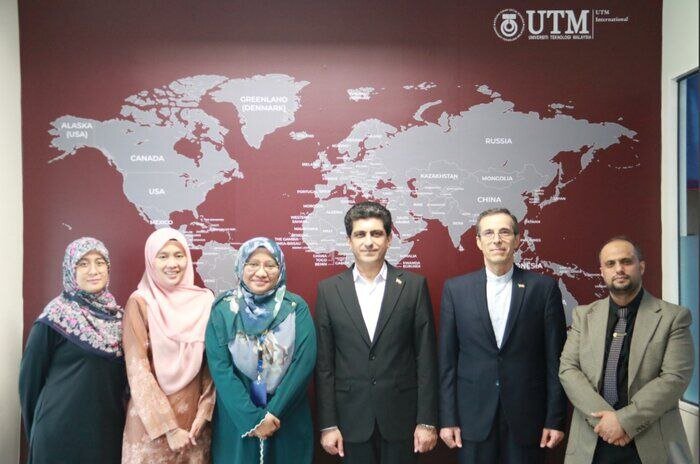
TEHRAN – Iran’s scientific advisor in East Asia, Australia and New Zealand Alireza Pertavakol met with the management of Universiti Teknologi Malaysia (UTM) to discuss ways to promote scientific and academic cooperation between the two countries.
On Saturday, Mr. Pertabakkor met with Noor Azaria Abu Bakar, head of UTM’s international department. Nor Ruwaida Jamian, President of the Malaysia-Japan International Institute of Technology. said Hafiza Binti Abbas, Head of Artificial Intelligence UTM Department, and Bashir Al-Haimi, Senior Lecturer at Azman Hashim International Business School (AHIBS), ISNA reported.
During the meeting, both sides explored the possibility of strengthening international cooperation and expanding exchanges between universities in the two countries.
Mr. Plutabagkor emphasized the importance of carrying out joint scientific research projects and proposed developing relations through the establishment of joint research centres, exchange of students and professors, awarding mutual scholarships, publication of joint scientific papers, holding short-term specialized scientific courses, industrialization of products of knowledge-based companies, cooperation with technology parks, provision of sabbatical leaves, etc.
AI, robotics, smart automation, renewable energy, and nanotechnology were among the issues discussed.
Iranian and Malaysian universities strengthen cooperatives
The 2024 Iran-Malaysia University Autumn Camp was held by the University of Malaya in Kuala Lumpur from November 3rd to 11th. A total of 50 Iranian students and professors participated in the third joint international school (autumn camp) run by Iranian and Malaysian universities.
Following the agreement signed between Isfahan University and UM University Malaysia on the occasion of the D-8 meeting in October 2023, the 3rd Iran-Malaysia Joint School was held with the theme “Developing young global scientists and leaders to address contemporary international challenges”.
According to a report by IRNA, the course included a comprehensive collaborative program in line with student and science diplomacy.
The course focused on six key topics, including the impact of artificial intelligence on security and privacy, integrated water resources management, artistic heritage and Islamic civilization, sustainable governance in climate change and crisis management, and balancing faith and reason in lifestyle.
In October 2024, in an effort to develop academic cooperation, the Sharif University branch of the Academic Center for Education, Culture and Research (ACECR) and Khajeh Nasir (KN) Toosi University of Technology signed a memorandum of understanding with the University of Malaysia and the Asia Pacific University of Technology and Innovation (APU), respectively.
According to a report by IRNA, Mohsen Mardani of ACECR Sharif University Branch and Mohammad Yusuf of Universiti Malaysia held an online meeting and signed a memorandum of understanding highlighting expanded cooperation in carrying out international joint research activities as well as technology sharing.
Officials also emphasized the need to create an appropriate platform for planning and developing joint ventures in technology, agriculture and health sectors.
Furthermore, it was decided to establish specialized working groups in the above areas to formulate short-, medium- and long-term plans.
Mr. Youssef announced that Malaysia is ready to lay the foundations for expanding knowledge-based activities and expressed optimism that the ongoing cooperation will serve as a precursor to implementing future joint activities based on innovation and creativity.
Mehul News Agency reported that the second MOU was signed at a meeting held on October 3 between KN Tussi University of Technology President Amir Reza Shahani and APU University Malaysia Vice President Ho Chin Kuan.
Officials emphasized expanding cooperation between the two universities and launching joint master’s programs in artificial intelligence (AI) and cybersecurity.
MT/MG