
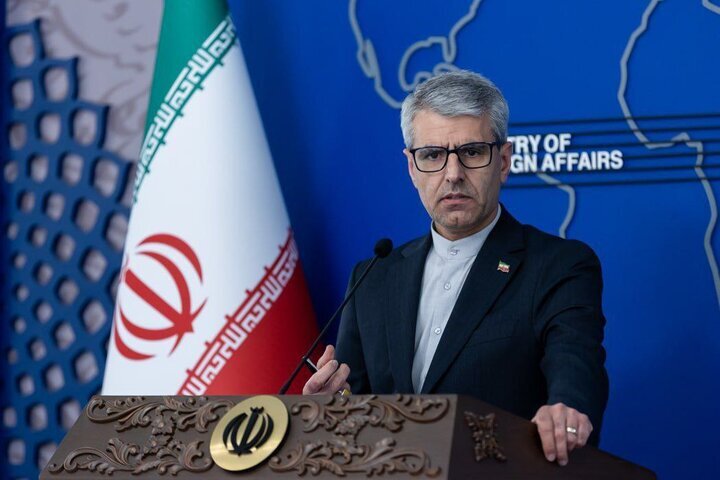
TEHRAN – Iranian Foreign Ministry Spokesman Esmail Bakaei addressed a wide range of regional and international issues at his weekly press conference, from rising tensions in Lebanon and Gaza to relations with Saudi Arabia and Turkey and the status of nuclear negotiations with Europe.
“The United States poses the greatest threat to national security.”
Bakuayi accused the United States of adopting a policy rooted in “naked force” and argued that its actions around the world, from the Western Hemisphere to Africa, amount to a grave threat to global and regional stability.
Citing threats against Venezuela, Cuba, Nicaragua, Brazil and Mexico, he said the US decision to close the airspace of other countries is “unprecedented and contrary to all international aviation norms.”
Since late August, Washington has sent warships, reconnaissance planes and special operations forces to the Southern Caribbean, culminating this month with the deployment of the USS Gerald R. Ford Carrier Strike Group.
The US has since launched dozens of attacks on ships claiming to be drug traffickers, killing more than 80 people, but has provided no evidence to support the claims. Legal experts have condemned the extrajudicial killings of victims by US forces as illegal.
US President Donald Trump on Saturday declared a “total closure” of the airspace over and around Venezuela.
Bakuayi also criticized US efforts to block South Africa’s participation in the G20 summit, saying the US’s “unconditional support” for Israel made Israel “complicit” in the regime’s actions. Under normal circumstances, he argued, the U.N. Security Council should treat U.S. actions as “grave violations” of international peace and security.
“Australia’s move is a form of blackmail on behalf of Israel.”
Reacting to Australia’s designation of the Revolutionary Guards, Mr Baquai said Iran had already communicated its position through public statements. He denied there was any legal or factual basis for Canberra’s decision, linking it to previous claims he said were driven by “false information”.
He added that Australian government officials themselves have confirmed that Iran is not involved in anti-Semitic incidents in the country. He said: “This move by Australia is simply a form of blackmail in the interests of the Zionist regime.”
The Australian government this week designated the Revolutionary Guards as a “state sponsor of terrorism.” Canberra has accused the Revolutionary Guards of carrying out two attacks on Jewish centers in Sydney and Melbourne in 2024, a claim Australian police found to be false after it was first raised in August.
“Saudi officials’ visit to Tehran is part of efforts to improve bilateral relations”
Baquai said the Saudi deputy foreign minister’s visit to Tehran was part of a two-year process to improve bilateral relations.
In addition to Iran-Saudi relations, the discussion also addressed issues related to Palestine, Lebanon, and Syria. He said both countries are committed to maintaining this trajectory to strengthen stability in West Asia.
Bakqai said the Saudi officials’ visit to Tehran was part of normal diplomatic exchanges and said Iran regularly held talks with Saudi Arabia as well as other regional countries. He denied claims that Saudi Arabia was mediating between Iran and the Syrian authorities, saying the talks were aimed at sharing perspectives and not creating a negotiating channel.
“Israel will only violate the ceasefire agreement.”
Commenting on Lebanon, Baquay said Israel routinely violates the ceasefire agreement, citing figures from a UNIFIL spokesperson that put the number of violations at 10,000. He argued that Israel not only undermines regional stability but also targets the development of neighboring countries. This increases the responsibility of those claiming to guarantee a ceasefire, he said.
He said that despite the declared ceasefire, violations were “growing rapidly”, noting that in Lebanon alone there had been “hundreds of thousands” of ceasefire violations, while in Gaza the number had reached 600.
“Iran FM’s visit to France focused on bilateral issues”
Baquai noted that the foreign minister’s recent visit to France, at the invitation of the French foreign minister, focused on bilateral issues and global developments, including the nuclear file.
He said his telephone conversation with EU foreign policy chief Kaja Callas had been arranged in advance and was not directly related to the Paris meeting, but that issues raised in France were also discussed with her.
“CIA revelations about US role in ISIS are not new”
Referring to comments by the former CIA director in Tel Aviv about US cooperation with al-Qaeda and ISIS during the Syrian conflict, Bakuayi said such revelations are not new.
He referred to previous statements by former US officials alleging that Washington played a key role in the emergence of ISIS and “Takfir terrorism” in the region.
“Arrangements continue for a possible visit by the Turkish president.”
Regarding the visit of Turkish Foreign Minister Hakan Fidan, Bakkai said that arrangements were continuing for a possible visit by President Erdoğan.
He reiterated Iran’s position that terrorism must be condemned everywhere, and said the two countries agreed to strengthen regional cooperation to combat and eliminate terrorist groups.
As part of his visit to Iran, the Turkish Foreign Minister met on Sunday night with Iranian President Masoud Pezeshkain, Foreign Minister Abbas Aragushi, and Speaker of Parliament Mohammad Baker Qalibaf.
“There is no deadlock on the nuclear issue.”
Regarding claims that Iran’s nuclear program is stalled, Bakuayi said Iran is simply exercising its rights guaranteed by international law and the NPT. He said the nuclear issue was imposed on Iran and the region by others and there was no basis for describing the current situation as an impasse. He argued that the real solution is for other countries to stop making demands that violate international law and stop interfering with Iran’s legal nuclear rights.
Regarding the renewed interest in European Troika negotiations, Bakkai said Iran has always maintained that meaningful negotiations require all parties to be aware of each other’s rights and legitimate concerns. He blamed previous setbacks on European resolutions influenced by US pressure, but said diplomatic engagement with Europe continues.
Baquay stressed that all Iranian nuclear activities are under the supervision of the IAEA, and said the United States and Israel should be held responsible for creating the current situation. He added that the leak of radioactive material would make inspection impossible, noting that there is no precedent or procedure for inspecting facilities that have been attacked.
Bakkai referred to US President Donald Trump’s contradictory statements, saying such contradictions were “logically indefensible” and that the nuclear issue has always been a pretext for the US to put pressure on the Iranian people.
Efforts were underway earlier this year to develop a new nuclear deal to replace the 2015 Iran deal that President Trump abandoned during his first term. Iranian officials have indicated they are prepared to reassure Americans that they are not pursuing nuclear weapons once sanctions reimposed after the U.S. withdrew from the JCPOA are lifted. They also insisted that Iran would not stop enriching uranium. However, reports suggest that the Iranian government is willing to offer greater concessions than it made under the JCPOA, which would result in President Trump striking a better deal than the one he abandoned.
These negotiations were abruptly halted and mooted on June 13, when the United States helped Israel launch a 12-day bombing campaign against Iran’s nuclear, civilian, and military infrastructure. The sixth round of nuclear negotiations was scheduled to be held in Oman just a few days later, on June 15th. President Trump later admitted he was “in charge” of the war and said he had done the “right thing” in meeting bin Salman.
“Iran will not interfere in Lebanon’s internal affairs”
In response to criticism from Lebanese groups, Bakkai denied accusations of Iranian intervention as baseless.
He said that while Lebanon’s problems were for the Lebanese to solve, Iran supported Lebanon’s inherent right to defend itself from Israeli attacks. He claimed that interference comes from those who “set deadlines” for Lebanon’s political process.
“We will not allow Israel’s dream of destabilizing Iran to come true.”
Asked whether Turkey or Saudi Arabia had sent threatening messages to Tehran, Bakuayi said no such messages had been received.
He said regional talks would naturally include concerns about Israeli “warmongering,” adding that Iran remains well prepared and “will not allow the regime’s evil dreams of destabilizing Iran to come true.”
“Implementation of the Iran-China Cooperation Agreement is progressing positively.”
Baqai said the implementation of the Iran-China long-term cooperation agreement is progressing positively and both sides remain committed to promoting the agreement as a strategic roadmap.
The Iran-China 25-Year Cooperation Plan or Iran-China Comprehensive Strategic Partnership is a 25-year cooperation agreement for the further development of Iran-China relations signed by the foreign ministers of China and Iran in Tehran on March 27, 2021. Under the 25-year draft agreement signed in Beijing on June 24, 2020, China is to invest $400 billion in Iran’s economy over that period. In exchange for a steady and large supply of oil from Iran.
Regarding the freight rail corridor with China, Bakkai said the line is of strategic importance and all parties agree that efforts towards full operation of this line must be expedited. He said recent discussions with the Chinese side had been constructive.