
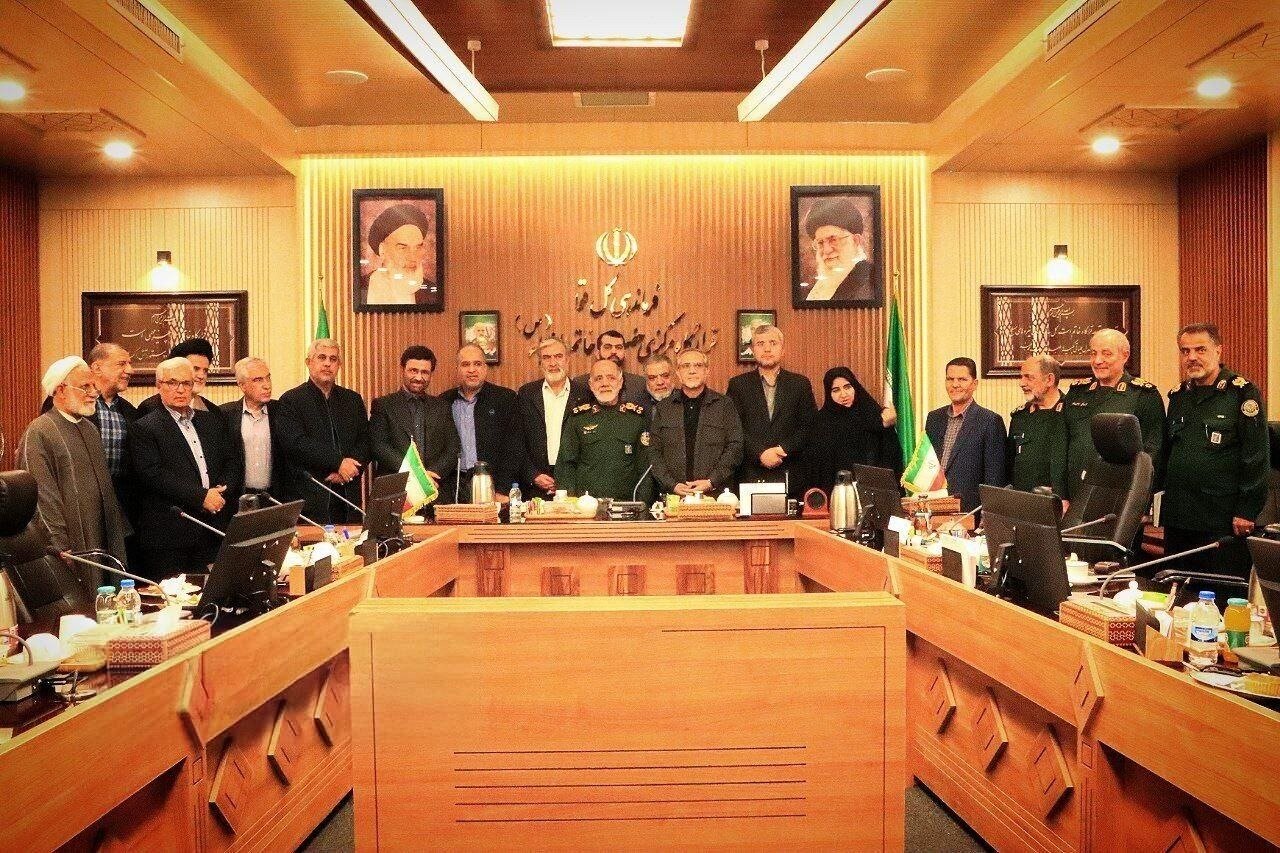
TEHRAN – In a meeting with members of the National Security and Foreign Policy Committee of Parliament, Central Command Commander Khatam al-Anbiya outlined Iran’s strategic preparedness and highlighted the military’s continued efforts to strengthen both its defensive and offensive capabilities as regional threats evolve.
Committee members took the opportunity to meet with Major General Ali Abdullahi, Commander of the Central Headquarters of Khatam Al Anbiya (PBUH), to praise the sacrifices of the armed forces and share their views.
At the beginning of the meeting, National Security and Foreign Policy Committee Chairman Ebrahim Azizi said that the purpose of the visit was to commemorate Iran’s martyrs, especially the fallen commanders, reaffirm the parliament’s full support for the military and follow up on strengthening the country’s defense capabilities.
Maj. Gen. Abdullahi outlined the mission of the Central Command. He said its core responsibility is to focus on wartime planning and conduct strategic and operational assessments in times of crisis.
He noted that continuously assessing military readiness is one of the command’s key missions. He said that given the evolving nature of threats and the characteristics of future wars, the Islamic Republic’s armed forces are prioritizing strengthening defense and offensive preparedness.
“The enemy should know that we are constantly monitoring him and be well prepared,” Abdullahi warned. “If they miscalculate and act against the Islamic Republic, we will impose a far greater price than they can hope to gain.”
Referring to recent conflicts, he said the imposition of the 12-day war against Iran was due to misjudgment by the enemy. “The Iranian military’s response was strong and made them regret their actions. The United States and the Zionist regime were defeated by the strength of our faith and national spirit.”
On June 13, 2025, the Israeli regime launched an unprovoked attack on Iranian territory, sparking a 12-day war that claimed well over 1,000 Iranian lives, including military commanders, nuclear scientists, and civilians. The United States also became involved in the war by bombing three Iranian nuclear facilities. The alleged justification for the invasion was to prevent Iran from acquiring nuclear weapons, but neither Israel nor the United States provided any evidence for that claim.
Foreign Minister Abdullahi stressed that Iran’s current security and stability are due to the leadership of the Supreme Commander and the unity, dedication and unity of the people, officials and military.