
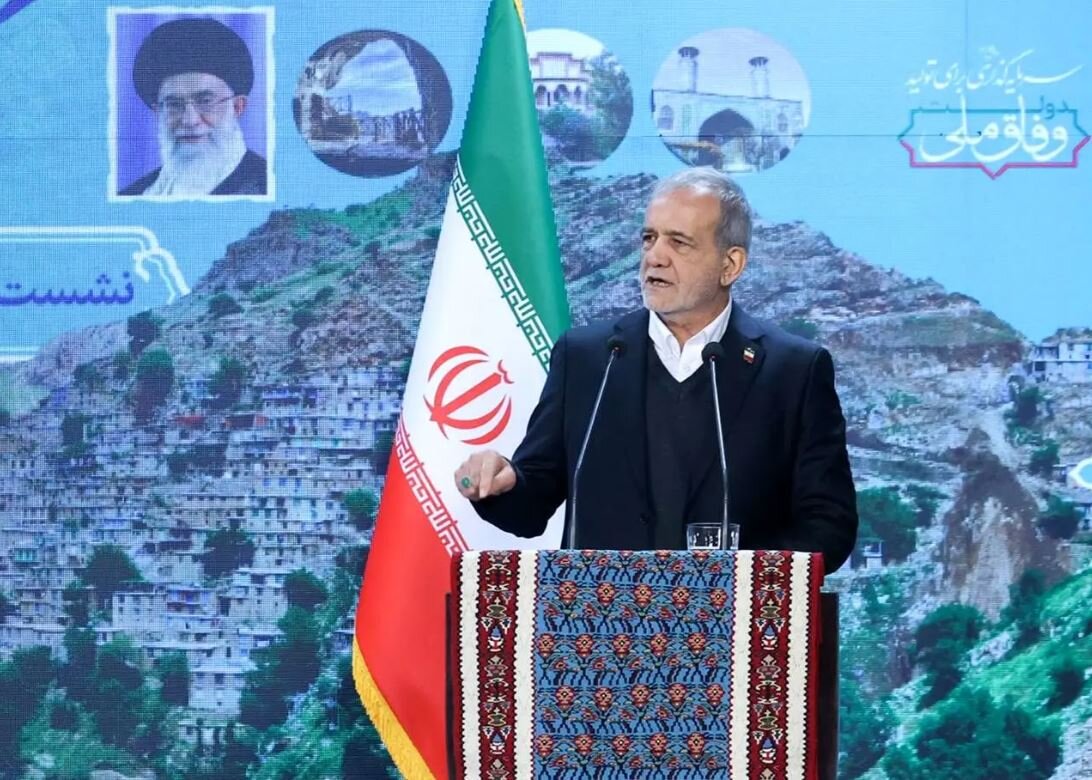
TEHRAN – Iranian President Masoud Pezeshkian said Tuesday that no pressure can bring a determined and resilient country to its knees, declaring that Iran’s enemies “will not be able to impose their demands with equipment or aircraft.”
Speaking at a ceremony commemorating the International Day of Persons with Disabilities, Mr. Pezeshkian praised the creativity and abilities of people with disabilities, explaining that they are a living example of the message contained in the book entitled “Bad Events are a Treasure Trove”, which was presented during the event.
Reflecting on the challenges his 14th administration faced from its first day in office, the President said early difficulties ultimately revealed overlooked opportunities and capabilities. “There is now a shared recognition across government that solving national problems requires leveraging all available resources, especially public participation. We are trying to see problems as treasure troves,” he said.
Emphasizing the government’s neighborhood-based mobilization initiatives, Mr. Pezeshkian drew historical parallels to the Iran-Iraq war, recalling how widespread international support for Saddam Hussein failed because “the people supported the revolution.” He added that Israel and the United States made similar miscalculations earlier this year, thinking that “a few days of bombing” could cause unrest within Iran. “Once again, the people supported the state and thwarted a conspiracy,” he said.
His remarks came on the heels of the June 13, 2025 conflict in which Israel launched an unprovoked attack on Iranian territory, sparking a 12-day war that killed well over 1,000 Iranians, including military commanders, nuclear scientists, and civilians. The United States escalated the conflict by bombing three Iranian nuclear facilities, justifying the attack with baseless claims that Iran sought nuclear weapons.
Iran retaliated with more than 22 waves of missile and drone attacks targeting Israeli military sites and infrastructure under Operation True Promise III. A cessation of fighting was announced on July 3 at the request of Israel and the United States. Iran declared the result a strategic victory, claiming it had succeeded in preventing its enemies from achieving their objectives.
The conflict has also derailed diplomatic efforts to forge a new nuclear deal to replace the 2015 JCPOA, which US President Donald Trump abandoned during his first term. In the months leading up to the war, Iranian officials had insisted that uranium enrichment would continue, but had reassured Washington that Iran would not pursue nuclear weapons once U.S. sanctions were lifted. Reports suggest that Iran may have been prepared to offer greater concessions than those included in the original JCPOA, allowing President Trump to insist on a “better deal.”
Despite these challenges, Mr. Pezeshkian emphasized that the government remains committed to working closely with the public. “Those who think that problems can be solved without the support and presence of the people are mistaken,” he said. “No problem can be solved by relying on people, regardless of gender, language or ethnicity. Society should not be divided into insiders and outsiders.”
He added that the administration, with the support of the people, is working to address long-standing structural imbalances, particularly those resulting from decades of uneven development. Improving conditions for people with disabilities remains a priority, he said, recognizing that “governments alone cannot solve everything, but with public participation any obstacle can be overcome.”